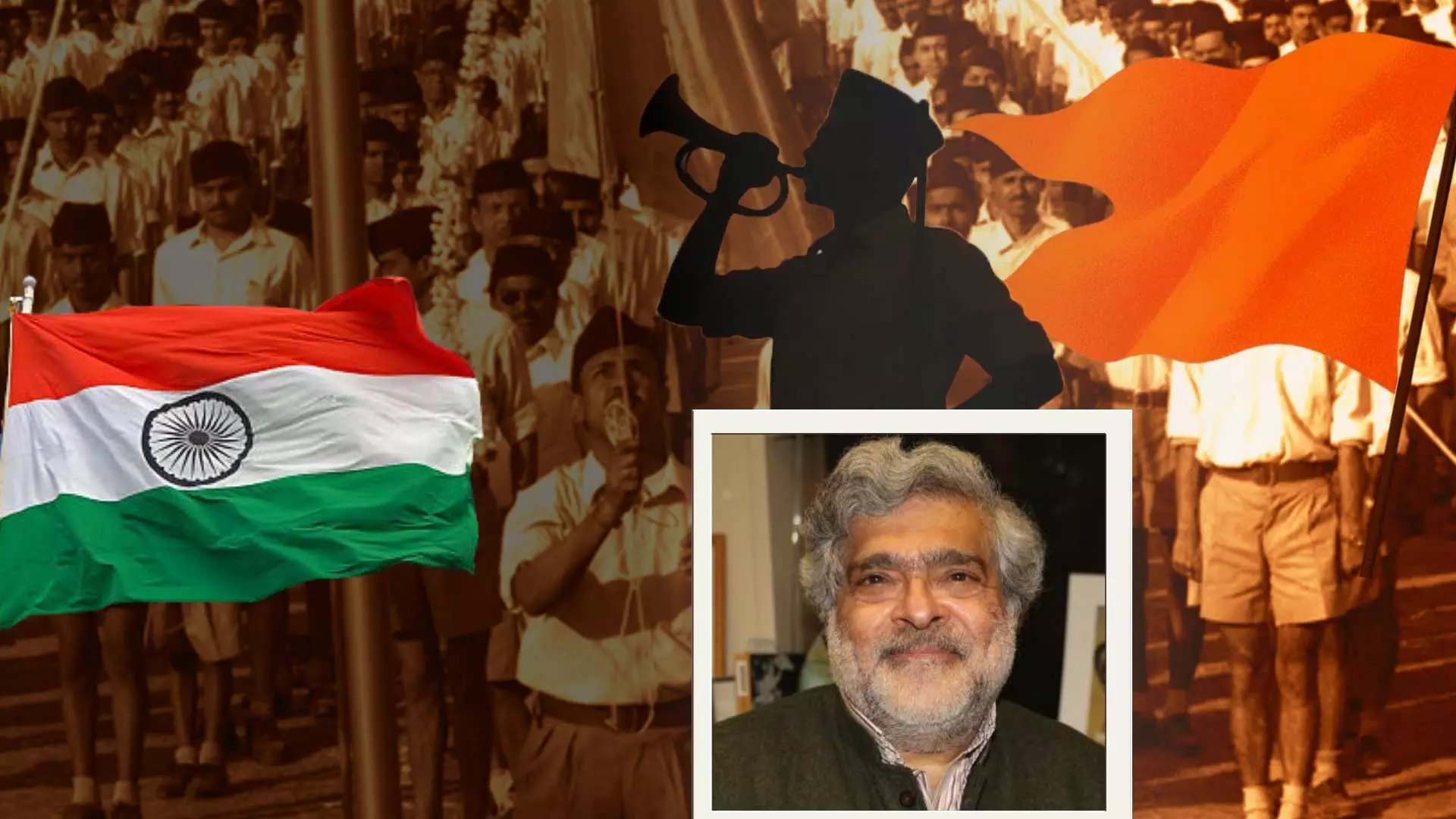
Why historian Vinay Lal finds RSS's idea of nationalism 'problematic'
In this episode of RS @100, Lal unpacks the contradiction between the RSS’s absence from anti-colonial struggle and its current monopoly on nationalist discourse

“The RSS never participated in the anti-colonial struggle. If nationalism before 1947 was synonymous with anti-colonialism, then by that measure, it becomes one of the most profoundly anti-national organisations in Indian history," said historian Vinay Lal in an interview.
As debates over the Rashtriya Swayamsevak Sangh’s ideological foundations sharpen during its centenary year, questions around its definition of nationalism, secularism, and constitutional values remain central to India’s political discourse.
The Federal spoke to Professor Vinay Lal, historian and professor of History and Asian American Studies at the University of California, to unpack the RSS’s conception of nationalism, its historical roots, and its implications for India as both a civilisation and a nation-state.
When the RSS uses the term ‘Rashtriya’ or nationalism, what exactly does it mean? How should we understand its idea of nationalism?
We can spend an enormous amount of time discussing this, but let’s begin with some basic distinctions. We are living in a nation-state system that emerged in 17th-century Europe after the Treaty of Westphalia. We must distinguish between nation-state, nation, and civilisation.
India is both a nation-state and a civilisation. It has been a civilisation for far longer than it has been a modern nation-state since 1947.
A nation-state may contain multiple nations, and some nations may not even have a state of their own, such as Palestinians or Kurds. Once we understand these distinctions, it becomes easier to understand what is at stake when the RSS uses the term ‘Rashtriya’. The RSS is often associated with cultural nationalism, but today it clearly extends beyond that. Since the Sangh Parivar effectively shapes state power, its nationalism now has a deeply political dimension.
Also read: India already a Hindu Rashtra, no need to declare it: RSS chief Mohan Bhagwat
The term ‘anti-national’ has been used repeatedly by the RSS and its ideological affiliates as a weapon against dissenters. But one of the RSS’s fundamental ideological goals is the creation of a Hindu Rashtra — a Hindu nation-state.
Savarkar’s definition of Hindu identity rested on the idea that Hindustan must be one’s fatherland, motherland, and holy land. This creates an exclusionary framework because Muslims and Christians may accept India as fatherland and motherland, but their holy lands lie elsewhere. This means non-Hindus can live in a Hindu Rashtra only at the pleasure of the Hindu majority. This is fundamentally different from the constitutional framework of modern India.
The RSS has repeatedly challenged core elements of the Indian republic — the Constitution, secularism, and even national symbols. Historically, it rejected the Constitution, often suggesting Manusmriti as a preferable governing framework.
The Indian Constitution may contain colonial inheritances, but to dismiss it as entirely derivative is historically false. It emerged from extensive Constituent Assembly debates and contains unique principles such as Directive Principles. If we examine the historical record, the RSS also questioned the national flag and other symbols at critical moments, including on the eve of independence.
So when we ask what kind of nationalism the RSS represents, we must ask whether it is nationalism rooted in constitutional democracy or in majoritarian civilisational identity.
You have argued that the RSS may itself be among the most anti-national forces in Indian history. Why?
If nationalism during the freedom struggle was synonymous with anti-colonial resistance, then participation in that struggle becomes central to nationalist legitimacy. The RSS simply did not participate in India’s anti-colonial movement. That is a historical fact.
Also read: RSS at 100 stands tall but is shadowed by a fraught past and fractious present
It did not join the national struggle against British colonialism. Therefore, by the standards of pre-independence nationalism, its claim to nationalism becomes deeply problematic. I generally avoid using terms like ‘anti-national’ because they are often abusive and politically weaponised. But given that the RSS itself uses this term against critics, it is historically valid to point out this contradiction.
An organisation that stayed away from the anti-colonial struggle while later claiming a monopoly over nationalism presents one of the deepest paradoxes in Indian political life.
How does the RSS’s idea of Hindu Rashtra conflict with India’s constitutional and secular framework?
The Constitution of India rests on pluralism and equal citizenship. The RSS’s ideological roots, especially through Savarkar and Golwalkar, move toward a Hindu nation-state framework.
This framework may tolerate minorities, but it does so conditionally, not as equal participants. That distinction is critical. The constitutional republic is based on universal citizenship. Hindu Rashtra is based on cultural hierarchy. This is why secularism becomes central.
Without secularism, the republic’s promise of equal belonging weakens substantially.
What is the politics behind the continued push around Vande Mataram versus Jana Gana Mana?
India’s strength lies in the fact that it is not merely a nation-state but a civilisation. When we obsess excessively over singular national symbols, we are often reducing India’s complexity into homogenised nation-state thinking.
Also read: RSS at 100: Hindutva is an ideological camouflage for its Brahminical core
India is unusual because it has accommodated multiple symbolic expressions of nationhood — Jana Gana Mana, Vande Mataram, and even Sare Jahan Se Achha. This ambiguity reflects civilisational richness. However, the RSS’s ideological project tends toward homogenisation. Nation-states generally seek one anthem, one language, one homogenised historical narrative. India historically resisted this singularity.
Vande Mataram itself has a complex history. While it inspired anti-colonial mobilisation, parts of it were also viewed as exclusionary by many Muslims. This was recognised by leaders like Jawaharlal Nehru and Rabindranath Tagore. The compromise eventually adopted was that Jana Gana Mana would serve as the national anthem, while Vande Mataram would hold equal respect as the national song.
That unresolved ambiguity was not necessarily a weakness — it was reflective of India’s plural civilisational ethos. Attempts to impose one over the other are often political projects aimed at homogenisation rather than accommodation.
Why do history and textbook battles become so central to nationalism?
Because the nation-state fundamentally depends on historical narrative. Textbooks become tools for homogenising a society’s understanding of itself.
History wars are not unique to India — at least 35 countries have fought intense ideological battles over textbook narratives. Control over history shapes future citizenship. This is why debates over history are never merely academic. They are struggles over national identity itself.
The content above has been transcribed from video using a fine-tuned AI model. To ensure accuracy, quality, and editorial integrity, we employ a Human-In-The-Loop (HITL) process. While AI assists in creating the initial draft, our experienced editorial team carefully reviews, edits, and refines the content before publication. At The Federal, we combine the efficiency of AI with the expertise of human editors to deliver reliable and insightful journalism.