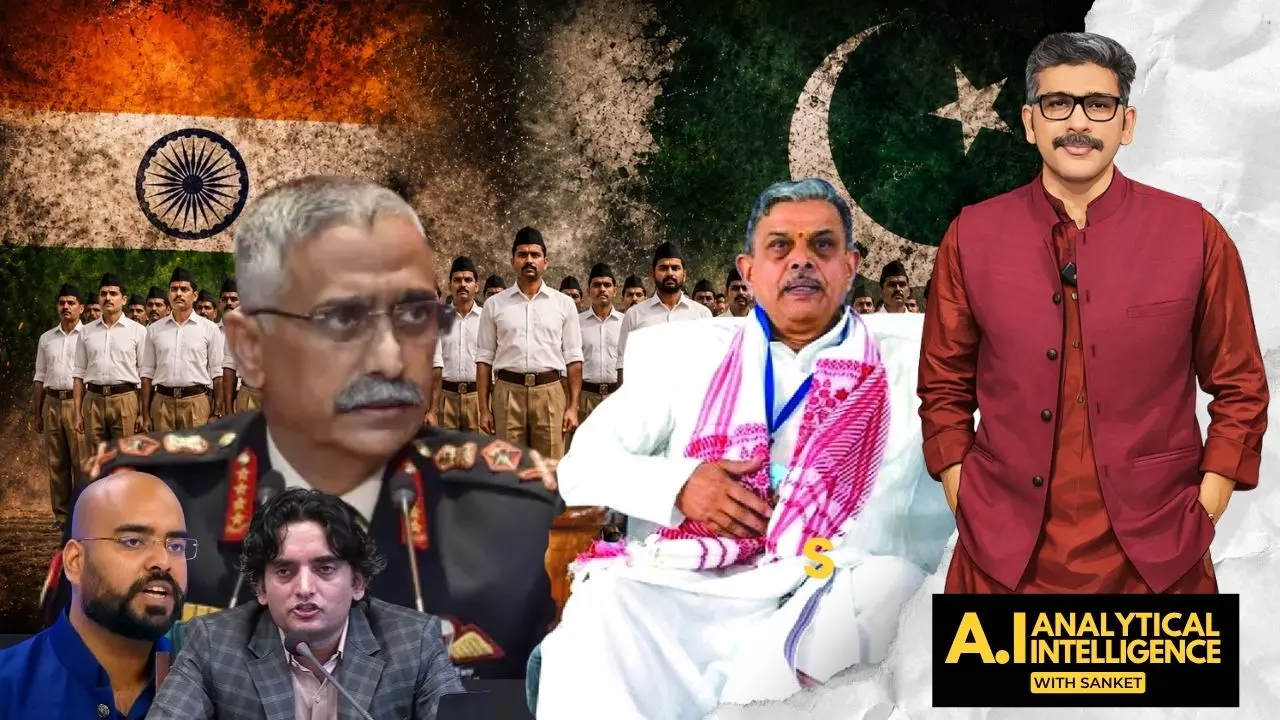
Is RSS turning soft on Pakistan or just being consistently inconsistent? | AI With Sanket
Dattatreya Hosabale’s call for dialogue with Islamabad triggered questions on whether the RSS is signalling a shift in New Delhi's policy or merely testing public sentiment

“RSS and consistency are poles apart,” political analyst Sajjan Kumar said while reacting to Rashtriya Swayamsevak Sangh (RSS) general secretary Dattatreya Hosabale’s remarks advocating dialogue and people-to-people contact with Pakistan. The comments, made on the first anniversary of Operation Sindoor, which was carried out in May 2025, have triggered a debate on whether the RSS is softening its stance on the neighbouring country.
Also read: RSS at 100: Hindutva is an ideological camouflage for its Brahminical core
Hosabale's remarks have gained significance because they appear to diverge from the Narendra Modi government’s long-held line that “terror and talks cannot go together”. His statement has also raised questions over whether the RSS is preparing the ground for a broader policy shift.
In this episode of AI with Sanket, The Federal spoke with Kumar and political consultant and advocate Nikhil Jain on whether the RSS official's remarks indicate a strategic recalibration or are part of the organisation's long-standing method of maintaining ambiguity.
Strategy shift
Kumar argued that Hosabale’s remarks cannot be dismissed casually because of his position within the RSS. “He is the Sarkaryavah (general secretary) of the RSS, the most powerful executive head of the organisation. Therefore, any statement coming from such a senior functionary amounts to what we call a speech act,” Kumar said.
At the same time, Kumar cautioned against reading the statement as a definitive ideological shift. According to him, the RSS has historically avoided taking rigidly defined positions on contentious issues.
“We have seen among top RSS functionaries a trait wherein they are consistently inconsistent. That is part of a long-term strategy,” he said.
Also read: How RSS emerged as a response to decline of Brahminical dominance 100 years ago
Kumar cited examples from the RSS’s changing stance on reservations. He referred to RSS chief Mohan Bhagwat’s remarks during the 2015 Bihar elections, suggesting a review of reservation policy, and contrasted them with later statements acknowledging the historical oppression of marginalised communities.
“The RSS has methodologically refused to define what Hindutva exactly is, unlike Savarkar,” Kumar said. “Whether it is the Muslim question, Pakistan, Indian traditions, conservatism or orthodoxy, you will find different speech acts at different junctures,” he said.
Dialogue debate
Jain said the RSS and the Bharatiya Janata Party (BJP) ecosystem have often altered their positions based on political convenience. He described the RSS's approach as “deception and opportunism”.
He also argued that the call for dialogue with Pakistan is not inherently wrong. “Pakistan is a nuclear-armed state. You cannot solve problems with Pakistan and China through war alone. Eventually, dialogue becomes necessary,” he said.
However, Jain questioned why similar suggestions from diplomats and opposition voices had previously attracted accusations of being “anti-national”. He referred to former foreign secretary Nirupama Rao’s advocacy for dialogue with Pakistan and said that those supporting engagement were often criticised by pro-government voices.
“The problem becomes when the RSS ecosystem and the government ecosystem present this bravado and machismo that everything can be solved militarily,” Jain said.
He also questioned whether military actions such as the Balakot air strikes and the abrogation of Article 370 (both in 2019) had fundamentally altered the terror situation.
“Did Balakot change the terror situation? Did Article 370 abrogation end terrorism? I would argue no,” Jain said.
Hosabale's recent visit to US
The discussion also turned to the timing of Hosabale’s remarks and his recent visit to the United States.
When asked whether the RSS leader’s statement could be linked to changing geopolitical realities, including Pakistan’s growing diplomatic relevance and reported international pressure for regional stability, Kumar said the timing naturally creates room for speculation.
“This statement is not in sync with the current establishment line and also not in sync with the popular sentiment among BJP supporters,” he said.
Also read: Why historian Vinay Lal finds RSS's idea of nationalism 'problematic'
He added that most RSS functionaries are personally “hawkish” on Pakistan and do not usually support the idea that civil society engagement can improve bilateral ties.
“That is why this statement is surprising. Maybe something happened during the US visit. One cannot avoid linking the two,” Kumar said.
He also maintained that there are different schools of thought within the establishment regarding Pakistan policy.
“We may have dovish and hawkish approaches within the government and the BJP. That is natural. But within the RSS, there is generally much less faith in dialogue as a solution,” he said.
Foreign policy role
The debate also examined the RSS’s historical engagement with foreign policy issues.
When this writer pointed out that the RSS has consistently expressed views on international affairs dating back to the eras of K B Hedgewar and M S Golwalkar and that the Modi era has largely seen alignment between the BJP government and the RSS on issues such as Israel, Pakistan, China and diaspora diplomacy, Jain opined that the RSS’s orientation is driven less by strategic coherence and more by ideological positioning.
“I would argue that the RSS position is not necessarily anti-China or anti-Pakistan but perhaps anti-Muslim and pro-US-Israel,” he said.
Jain pointed to India’s expanding defence and strategic relationship with the US and referred to recent remarks made by senior RSS leader Ram Madhav in the US.
He claimed that the Modi government and the RSS have increasingly aligned themselves with American geopolitical priorities.
“The US has a certain plan for South Asia and the RSS appears comfortable aligning with it,” Jain alleged.
Narrative cracks
The conversation later shifted to whether Hosabale’s remarks reveal fractures within the larger BJP-RSS ecosystem.
Kumar said there are visible “cracks” emerging within the broader right-wing discourse.
“You find more fractures now beyond electoral unity. The domain where alternative viewpoints were instantly labelled anti-national is weakening,” he said.
According to Kumar, Hosabale’s statement itself reflects these tensions.
“This is one symptom of that crack,” he said.
He also predicted that criticism against Hosabale may come not only from opposition circles but also from sections of the ideological right.
Also read: How RSS has reshaped India’s history, politics: Historian Tanika Sarkar explains
“The most acidic attacks may come from the vitriolic spaces within the right-wing ecosystem itself,” Kumar said.
Jain agreed that sections of the BJP’s support base would struggle to reconcile Hosabale’s remarks with years of anti-dialogue rhetoric.
At the same time, he argued that the BJP leadership has become adept at politically navigating contradictions.
“They have mastered the art of hypocrisy and contradictory messaging,” Jain said.
He argued that while opposition voices may continue to be labelled anti-national for advocating talks with Pakistan, similar remarks from senior RSS leaders would likely be defended as strategic positioning.
Unanswered questions
The discussion concluded without a clear consensus on whether Hosabale’s remarks represent a genuine policy shift.
Kumar maintained that the RSS has historically avoided doctrinal clarity and often left room for multiple interpretations.
Jain, meanwhile, argued that the statement reflects an attempt to soften the organisation’s image while adapting to geopolitical realities.
What remains uncertain is whether the comments will eventually influence government policy or fade away as a temporary headline.
The content above has been transcribed from video using a fine-tuned AI model. To ensure accuracy, quality, and editorial integrity, we employ a Human-In-The-Loop (HITL) process. While AI assists in creating the initial draft, our experienced editorial team carefully reviews, edits, and refines the content before publication. At The Federal, we combine the efficiency of AI with the expertise of human editors to deliver reliable and insightful journalism.