








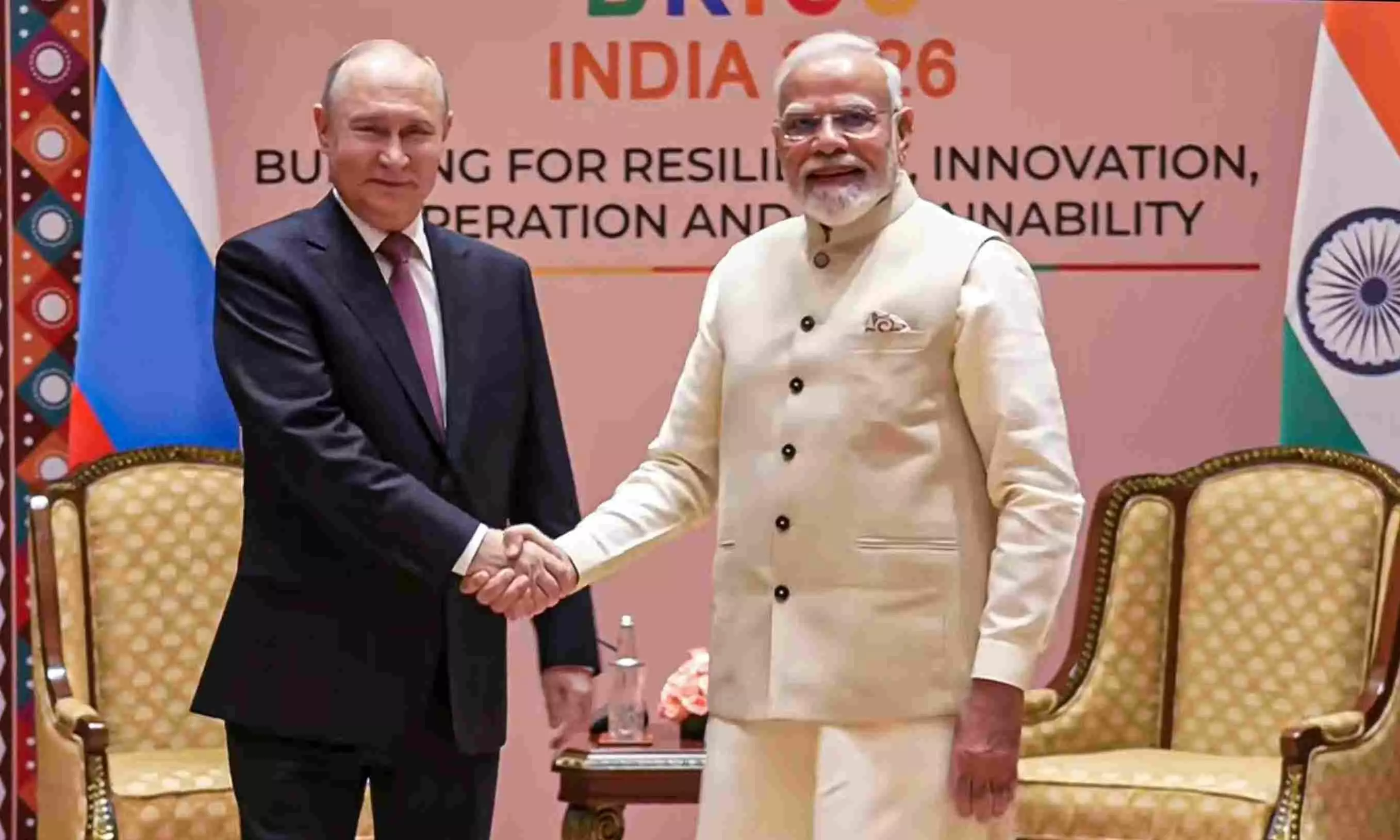
Prime Minister Narendra Modi meets Russian President Vladimir Putin ahead of the BRICS Summit 2026 in New Delhi. | PTI
BRICS LIVE: Modi, Putin hold extensive talks on trade and defence
Two-day summit starting Saturday is expected to focus on boosting collective resilience in food, energy, health, disaster reduction and critical supply chains

Prime Minister Narendra Modi on Friday (September 11) exuded confidence that there will be positive and meaningful discussions at the BRICS Summit on various issues with a shared wish for global welfare.
"Over the next few days, leaders from around the world will gather for the BRICS Summit. I am fully confident that there will be positive and meaningful discussions on various issues with a shared wish for global welfare," Modi said in a post on X.
Also read: SCO and BRICS, yes, but is it time for India to revive SAARC?
India is leveraging the two-day BRICS summit starting Saturday (September 12) to position the grouping as a complementary engine for economic growth while championing the Global South's core developmental priorities – most notably safeguarding food, energy, and supply chain security.
The summit is taking place against the backdrop of a global economy facing the adverse impacts of the Russia-Ukraine war, the West Asia crisis, especially the blockade of the Strait of Hormuz, and the Trump administration’s trade and tariff policies.
Who are attending?
The summit will be attended by leaders of 11 member countries and 10 partner countries besides some international organisations including Russian President Vladimir Putin, Chinese President Xi Jinping and Iran President Masoud Pezeshkian.
With New Delhi putting the finishing touches on the summit, China has confirmed President Xi Jinping's attendance, marking his first trip to India after a seven-year gap, while Russian President Vladimir Putin has already landed in India and is scheduled to hold bilateral talks with Prime Minister Narendra Modi later on Friday.
Besides Putin and Xi, Iranian President Masoud Pezeshkian, South African President Cyril Ramaphosa, Indonesian President Prabowo Subianto, Egyptian President Abdel Fattah El-Sisi, Malaysian Prime Minister Anwar Ibrahim, Abu Dhabi Crown Prince Mohamed bin Zayed Al Nahyan, Ethiopian Prime Minister Abiy Ahmed Ali, and Vietnamese Prime Minister Le Minh Hung are among the top leaders attending the crucial meet in Delhi.
Chinese President Xi will also hold talks with Modi during his two-day visit - September 12 and 13 – to the Indian capital.
Delhi on high alert
With around 15,000 Delhi Police personnel, 200 companies of paramilitary forces and more than 500 CCTV cameras across Delhi, the capital is under a thick blanket of security for the two-day 18th BRICS Summit starting Saturday.
Delhi Traffic Police has clarified that there will be no shutdown of the city, but commuters should expect temporary stoppages, diversions and restrictions on routes used by VVIP convoys.
Traffic will continue to move normally wherever security arrangements permit, officials said, adding that stoppages during the movement of foreign dignitaries will not have a fixed duration and vehicles will be released in phases depending on the security situation and prevailing ground conditions.
Arrangements have been put in place to ensure maximum security for the visiting dignitaries while causing minimum inconvenience to the public, officials said.
Read our BRICS stories here:
India's BRICS tightrope: Navigating China, Trump, and Middle East crises SCO and BRICS, yes, but is it time for India to revive SAARC?
Delhi: BRICS Summit to focus on building collective resilience amid global crises
Modi-Putin meeting at BRICS Summit: Trade, ties, defence and Ukraine likely on agenda
Why upcoming SCO and BRICS summits are thorny for India
Follow this space for more live updates
Live Updates
- 11 Sept 2026 9:10 AM IST
Fully prepared to handle any contingency: Special Commissioner of Police
“While we are extremely vigilant about security, as the host country, it is also our responsibility to ensure our guests face no embarrassment and that nothing occurs in or around Delhi that could cause us international embarrassment. We are keeping a close watch on social media activity, potential snap demonstrations, and similar incidents... Our security protocols always include contingency plans; we have rehearsed these scenarios and are fully prepared to handle any contingency,” said Special Commissioner of Police on Manish Agarwal while speaking on the security preparedness ahead of the BRICS summit.
#WATCH | Delhi: On security preparedness ahead of the BRICS Summit, Special Commissioner of Police (Security) Manish Agarwal says, "...While we are extremely vigilant about security, as the host country, it is also our responsibility to ensure our guests face no embarrassment and… pic.twitter.com/C2Ccx9RuiR
— ANI (@ANI) September 11, 2026 - 11 Sept 2026 9:07 AM IST
International Media Centre to accommodate 1,300 journalists from BRICS, invitee nations
The International Media Centre at the Bharat Mandapam Complex is equipped to accommodate between 1,200 and 1,300 journalists.
A large number of journalists are expected to come from BRICS and partner and invitee countries.
#WATCH | BRICS Summit 2026 | Delhi: Vasudev Ravi, OSD, PR, Ministry of External Affairs (MEA), says, "As with any Summit, we are organising an International Media Centre within the Bharat Mandapam Complex. We expect somewhere between 1200-1300 journalists to be there in a ratio… pic.twitter.com/t9Fi29xfUo
— ANI (@ANI) September 11, 2026 - 11 Sept 2026 8:22 AM IST
15K cops, 200 paramilitary companies, traffic curbs - Delhi under tight security for BRICS Summit
Delhi is on high alert with tight security and temporary traffic curbs as India hosts top world leaders for the BRICS Summit at the Bharat Mandapam over the weekend.
With around 15,000 Delhi Police personnel, 200 companies of paramilitary forces and more than 500 CCTV cameras across Delhi, the capital is under a thick blanket of security for the two-day 18th BRICS Summit starting Saturday.
Delhi Traffic Police has clarified that there will be no shutdown of the city, but commuters should expect temporary stoppages, diversions and restrictions on routes used by VVIP convoys.
Traffic will continue to move normally wherever security arrangements permit, officials said, adding that stoppages during the movement of foreign dignitaries will not have a fixed duration and vehicles will be released in phases depending on the security situation and prevailing ground conditions.
Arrangements have been put in place to ensure maximum security for the visiting dignitaries while causing minimum inconvenience to the public, officials said.
“We have made elaborate arrangements by ensuring minimum inconvenience to the public. We have also issued advance advisories on traffic arrangements,” a senior police officer said.
Delhi Police has conducted extensive surveys of the identified routes and held coordination meetings with multiple agencies and neighbouring states, officials said.
The security arrangements will cover the airport, hotels, Bharat Mandapam and other locations the dignitaries would visit.
In the New Delhi zone, more than 500 CCTV cameras, including high-resolution ones, facial recognition systems and vehicle number plate-reading cameras will provide round-the-clock surveillance through a monitoring room, the officials said.
Enhanced access control, verification, intelligence gathering, traffic management and emergency response mechanisms have also been put in place at the summit venue and hotels where the foreign dignitaries would stay.
The traffic police said more than 35 roads could be affected during the summit period. Key roads include Mathura Road, Sardar Patel Marg, Shanti Path, Janpath, Ashoka Road, Barakhamba Road, Tolstoy Marg, Africa Avenue Road, Niti Marg, Panchsheel Marg and APJ Abdul Kalam Road.
The impact is expected to be significant for commuters travelling between Noida and central Delhi, east Delhi and central areas, and from Dwarka and west Delhi towards Dhaula Kuan, the airport and south Delhi.
The movement of the Egyptian delegation between its hotel in Saket and central Delhi could also put additional pressure on south Delhi roads, particularly during peak hours.
Officials said the scale of the summit would require multiple high-security movements each day.
A visiting leader could travel between the airport, hotel, summit venue and bilateral meetings or other engagements, resulting in around 70-80 or more high-security movements across the city in a single day.
Each movement requires separate traffic regulation, access restrictions and route coordination, making the impact on commuters significantly larger than during an ordinary VIP visit, the officials said.


