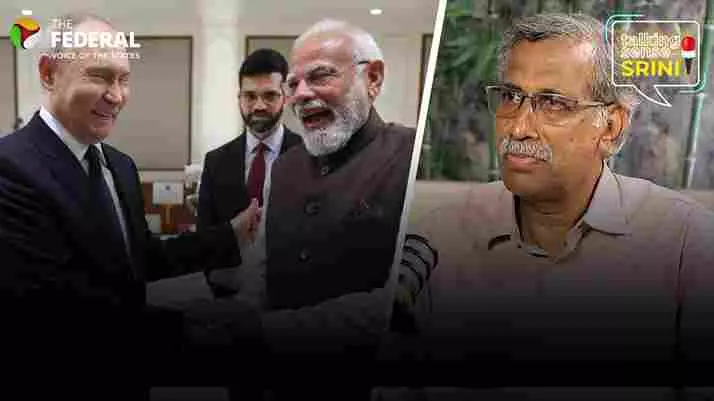
Srinivasan said that Modi’s reiteration that India stands “on the side of peace” on the Ukraine conflict was aimed at a global audience, reinforcing India’s strategic autonomy.
Putin in Delhi: The high-stakes messages behind the optics | Talking Sense With Srini
Modi breaks protocol to greet Putin, affirming deep ties between the two nations despite US scrutiny over discounted crude imports and Ukraine conflict stance

Russian President Vladimir Putin's visit to New Delhi, marked by Prime Minister Narendra Modi breaking protocol to personally receive him at Palam airport, underscores the durability of the India-Russia partnership even as both nations navigate heightened US scrutiny, according to The Federal’s Editor-in-Chief S Srinivasan.
On Talking Sense With Srini, Srinivasan said the latest visit is “perhaps the most significant” among Putin’s ten trips to India, given that both countries face direct pressure from Washington. The US has sanctioned Moscow over the Ukraine war and signalled concerns about India’s imports of discounted Russian crude.
Also read: India-Russia summit: Cautious talks, no big announcements as Trump’s shadow looms
India has now sharply reduced those purchases, yet Srinivasan noted the “palpable bonhomie” between the leaders suggested Moscow was not displeased.
Global south outreach
He said the relationship, rooted in Soviet-era ties, “continues to be on firm ground,” with Russia still supplying about two-thirds of India’s military equipment despite diversification efforts since the late 1980s. The visit also aligns with Russia’s broader outreach to the Global South.
Putin’s rare 90-minute interview with Indian television, something he once reserved for major Western networks, was a “strong signal” of that shift, Srinivasan said.
Both countries reaffirmed a target of raising bilateral trade to $100 billion by 2030, though the goal remains challenging because current volumes are heavily skewed by energy imports. With crude volumes expected to drop, Srinivasan said trade diversification in services, manpower, IT collaboration and emerging areas such as AI-driven medical research will be essential. Discussions on increasing the use of the rupee and ruble also point to evolving trade mechanisms.
Energy cooperation
Energy cooperation remains a key pillar. India, facing rising demand and climate commitments, is exploring expanded nuclear collaboration with Russia, which already built the Kudankulam reactors that supply half of India’s nuclear power. Putin indicated Moscow is willing to scale up support.
Also read: Putin’s India visit: What are the key takeaways? | Capital Beat
While no major defense deal was announced, Srinivasan said negotiations on aircraft, tanks, naval platforms and submarines are likely ongoing.
'On side of peace'
Modi’s reiteration that India stands “on the side of peace” on the Ukraine conflict was aimed at a global audience, he said, reinforcing India’s strategic autonomy. Putin, for his part, described India as a far more assertive and evolved nation than decades ago.
The US, Srinivasan added, “will look at this meeting very carefully,” even as both sides insist the partnership is not directed against any third country.