








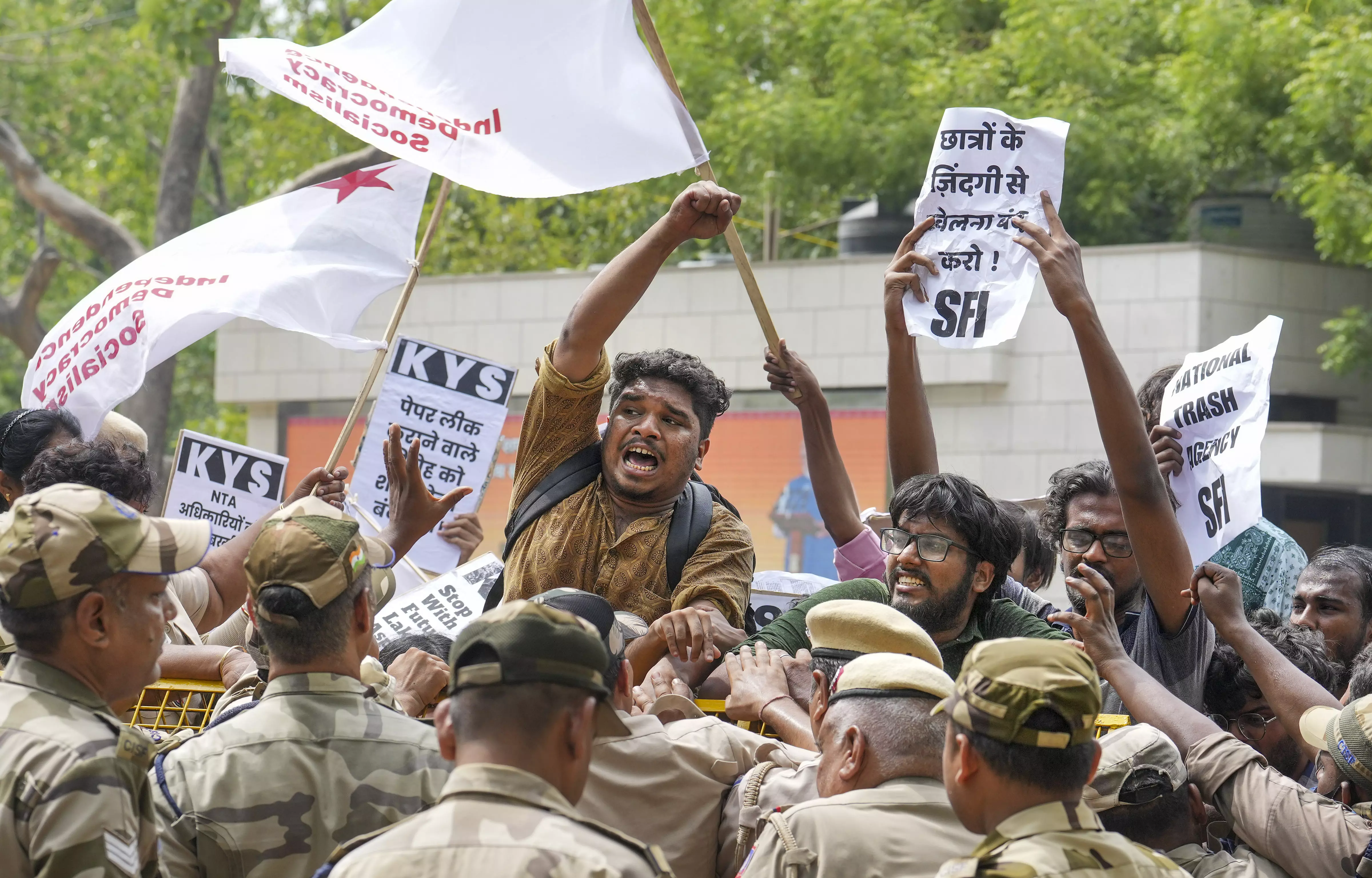
Delhi student protests: SC forms panel to probe police excesses, violence
Five-member committee headed by former SC judge Justice R Subhash Reddy to examine alleged harassment of protesters, police action, and chain of command

The Supreme Court has formed a five-member high-powered committee headed by former top court judge Justice R Subhash Reddy to examine allegations of police excesses against student protesters in Delhi recently and violence against police personnel.
A bench of Chief Justice Surya Kant and Justices Joymalya Bagchi and V Mohana said the committee would also comprise former Punjab and Haryana High Court Chief Justice Ravi Shankar Jha, former Delhi High Court Judge Justice Shalinder Kaur, former CBI Director Rishi Kumar Shukla and retired Meghalaya DGP L R Bishnoi.
High-Powered Enquiry Committee
"This HPEC (High-Powered Enquiry Committee) has been constituted bearing in mind a wide variety of considerations, including the individual expertise and experience of each of its members, as well as the diversity of the Committee, among other factors. We are confident that the recommendations of the HPEC will be of invaluable assistance to this Court, and the Committee will be able to undertake a comprehensive assessment of all such issues as merit due contemplation," the bench said.
Also Read: SC to form committee to probe claims of police excess, protest violence
The top court clarified that as a matter of abundant caution, the enquiry undertaken by the HPEC shall not be a one-time exercise.
It asked the Committee to undertake a continuous and periodic assessment of the issues and shall submit its interim findings periodically.
Issues to be addressed on priority basis
The apex court recommended that the HPEC should address certain issues on a priority basis, foremost amongst which is the matter relating to the alleged incidents of targeted violence, harassment, and molestation of female protesters.
"Similarly, the HPEC may also assess the grievous harm and injury allegedly caused to protesters by police authorities and security personnel and investigate aspects such as the chain of command resulting in such excesses, those responsible for such actions and whether there were any breaches of any of the existing laws, rules or norms in exercising such force," the bench said.
Terms of Reference for the committee
Whether there was use of excessive force and violence against protestors by police authorities and other agencies, including use of pellet guns, electric batons, tear gas, lathi charge, without giving adequate warning, and if these resulted in severe bodily harm/injuries to the protestors.
Whether the use of force was a proportionate and measured response to the protest.
The desirability of banning use of metallic kinetic projectiles/pellets having regard to the grave and irreversible bodily harm these can cause.
The necessity of ensuring that police and security personnel wear uniforms and visible nameplates at the time of using force during crowd control measures, arresting protestors in order to secure accountability and identification of individual officers.
Enquiry into allegations of monitoring and surveillance of protestors by police and the extent to which such measures were deployed and if these were consistent or violative of the citizens' constitutional right to privacy and of free assembly.
Also Read: From JP to CJP: How Delhi remains the epicentre of India’s power-shifting protests
Enquire into alleged incident of targeted violence, harassment, molestation, secondary victimisation against female protestors.
Regulation of issuance of blanket prohibitory orders under Section 163 BNSS.
Establishing strict constitutional thresholds and safeguards to prevent use of Section 152 BNS to stifle political dissent and peaceful protest.
Alleged use of force by protestors against police officials.
Damage to public property by protestors.
Also Read: NEET protests: Delhi lit the spark, and small towns, cities are keeping it burning
The Cockroach Janta Party (CJP)-led march to Parliament on July 20 in Delhi saw clashes between protesters and security personnel, who used lathis and teargas shells to disperse crowds attempting to move towards Parliament.
(With agency inputs)