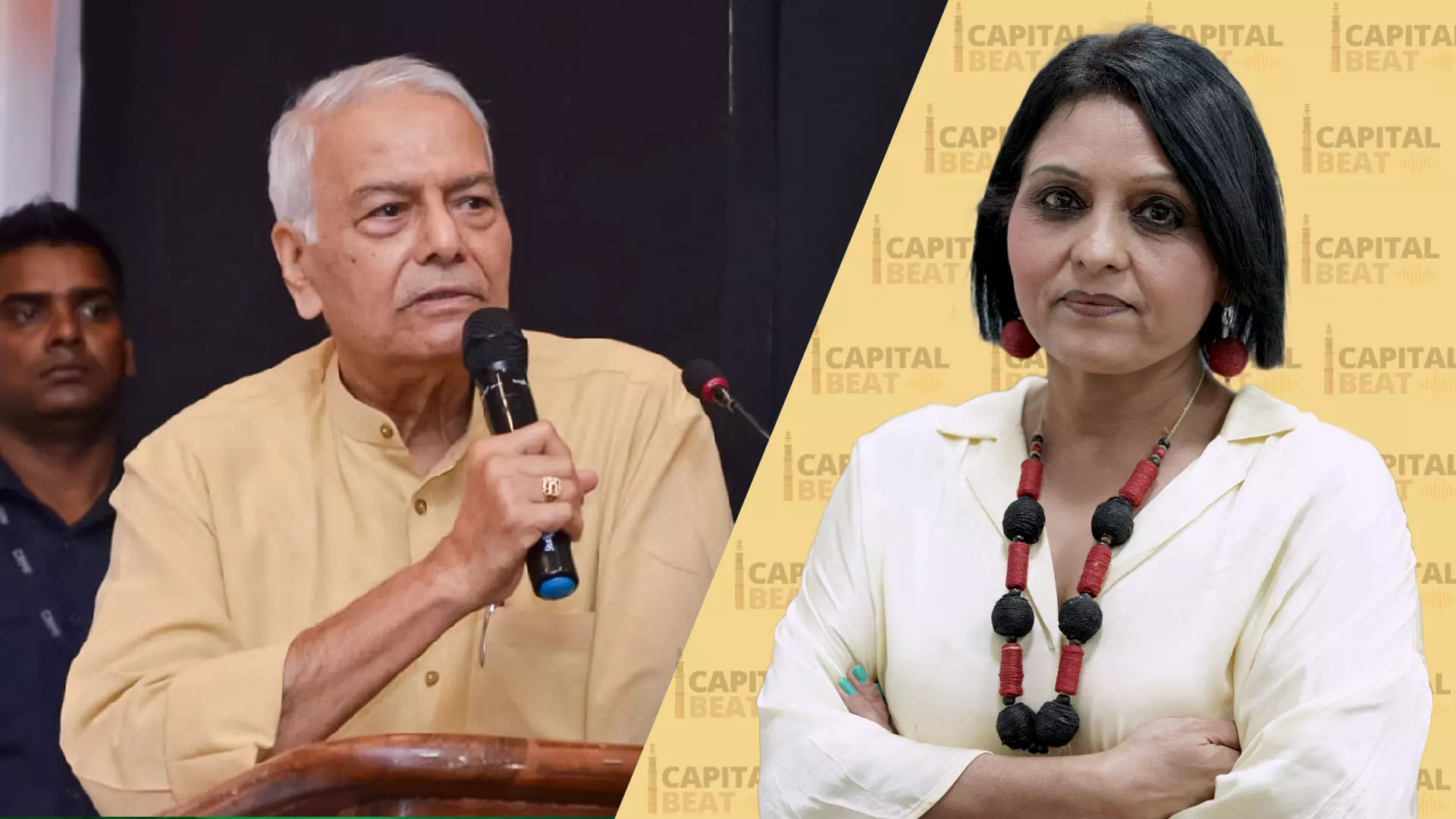
Why SHANTI Bill is a big risk: Yashwant Sinha speaks out
In this exclusive interview, Sinha questions SHANTI Bill, warning that scrapping nuclear ‘supplier liability’ could weaken accountability in case of accidents

In this episode of Capital Beat, The Federal spoke to former BJP leader and Union minister Yashwant Sinha to unpack the implications of the Sustainable Harnessing and Advancement of Nuclear Energy for Transforming India Bill, 2025 (SHANTI Bill).
With the government pitching it as a historic reform and the Opposition warning of serious risks, the debate goes to the heart of India’s energy future, corporate influence, and public safety.
What is your overall view on the SHANTI Bill passed by the government?
It is one of the ironies of history that I should appear on your show to oppose a piece of legislation introduced by a BJP-led NDA government on an issue that we, as the BJP, had opposed wholeheartedly and vigorously in 2010.
I was a member of the Lok Sabha at that time, and I remember those days very clearly. There were extensive negotiations. I must say, to the credit of the UPA government then, that despite having the numbers to push the Bill through the Lok Sabha, they still reached out to us. Ultimately, they accepted the liability provision that the BJP had insisted upon.
Now, a BJP government is undoing what the BJP itself stood for in 2010 by doing away with the liability clause as it was originally inscribed. That is what makes this so disturbing.
Why do you see the removal of the liability clause as such a serious issue?
The issue is that we are opening up the nuclear energy sector to private participation. Until now, this sector was reserved for the public sector. It has not made much progress, it is true—the share of nuclear energy in India’s overall energy basket is only around 3 per cent.
Also read: LS passes SHANTI Bill 2025 to target 100 GW by 2047; Opposition seeks JPC debate
But from 2010 to 2025, there has been a tremendous increase in renewable energy capacity. So that argument must be seen in perspective.
More importantly, if you want to develop nuclear energy, there are issues that must be addressed. One of the most critical is liability in case of an accident. Nuclear accidents are not unknown. We all know about Fukushima and Chernobyl. These are not distant memories.
The real question is: what happens to the victims of a nuclear accident?
What was the intent of the liability law passed in 2010?
In 2010, it was clearly decided that if a supplier of nuclear equipment supplied defective equipment, and that defect led to an accident, the supplier would also be liable, along with the operator, for damages.
That, in a nutshell, was the crux of the Civil Liability for Nuclear Damage Act, 2010. Supplier liability was a fundamental safeguard.
Also read: Lok Sabha debates SHANTI Bill as India eyes 100-GW nuclear power by 2047
What is happening now is that this safeguard is being dismantled. Ever since that law was passed, foreign suppliers have been pressuring the Government of India to change it—to either remove their liability altogether or cap it at Rs 3,000 crore, which is what this new Bill proposes.
The government has succumbed to that pressure.
What are the consequences if an accident occurs under the new framework?
If, God forbid, an accident happens, foreign suppliers will be completely in the clear. Even if it is conclusively established that the accident was caused by defective equipment supplied by them, they will not be liable.
This was unacceptable to the BJP in 2010. It should be unacceptable to Parliament today. Yet here we are, with a BJP government undoing the very stand the party once took.
Do you believe this Bill is being driven by corporate or foreign pressure?
Absolutely. It is happening under pressure from certain corporate houses in India, and it is happening under pressure from the US administration.
The US exerted similar pressure even in 2010. But at that time, because of the role played by the Left parties, the BJP, and the understanding shown by the UPA government, we did not succumb.
Also read: Atomic Energy Bill 2025: Why India’s 100 GW nuclear mission is a distant dream | Interview
This government, which is very friendly with certain corporate houses, is clearly doing their bidding. It is succumbing to pressure from both domestic corporates and foreign interests, and that is deeply unfortunate.
The government says the Bill will reform regulation and create a stronger nuclear oversight mechanism. Do you agree?
I do not buy that argument at all.
The second point you mentioned—about regulation—is actually the most dangerous. If foreign private players want to invest in India, what is stopping them from collaborating with public sector nuclear companies? Even joint ventures could have been encouraged with the existing Nuclear Power Corporation of India.
The idea that foreign collaboration will only happen if the Indian partner is a private company is very difficult to accept. Foreign entities have collaborated with Indian public sector entities in the past.
Nuclear energy is an extremely complex field. The Nuclear Power Corporation of India has decades of experience running nuclear plants. A new private player—whether Adani, Ambani, or anyone else—will not have that experience. They will depend entirely on foreign suppliers.
You also raised concerns about changes to the judicial process. Can you explain that?
Yes. The Bill bars the jurisdiction of regular courts and proposes a special tribunal to deal with disputes.
Why? Why interfere with the normal judicial process that applies to every other sector in the country?
Also read: Atomic Energy Bill: What it means to allow private firms into India’s nuclear sector
This is another clear indication that the government is bending over backwards to accommodate foreign pressure and domestic corporate pressure, serving everything on a platter to them.
If anything goes wrong in the future, the consequences will be disastrous.
The government claims the Bill will end monopoly in the nuclear sector. How do you respond to that?
This is one monopoly that actually works. It is a public sector monopoly created through a well-thought-out policy, and it has served the country well.
You are not opening a cycle repair shop here. Nuclear energy is a highly complex and capital-intensive field.
Let me give you an example. Suppose you license a private player to set up a 1,000 MW nuclear plant. The initial capital cost is enormous. When I was bringing insurance sector reforms, one major consideration was the huge capital required to start an insurance company.
Nuclear plants require even more capital. While running costs may be lower than thermal plants, the upfront investment is massive.
So why can’t the government simply encourage the Nuclear Power Corporation to raise funds from the market, raise foreign debt if needed, and support it with government resources? Why invite private players at all?
That is what makes this move suspicious.
What about the FDI push and the claim that foreign technology is needed?
India developed its nuclear capability indigenously. The contributions of Homi Bhabha and Jawaharlal Nehru are well known. India is second to none in nuclear technology, and I say this with full responsibility.
Our main challenge in the past was nuclear fuel supply, because we were not signatories to international accords. That changed after the 2005 Indo-US nuclear deal. Fuel supply constraints have eased.
Also read: US lifts sanctions on 3 Indian companies, including BARC
We are also developing our own fuel technology to reduce dependence on foreign suppliers.
So we do not need foreign technology to advance in nuclear energy. What we need is capital.
I would have had no objection if the government had said that supplier liability will remain intact and that foreign players can collaborate with the public sector initially. Let us see how that works over 10 or 15 years.
Instead, the entire legal framework has been overturned.
Do you see a pattern in how this government legislates major reforms?
Yes, very clearly. This is an extremely important Bill with grave long-term consequences.
The least Parliament should have done was refer it to a Standing Committee or form a Joint Parliamentary Committee and give it three to six months for scrutiny.
That was not done. The government is clearly in a hurry.
We waited 15 years after the 2010 liability law. Why could we not wait a few more months? Why rush this through Parliament? Who is being obliged by this hurry?
Something is clearly happening behind the scenes that is not in the public domain.
The government argues that the Bill is essential to achieve 100 GW of nuclear capacity by 2047 and meet decarbonisation goals. Your response?
This is complete nonsense.
There was nothing stopping India from expanding nuclear energy earlier. We are self-sufficient in technology. What we need is capital, which the government could have arranged without dismantling liability safeguards.
Also read: Safety before production: Minister Jitendra Singh on India's nuclear plants
What I see here is a clear design. The Bill is rushed. Crucial safeguards are removed. The judicial system is bypassed.
All this is done to make the sector attractive for foreign partners and domestic corporates, who will enjoy assured profits without liability.
If there is an accident, victims will have no meaningful compensation. People’s safety is not a consideration.
These grand promises of 100 GW by 2047 are dreams of the distant future, while real damage is being done in the present. This government lives either in the distant past or the distant future—not in today’s reality.
(The content above has been transcribed from video using a fine-tuned AI model. To ensure accuracy, quality, and editorial integrity, we employ a Human-In-The-Loop (HITL) process. While AI assists in creating the initial draft, our experienced editorial team carefully reviews, edits, and refines the content before publication. At The Federal, we combine the efficiency of AI with the expertise of human editors to deliver reliable and insightful journalism.)