congress shirtless protest
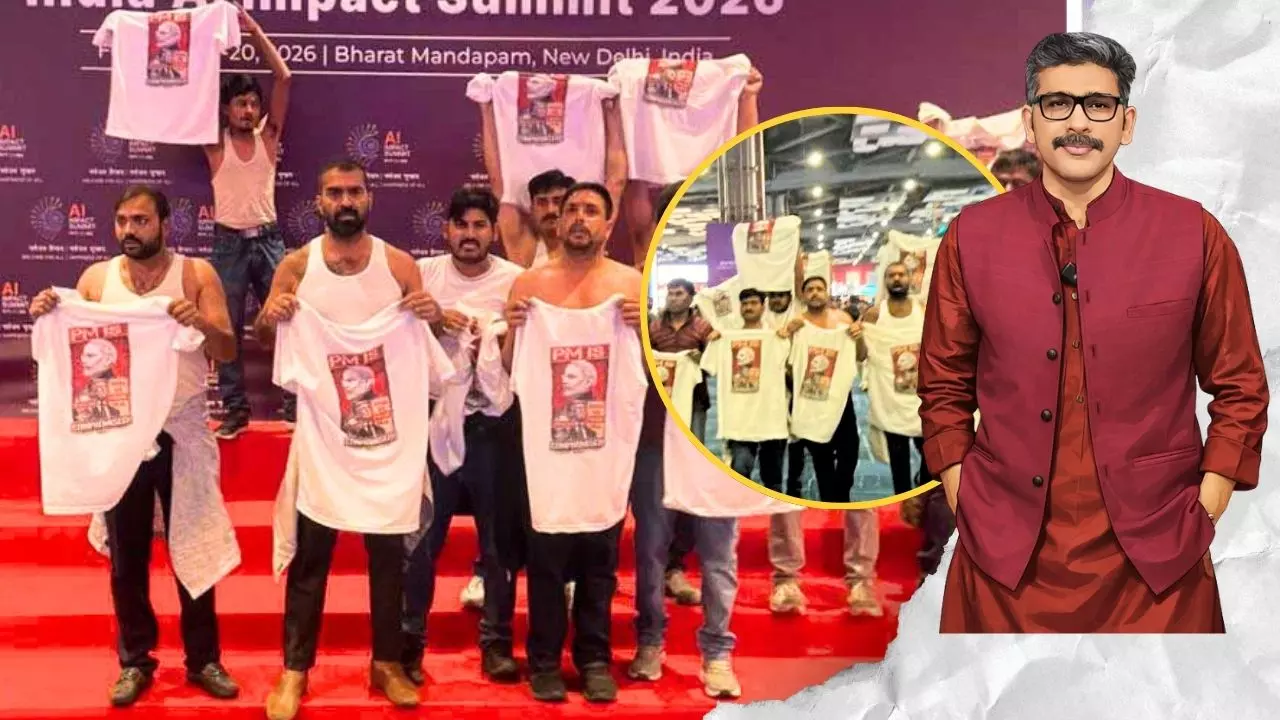
Shirts off, gloves off: Did Congress's AI summit protest embarrass India?
Panel on AI with Sanket debates whether the shirtless demonstration was democratic dissent or a damaging spectacle on a global stage

A shirtless protest at India's high-profile AI summit sparked more heat than the event itself — at least in the political arena. As Congress workers stripped down in demonstration, the act ignited a fierce debate about propriety, patriotism, and who really had something to hide.
Political consultant Nikhil Jain and author-analyst Karan Verma joined The Federal's YouTube show AI with Sanket to thrash out whether the Opposition drew attention to legitimate concerns or handed the BJP an easy distraction.
The discussion began with a direct question: Was protesting shirtless at a high-profile international summit justified?
Nikhil Jain made his position clear. “Personally, I don’t agree with this form of protest,” he said, arguing that there is a “right time and right place” for dissent. However, he stressed that the method should not overshadow the issues raised — including allegations that India had compromised farmers and small businesses in a trade deal with the United States.
Also Read: Delhi court calls shirtless protest assault on public order
He claimed the BJP had focused on optics while ignoring substantive concerns about tariffs, agricultural imports and oil purchases from Russia. “The moment these guys protested in this manner, the BJP has gone all guns ablaze after them… but is conveniently running away from the important question,” he said.
Karan Verma agreed that it was “not the right place to protest” but went further, calling it an embarrassment. He argued that with “20 heads of states” and “60 ministers” present and billions pledged in investments, such a protest projected instability. He described the protesters as “hoodlums” who tried to “tarnish our image”.
Alliance silence
The host raised another pointed question: Why had none of the Congress’s major allies publicly supported the protest?
Jain said differences within the INDIA bloc were natural. “It’s an actual alliance of different political parties… bound to have differences,” he explained. According to him, while allies may disagree with the manner of protest, they do not oppose the issues raised.
Verma countered that the protest had isolated the Congress and united opinion against it. He argued that instead of cornering the government on summit glitches, the opposition had made the conversation about shirts and optics.
India insulted?
A central flashpoint in the debate was whether the protest amounted to “insulting India”.
The host questioned the inconsistency: if thefts, alleged mismanagement, and logistical chaos at the summit did not insult India, how did a shirtless protest do so? Delegates reportedly walked long distances due to VIP movement restrictions, and questions were raised about exhibition stalls and technical failures.
Also Read: Congress uses robodog row to target govt, asks how Galgotias got into AI meet
Verma drew a distinction between “genuine errors of mismanagement” and a deliberate political act during an international event. “There is a difference between accountability and this sort of naked display,” he argued. He maintained that such protests suggest that “democracy here is not functioning properly” and cast a shadow when “the international gaze is right upon you.”
Jain disagreed. He cited examples of protests at global forums like Davos and even at fossil fuel summits in Azerbaijan, saying such dissent demonstrates democracy rather than diminishes it. “It shows that you are not China… you are a democratic country where people can protest,” he said.
Bailout package?
The discussion then shifted to whether the protest had inadvertently provided a “bailout package” to the government, shifting focus away from substantive questions.
Jain admitted at the outset that he did not endorse the form of protest and conceded that the debate had become about shirts rather than trade deals. “Nobody is talking about PM being compromised or the US-India trade deal,” he observed, arguing that this was precisely the problem.
Verma insisted that the opposition’s conduct repeatedly derails serious discussions. He cited instances where, in his view, Rahul Gandhi’s references to Pegasus and the Hindenburg report had been addressed or dismissed following Supreme Court scrutiny. According to him, parliamentary sessions were disrupted unnecessarily.
Jain responded that whenever the opposition raises questions, it is branded “anti-national” or worse. He alleged that questions about trade agreements and national security were brushed aside, shifting the conversation away from accountability.
Security concerns
Another issue that surfaced was summit security. How did protesters enter a venue with multiple layers of security and QR-code access?
The host flagged this as a serious concern. Jain argued that if Wi-Fi, UPI systems and even exhibition items could malfunction or go missing, it was unsurprising that protesters entered with T-shirts. Verma countered that the individuals were recognised Congress workers with valid QR codes and carried no weapons. “Their biggest weapon was their bare-chested body,” he said.
He questioned whether future security would now treat opposition members as “dodgy elements”.
Limits of protest
The debate eventually touched on the constitutional limits of protest. Verma cited the Supreme Court’s observations during the Shaheen Bagh case, stating that the right to protest is not unfettered and must comply with designated norms.
Also Read: Congress’ shirtless protest inspired by Nepal’s Gen Z: Delhi Police; IYC workers sent to police cust
Jain reiterated that while he personally opposed the manner of the shirtless protest, dissent itself should not be delegitimised. He accused the BJP of branding any criticism during international events as anti-national.
Both panellists agreed on one point: removing shirts inside the summit hall was not appropriate. But they diverged sharply on whether the act constituted national embarrassment.
Broader mandate
In closing remarks, the host suggested that India’s global standing could not be undone by “a few shirts off,” arguing that the AI summit’s broader mandate and declaration were larger than the controversy.
The exchange underscored a deeper divide: whether optics outweigh issues, and whether opposition protest strengthens or weakens democracy when the world is watching.
The content above has been transcribed from video using a fine-tuned AI model. To ensure accuracy, quality, and editorial integrity, we employ a Human-In-The-Loop (HITL) process. While AI assists in creating the initial draft, our experienced editorial team carefully reviews, edits, and refines the content before publication. At The Federal, we combine the efficiency of AI with the expertise of human editors to deliver reliable and insightful journalism.