‘Gyanesh Centre’s mascot of illegal activities; he must go, SIR must be scrapped’
Independent advocate and activist Rajalaxmi Ankalagi discusses crackdown on anti-SIR protests in Delhi, voter deletion concerns, and the Supreme Court's role in citizen rights

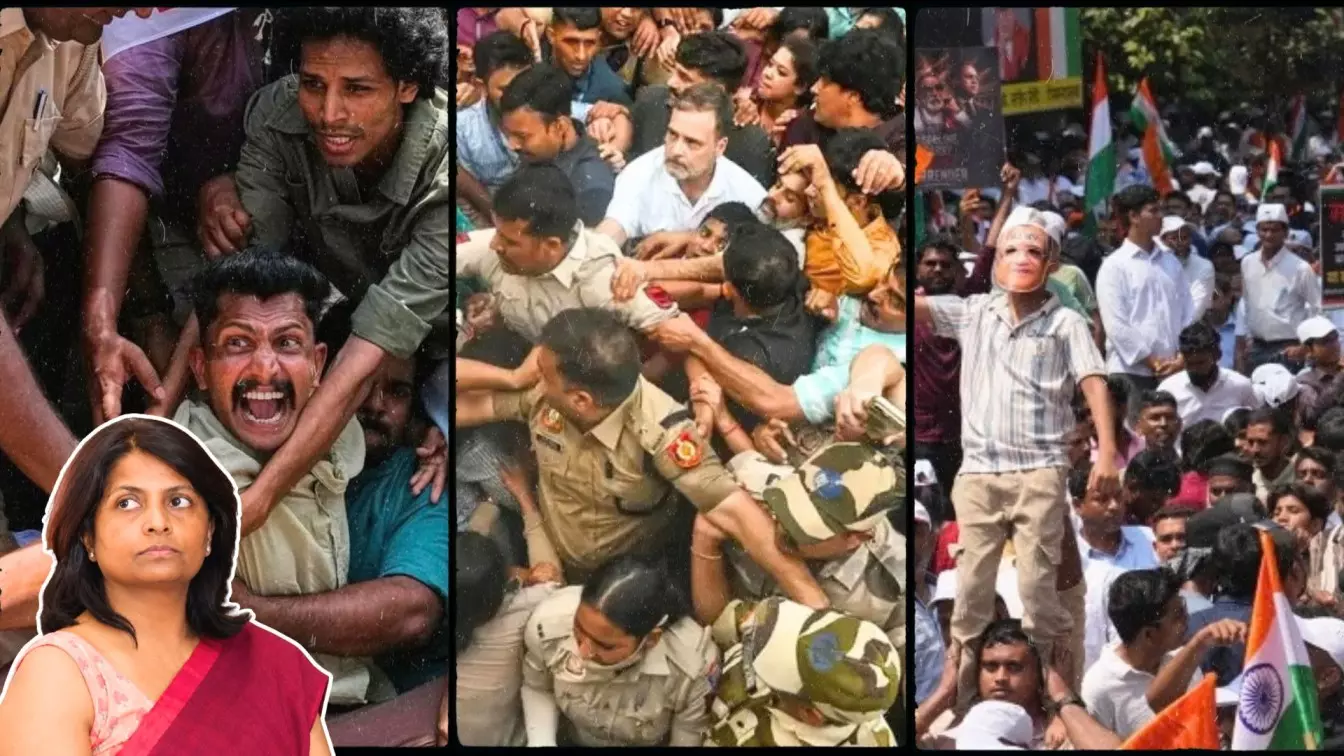
Scrapping the Special Intensive Revision (SIR) of electoral rolls is essential because the entire process is illegal and it should go hand in hand with the resignation of Chief Election Commissioner (CEC) Gyanesh, the mascot using whom the Centre conducts all electoral manipulations, says independent advocate and activist Rajalaxmi Ankalagi.
As nationwide protests against electoral roll revisions face heavy police crackdowns and mass detentions in Delhi and Karnataka, critical questions have surfaced regarding the right to peaceful assembly and the constitutional duty of the Election Commission. In an interview with The Federal, Ankalagi speaks about the legality of the SIR, the Supreme Court’s proportionality test, and why youth-led agitations against the poll body are expanding beyond traditional political lines.
How do you view the massive crackdown against protesters in Delhi and other parts of the country, leading to over a thousand detentions?
Today’s (October 10 and 11 protests by the CJP) developments are not a single, isolated incident of agitation. We have been witnessing the same kind of movement against SIR and CEC Gyanesh Kumar over the last several days and weeks. This is the culmination of a broader unrest among the youth, directed against Kumar.
Also read: ‘Why is Delhi jailed? ’: Rahul accuses Modi of protecting Gyanesh, says protests won't stop
It is not just about the SIR process. While the SIR triggered the issue, the unrest among the youth is multifaceted. There are innumerable problems in the country today that the general public is completely unaware of, largely because mainstream media displays a narrative that is completely disconnected from ground reality.
Anyone actively involved in the production, finance, economy, or development of this country, or anyone actively contributing to any field or company is facing the brunt of economic and financial hardship. A major chuck of the younger population suffers from unemployment.
There are three categories of youth: one who are aware of their rights, duties and the government’s functioning. Second are the ones deprived of proper education, especially in rural areas. These are youths whose attention is diverted from real problems and they easily fall prey to radical ideas of the saffron brigade. The third are a category of youth completely focused on their careers and don’t want to align with any kind of politics and want to stay safe.
Under these circumstances, having such a large youth population engage in this protest sends a powerful message not only to India but to the entire world. A protest against a strong regime gives a hopeful indication to youth in other nations. I see this as a positive development and a sign of hope that Indian democracy will survive in the hands of such youth.
Where do you see these protests heading? Will they die down following the heavy police crackdown, or will the action act as a catalyst for more widespread demonstrations?
I am a staunch optimist, and after analysing the situation, I can clearly say that this crackdown will act as a catalyst. This movement is not going to die down. If it were meant to die down, it would have happened on July 20th itself, given the brutal police force inflicted on the youth, including young girls aged 14 and 15 who were targeted and made to apologise in front of the media.
Also read: ‘Jantar Mantar 2.0 is on’: CJP, student activists vow to continue protests
Despite that repression, the fact that youth across the country are mobilising and rising near Jantar Mantar proves that the movement will not dissipate. It will only die down when the youth receive what they expect: proper education, adequate facilities, proper employment, and stable opportunities to settle down.
That resolution is not happening in the near future because, as our prime minister stated recently, he has shifted his goalpost to 2047. Under these circumstances, the protest will not die down; it will definitely intensify in the coming days.
Protesters are demanding both the resignation of the CEC and the scrapping of the SIR. Have these two demands become intertwined, given how the state apparatus appears to be rallying behind Gyanesh Kumar?
There is a misconception that needs clarification: the state machinery is not protecting Gyanesh Kumar; they are protecting themselves. Gyanesh Kumar is merely a pawn. Even if he resigns, another individual will replace him and continue the same operations.
Removing a single person, similar to what happened with former education minister Dharmendra Pradhan, does not automatically transform the system. However, it establishes a precedent of accountability, which this government previously neglected. Earlier, leaders like Rajnath Singh used to state that resignations were not part of their government culture. But the youth taught them a lesson, and Pradhan’s resignation opened a great chapter in Indian democracy, reminding people how democratic accountability used to function.
Also read: Gyanesh Kumar back in spotlight as Kerala reopens PATI-BEL case
In earlier years, when decisions violated constitutional principles, opposition leaders engaged in ‘satyagraha’, hit the ground, and protested despite administrative action. Even late leader Arun Jaitley participated in youth protests in his younger days, which reflected the true beauty of democracy.
Gyanesh Kumar is the mascot behind whom the central government conducts illegal activities. I use the word illegal deliberately because all decisions taken by him regarding the SIR are illegal. Therefore, scrapping the SIR is one essential step, and the resignation of Gyanesh Kumar is the other. They go hand in hand and cannot be viewed in isolation.
Regarding the SIR, Forms 6 and 7 are being blatantly misused. Gyanesh Kumar publicly claimed that modifications to Form 6 were made with the permission of the Supreme Court. However, Justice Surya Kant clearly stated in the Supreme Court that no such permission was ever granted to modify Form 6. Despite such outright delinquency in public statements, everything continues in his favour, demonstrating how the central government has misused the EC to manipulate electoral outcomes in state and national elections.
Look at states like Bihar and West Bengal, where tens of lakhs of voters—65 lakh, 90 lakh, 45 lakh—were deleted from electoral rolls right before elections. During India's first general election in 1951, when independent India faced high illiteracy, widespread poverty, and inadequate state machinery, the first CEC, Sukumar Sen, ensured that every eligible citizen was enrolled so they could cast their vote. That was the essence of democracy.
Today, with all modern machinery at our disposal, the roles have reversed. Earlier, citizens chose their representatives; now, elected representatives choose their voters by deciding who will vote for them and eliminating opposing voters from the list.
The Supreme Court previously emphasised the principle of proportionality in police responses. Does the recent crackdown on protesters meet that proportionality yardstick?
The definition of proportionality varies depending on who applies it. When the Supreme Court used the phrase "reasonable restrictions," it was fully aware of how the Delhi Police and administration would interpret it. The court had an opportunity to protect democracy, facilitate a peaceful protest in Delhi, and etch its name in history, but that opportunity was missed.
Watch | CJP vs Centre: Is crackdown on Gen Z, leaders, activists justified?
By granting the authority of "rationality" and "reasonable restrictions" to an administrative apparatus that lacks independent judgment and is controlled entirely by two individuals—Prime Minister Narendra Modi and Union Home Minister Amit Shah—the court effectively stripped away constitutional protections from the people.
There is a popular saying in North Karnataka: "Ne athang madu, na satang madti ni" (You pretend to cry, and I will pretend to console you). That is exactly how the authorities are acting. Despite an emergency hearing in court, Delhi was converted into an impenetrable fortress. Nobody watching this in 2026 would believe that fundamental rights still exist in our Constitution.
This was a call for a peaceful protest. The administration and right-wing elements repeatedly claim that the youth or opposition groups possess no real power and can be crushed at any time. If they truly have no power, why does the government fear them so much? Allowing the protest would have allowed democracy to survive.
This is a black day for Indian democracy. Nevertheless, anyone who respects the Constitution will come together. This struggle is not limited to October 10, 2026; youth will continue to step forward whenever an opportunity arises to protect democracy from dictatorial tendencies.
The Supreme Court stepped in with great urgency to order the release of lawyers detained during the protests. Can we expect the courts to act with the same urgency for ordinary citizens and youth who have been detained?
While the principle of equality before the law dictates that everyone is equal, the Supreme Court acted swiftly for lawyers primarily because lawyers are an integral part of the judiciary, and the court sought to avoid a direct confrontation with the legal community.
Unfortunately, the same urgency and interest are not extended to the general public or the youth. The extensive police preparations, multi-layered barricading, and deployment of buses to carry away protesters demonstrate that a dual yardstick is being applied by both the administration and the judiciary.
Also read: Meet the faces of India’s Gen Z protest movement
We witnessed this following the July 20 CJP protest. Despite assurances that FIRs would be withdrawn and cases dropped, many cases remain active today despite Supreme Court guidelines. With new agitations come new cases, new FIRs, and double standards.