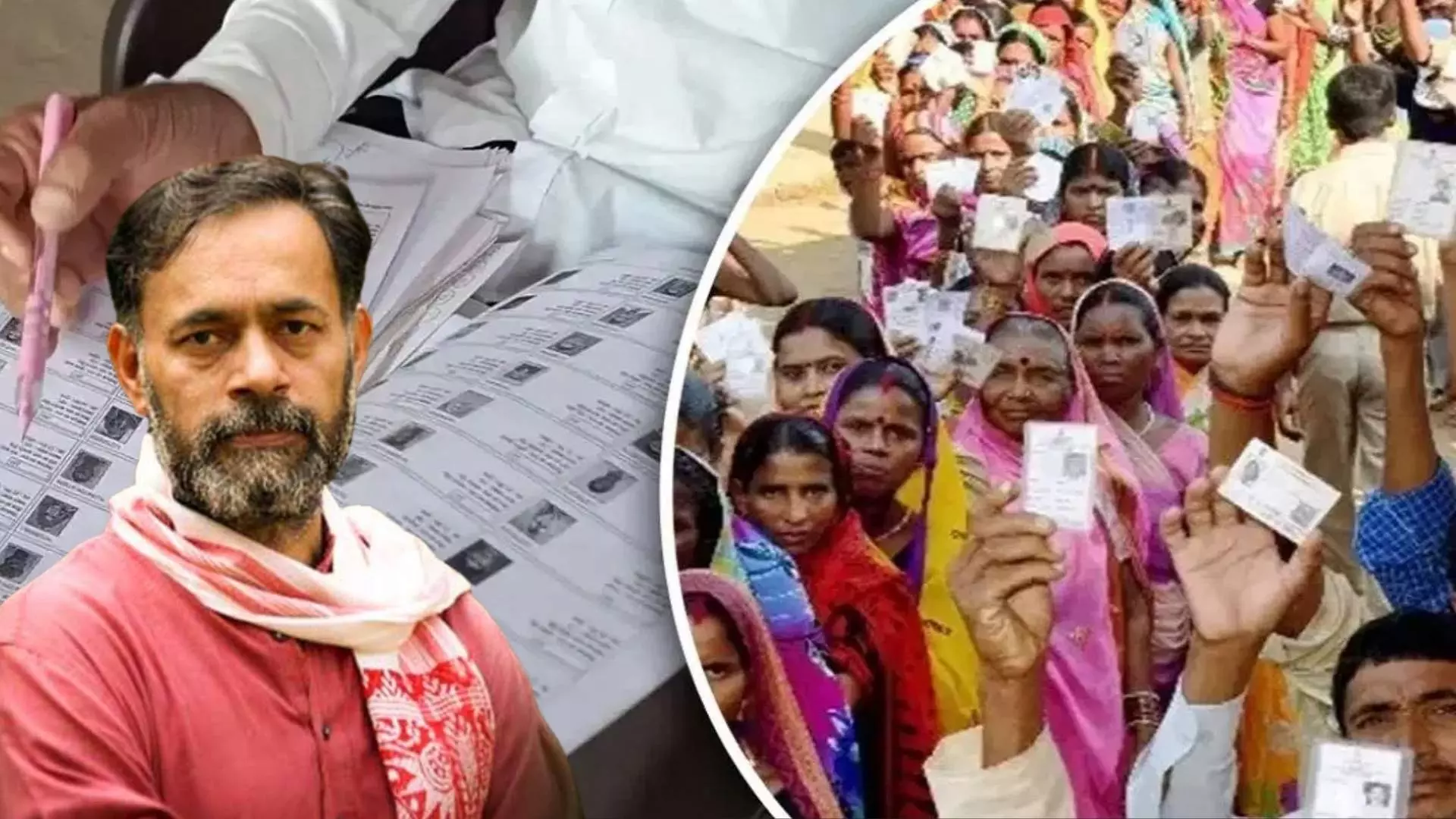
Not revision, it's voter disenfranchisement: Yogendra Yadav on SIR drive
In an exclusive interview, the political activist and convener of Bharat Jodo Abhiyan says SIR exercise is unprecedented, flawed, and politically motivated

As debates intensify over the Special Intensive Revision (SIR) of electoral rolls, concerns around voter disenfranchisement and institutional neutrality have moved to the centre of India’s democratic discourse.
The Federal spoke to Yogendra Yadav, political activist and convener of the Bharat Jodo Abhiyan, to unpack why he believes the SIR exercise is unprecedented, flawed, and politically motivated.
What is really wrong with the SIR exercise, which the government claims is meant to clean the voter list?
The problem begins with how this exercise is being framed. It is being presented as a routine voter list cleanup, but that is simply not true. This is not a normal revision. It is a de novo rewriting of the voter list in a manner that has not happened since 1950.
Another major issue is that people keep saying “the Election Commission is doing this”. The reality is that the line between the Election Commission, the government, and the ruling party has been completely blurred. That itself is half the problem. This exercise is not aimed at cleaning electoral rolls. In fact, electoral rolls are more inaccurate today than they were earlier. It has nothing to do with removing foreigners from voter lists either.
This is an unprecedented exercise with ulterior motives
In Bihar, not a single data point has been produced so far to justify that claim. If the intention was to address illegal migrants, this exercise should have begun in Assam. Instead, Assam has been given a complete exemption. What is happening is nothing short of large-scale disenfranchisement.
But revisions of voter lists have happened earlier as well. Why is this different now?
The Election Commission’s claim that this is a repetition of an old exercise is completely false. I challenge this assertion. Never in the history of independent India has an existing voter been asked to fill a fresh enumeration form. Never has a voter been asked to prove citizenship as part of voter list revision. This is illegal.
Also read: National hearing raises alarm over SIR as testimonies cite mass deletions, bias
We have produced documents from the Election Commission itself from 2002 before the Supreme Court. Those documents clearly state that citizenship should not be determined during such revisions. So, when the Election Commission says this has happened before, it is a lie. And it is deeply shameful that a constitutional body is putting out such falsehoods.
This is an unprecedented exercise with ulterior motives. The motive is clear: to prune voter lists on a large scale so that voters inconvenient to the BJP are removed.
You mentioned ulterior motives and disenfranchisement. Is there evidence that this exercise favours the ruling party?
Absolutely. This has been an exercise in bureaucratic overreach that has created massive problems for ordinary citizens and for Booth Level Officers as well.
At the end of this process, what have we achieved? Do we have better electoral rolls? No. Do we have greater equity? No. In fact, evidence suggests that wherever SIR has been carried out, more women have been removed from voter lists than men. Why is that happening? There is no credible answer.
The only explanation is the complete alignment between the BJP, the Home Ministry, and the Election Commission. The SIR is being used to improve the electoral prospects of the ruling party.
The BJP says elections were held in Bihar and there was no widespread protest. How do you respond to that argument?
That claim is also false.
Also read: PM Modi accuses TMC of opposing SIR to protect infiltrators
According to the Election Commission of India’s own data, 3.9 lakh objections were raised. Around 24 lakh new names were added. But here’s the critical question: were these really new voters?
Nearly half of these 24 lakh names belonged to people over the age of 25. How do you suddenly get new voters who are over 25 years old? The answer is simple. Around 65 lakh names were deleted earlier, and many of those people were forced to get themselves re-added because they had no other option.
So, to say the Bihar exercise was smooth or protest-free is a lie. There were objections and grievances, but with elections looming, political parties had very limited room to respond. As this exercise moves to other states, the reality will become much clearer.
If you oppose the SIR, what would you propose instead to make voter list revision credible?
There is already a standard procedure in this country. It just needs to be followed honestly.
The correct method is to go door to door, house to house. Verify whether existing names are correct and check if any names need to be added. This is how voter list revision has always been done. Why introduce new enumeration forms? Why demand proof of citizenship? None of this is required.
All that is needed is a proper, intensive, transparent revision of voter lists using established procedures. This has worked for decades. The question is simple: why not just do that?
The content above has been transcribed using a fine-tuned AI model. To ensure accuracy, quality, and editorial integrity, we employ a Human-In-The-Loop (HITL) process. While AI assists in creating the initial draft, our experienced editorial team carefully reviews, edits, and refines the content before publication. At The Federal, we combine the efficiency of AI with the expertise of human editors to deliver reliable and insightful journalism.