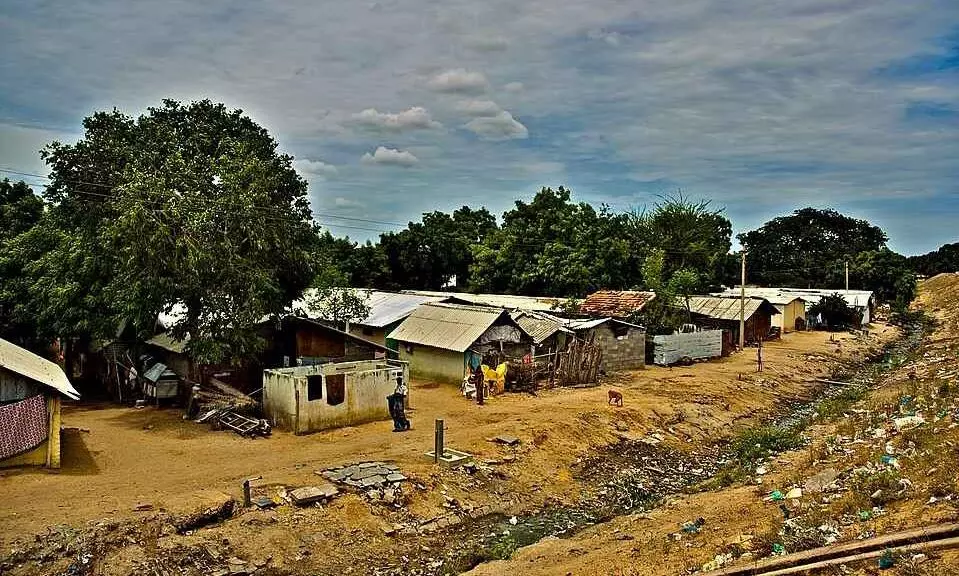
Unlike those in the West who soon got citizenship of their newly-adopted countries, the Tamils in India remained in refugee camps. Representative image: Wikimedia Commons
Sri Lanka’s new intelligence check puts Tamil refugees’ return plans in doubt
A mandatory security clearance from the country’s intelligence agency has left thousands of refugees in India wary of returning home

Rasiah Pathmanathan has had no problem worth mentioning since he returned to his ancestral abode in northern Sri Lanka, an incredible 36 years after he fled his country with his parents to India to escape a renewed Tamil separatist war.
The 51-year-old says that since he came back to Viswamadu in Mullaitivu district in March this year, he, his wife, and their teenage son could secure their national ID cards and family card within a month.
Yes, there was a slight delay in getting school admission for his son, but that was due to technical reasons.
“Otherwise, I have had no issues,” Pathman, as he is known among friends, told The Federal over the telephone.
Of course, it helped that his family house was intact. He and his family adjusted quickly to the new surroundings after he reconnected with Tamil friends whom he last saw in 1990 and who, like him, were now grown up and were adults.
But Pathman’s smooth sailing may not hold much hope for the thousands of Sri Lankan Tamil refugees still living in India despite Colombo’s decision to axe a controversial rule that prevented many of them from making the return journey.
Tamil refugees returning to Sri Lanka in danger of arrest
It was in May 2025 that a Sri Lankan Tamil man who flew back to Palaly airport in Jaffna from Tamil Nadu with the help of the UNHCR was arrested on arrival for having left the country decades earlier in an unauthorised manner.
After the Criminal Investigation Department produced him in a court, he was remanded. He got bail only after a furore. A peeved UNHCR disengaged from the refugee repatriation.
Also Read: Sri Lanka placing roadblocks on Tamil refugees’ return from India
The mass of refugees quickly realised they were all in danger because everyone had fled Sri Lanka from 1983 onwards by sea – and not through any authorised port - after a massive anti-Tamil orgy engulfed Colombo following the killing of 13 soldiers by Tamil Tigers.
As a nascent Tamil militancy gave way to a full-fledged insurgency, thousands of Tamils continued to flee Sri Lanka. Many eventually made the West their new home. A vast number took refuge in India.
Plight of refugees in India
Unlike those in the West who soon got citizenship of their newly-adopted countries, the Tamils in India remained in refugee camps. A section also lived on their own in Tamil Nadu. Their pleas for Indian citizenship were rejected.
No wonder, a third of the estimated 80,000-plus refugees in India would be happy to go back to Sri Lanka, now that the separatist war is long over, says the Organisation for Eelam Refugee Rehabilitation (OfERR), which cares for the displaced Tamils in India.
New rule with a catch
On August 11, the Sri Lankan government ruled that all the refugees who left the country until May 19, 2009 – when the war ended - can return through designated ports without facing prosecution for unauthorised departure.
But there was a new catch: besides identity authentication at the nearest Sri Lankan diplomatic mission, they would need a security clearance from the State Intelligence Service (SIS), the island nation’s main intelligence agency.
Also Read: Should Sri Lankan Tamils in TN get Indian citizenship? Tamils are split
Until now, only a police verification was sought for the refugees to get a Sri Lankan travel document. The involvement of the SIS, accused of torturing innumerable Tamils during the war, has stunned both the refugees and OfERR.
Further, refugees accused of murder, treason (not defined), and “other serious offences” can be detained on arrival and handed over to the relevant authorities.
‘Everyone treated as terrorist suspects’
Chandrahasan Ilangovan, whose ailing father SC Chandrahasan founded OfERR in 1984, is livid.
“They are treating everyone as terrorist suspects instead of as humanitarian victims of the war,” he told The Federal. “This is extremely regressive and dangerous.”
He went on, “All previous governments wanted only a police investigation of the returnees. This government is inducting a notorious intelligence service. This never happened until now. No one knows how long this process will take.”
Also Read: 'India not a dharamshala': SC junks Sri Lankan's plea for refuge
Ilangovan, who commutes between Jaffna and Chennai, said that while the JVP-led government says it won’t discriminate against Tamils, it had attached a new and stringent condition even 17 years after the war ended.
“Why ask for intelligence checks for people who left the country 20 or 30 years ago?” he asked. “I find this a way of punishing them one more time.”
‘Baffling rule’
A middle-aged refugee who lives in Chennai called the new rule baffling.
Requesting that he should not be named, the man said, “The problem with these intelligence agencies in Sri Lanka is that they are almost wholly Sinhalese. They can pick on something minor and hold it against us. In fact, they are one reason why Tamils fled Sri Lanka.
“If you ask me, I want to leave India. Who wants to be a refugee forever? But do I want to go back and face the Sri Lankan intelligence? No way.
Also Read: Life of squalor, very few jobs: Why Lankan refugees are risking their lives to come to India
“I know I have not done any wrong. I left Sri Lanka because I did not want to be involved in any violence. But what if someone makes a false accusation against me? How can we fight back? I don’t understand why they have introduced this nonsense.”
According to a section of activists among the refugees, Colombo may have acted thus knowing that this will put brakes on the path of many wanting to leave India.
Dwindling Tamil population and representation
Tamil leaders in Sri Lanka have been urging the refugees to come back as their mass return would push up the dwindling Tamil population in the country.
The falling Tamil population is impacting the community’s representation in parliament. As of now, only one of the three districts in Sri Lanka’s east has a Tamil majority. In the other two, Muslims, who too speak Tamil but are a separate ethnic group, are the single largest entity.
“Maybe the government doesn’t want the Tamils to return,” one activist said. “This can’t be ruled out. Anything is possible in Sri Lanka.”
Need for resolution to refugee problem in India
It was in February this year that then-Tamil Nadu Chief Minister MK Stalin urged Prime Minister Narendra Modi to come up with a human resolution to the lingering problems of the Tamil refugees.
He pointed out that a whopping 40 per cent of them were born in India.
According to OfERR, this section has no interest in going back to Sri Lanka, a country they have never seen. Ideally, they would want to be Indian citizens.
Also Read: Statelessness stares at one lakh Sri Lankan Hindus
There is another group which seems divided between remaining in India and going back to Sri Lanka – provided they get livelihood there. In any case, many of these people do not have a house to go back to. They will want relatives or close friends to put them up until they get a dwelling.
Then there are those who want to leave India. But the Sri Lankan government has just tripped them by seeking, for the first time, a clearance from the intelligence agency. No one knows how many refugees can pass this test.