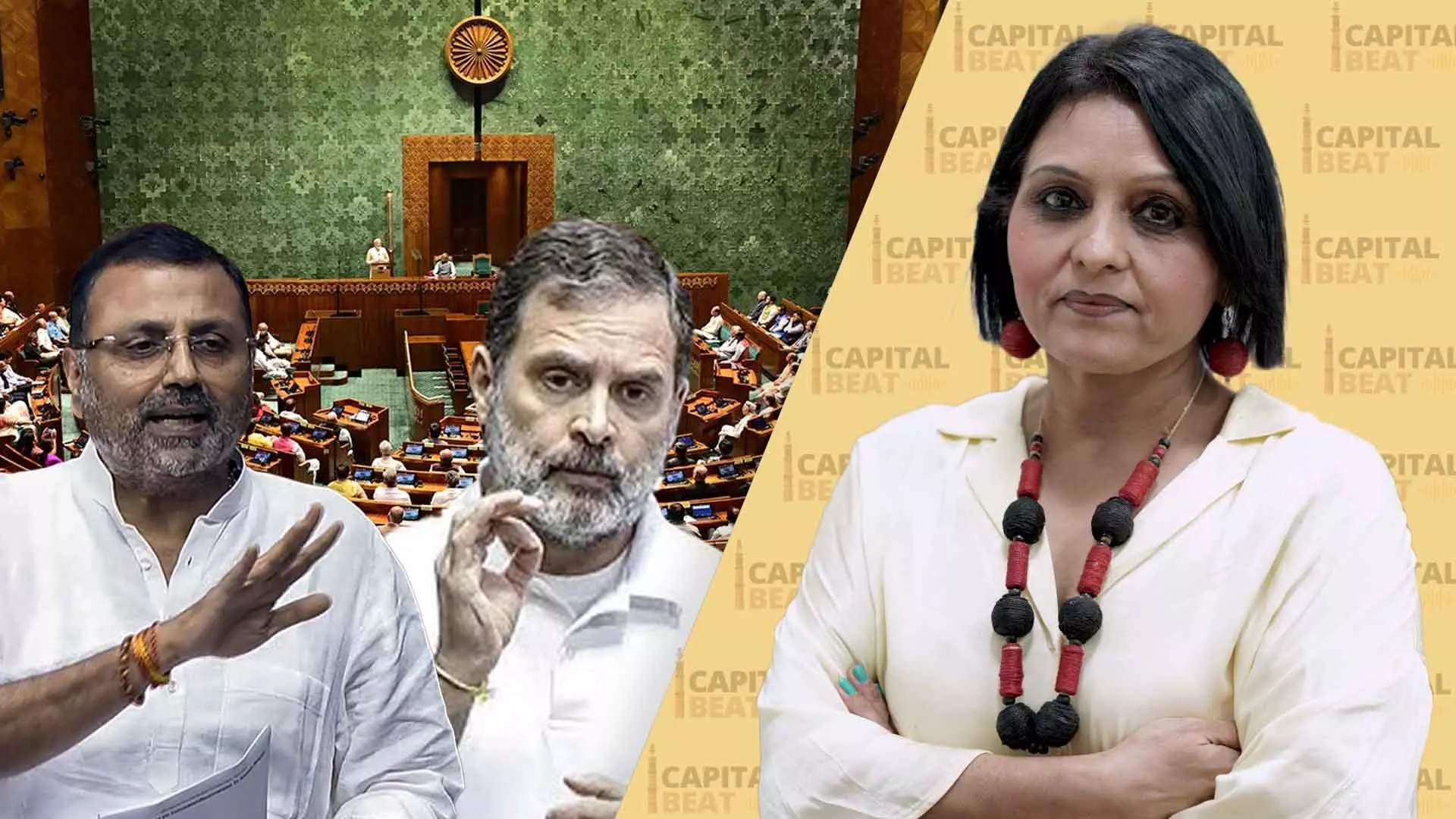
What is substantive motion and why does Dubey want Rahul expelled from LS?
The substantive motion has sparked a larger debate about parliamentary procedure, accountability, and the health of India’s legislative institutions. Experts discuss on Capital Beat episode

BJP MP Nishikant Dubey has moved a substantive motion in the Lok Sabha seeking the termination of Leader of the Opposition Rahul Gandhi’s parliamentary membership and a lifetime ban on contesting elections.
On this episode of Capital Beat, The Federal spoke to PDT Achary, former Secretary General of the Lok Sabha; senior journalist and political commentator Javed Ansari; and The Federal’s Political Editor Puneet Nicholas Yadav to unpack the legal, procedural, and political implications of the move.
The controversy erupted after Union Parliamentary Affairs Minister Kiren Rijiju initially indicated that a breach of privilege motion would be brought against Congress MP Rahul over remarks he made in Parliament. However, the government has since stepped back from the privilege motion route, with Dubey instead filing what is being described as a substantive motion.
Also read: With Naravane backing Penguin, Rahul pivots to India-US trade deal
Calling the move unprecedented in recent years, Achary said the motion, as read out publicly, “does not seem to be properly worded” and fails to clearly state what exactly the House is being asked to decide.
What is a substantive motion?
Achary clarified that a substantive motion is “a self-contained proposal put before the House for eliciting its decision”. Most motions moved for a decision of the House — including a motion of thanks or even a privilege motion — are technically substantive motions.
Also read: Govt clears procurement of 114 Rafale jets, other military hardware worth Rs 3.60 lakh cr
However, he questioned whether Dubey’s notice meets that standard. “From what you have read out, it doesn’t seem to be a properly worded, properly framed substantive motion,” Achary said, adding that it appears “diffused” and unclear in its objectives.
He explained that if a member seeks action against another member for alleged conduct unbecoming of a parliamentarian, established guidelines dating back to 1988 must be followed. These guidelines require that notice be given, evidence be produced, and that the concerned member be given an opportunity to present their version. The matter is examined at multiple stages before potentially coming before the House.
According to Achary, if the Speaker finds a prima facie case, a committee of members is constituted to investigate and submit a report, on the basis of which the House may act.
Privilege motion shelved
One of the key developments is the government’s apparent decision not to move a privilege motion against Rahul.
Nicholas Yadav pointed out that although Rijiju had publicly stated that a breach of privilege notice would be filed, the government now appears disinclined to pursue that path. A significant portion of Rahul’s remarks — referring to Jeffrey Epstein, Gautam Adani, Anil Ambani, and allegations of a “sell-out” trade deal — were expunged from parliamentary records.
Yadav also noted a crucial procedural hurdle: “There is no privileges committee in the Lok Sabha as of now.” The previous committee’s term expired in June 2024 and has not been reconstituted. Without a functioning privileges committee, a privilege motion cannot proceed in the usual manner.
He further observed that parliamentary rules do not permit retrospective consideration by a committee that did not exist at the time a notice was filed.
This raises questions about why the privilege route was publicly announced in the first place. While Rijiju would have been aware of the absence of a committee, the government has not offered an explanation for the shift in strategy.
Political payback?
Ansari described the substantive motion as “payback” for the discomfort and embarrassment caused to the government by Rahul’s recent speeches in Parliament.
He said the episode reflects a broader erosion of parliamentary norms. “Parliament is not for retribution,” Ansari remarked, adding that privilege motions and expulsions are serious instruments and should not be used for tit-for-tat politics.
He also expressed concern over the non-constitution of key parliamentary bodies. “We haven’t had a Deputy Speaker since 2014. If there is no ethics committee, no privileges committee, it’s shocking — but it reflects the times we live in,” Ansari said.
According to him, whether the motion succeeds will ultimately depend on numbers. “If the BJP and the NDA are intent on getting it passed, it will pass because they have a brute majority,” he said, though he warned of potential political repercussions.
Contentious language
Yadav described parts of the substantive motion as “theatre of the absurd”. The notice reportedly refers at one point to Rajiv Gandhi instead of Rahul Gandhi and includes allegations that are not substantiated within the text.
He argued that any presiding officer strictly applying parliamentary rules should reject such a motion at the threshold. “It looks more like a seeking attention motion or diverting attention motion,” Yadav said.
He pointed out that in past instances where substantive motions led to expulsion — such as the 2005 cash-for-query scandal or the Babu Bhai Katara case — there were clear grounds, detailed inquiries, and committee reports backing the action.
In those cases, inquiry committees were set up, investigations conducted, and reports submitted before the House voted on expulsion. The current motion, by contrast, appears to lack detailed procedural backing.
Allegations and rules
The panel also discussed Rule 353 of the Lok Sabha Rules of Procedure, which pertains to allegations against members. Yadav noted that ministers, including the Prime Minister, are accountable to Parliament and can respond to allegations made in the House.
He said that expunging Rahul’s remarks rather than responding to them raises procedural and political questions.
Achary, for his part, dismissed the idea that Rahul’s speech automatically warranted a privilege motion. “When a member makes a speech… if he makes some charge against the minister or prime minister, they are answerable to the House. They can refute it. End of the matter,” he said.
What next?
With Parliament set to adjourn for recess, the timing of the motion remains uncertain. Private members’ business is typically taken up on Fridays, but whether Dubey’s motion will be admitted and scheduled for discussion depends on the Speaker’s discretion.
Ansari noted that even if the motion is admitted and passed, the political fallout could extend well beyond Parliament. “It won’t end there,” he said, suggesting that expelling the Leader of the Opposition would have significant political consequences.
For now, the substantive motion has sparked a larger debate about parliamentary procedure, accountability, and the health of India’s legislative institutions.
(The content above has been transcribed from video using a fine-tuned AI model. To ensure accuracy, quality, and editorial integrity, we employ a Human-In-The-Loop (HITL) process. While AI assists in creating the initial draft, our experienced editorial team carefully reviews, edits, and refines the content before publication. At The Federal, we combine the efficiency of AI with the expertise of human editors to deliver reliable and insightful journalism.)