








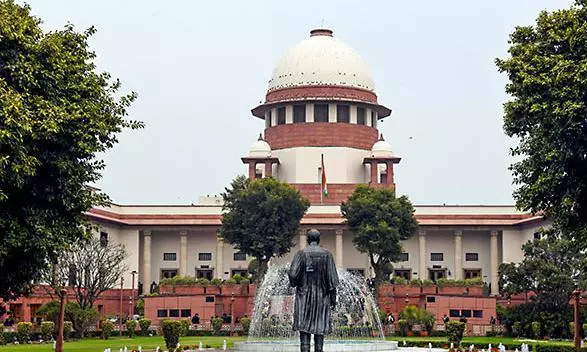
Supreme Court draft AI rules mandate disclosure of AI use in court filings
The Supreme Court's draft AI regulations require lawyers to disclose AI-assisted filings, prohibit AI-only judicial decisions and emphasise human oversight in courts

The Supreme Court has released a draft regulation governing the use of Artificial Intelligence (AI) tools in court across the country. The draft regulations titled Regulations for Use of Artificial Intelligence in Courts, 2026, state that lawyers can use AI tools for preparing pleadings, but make it mandatory for them to inform the court when they use such tools.
As per the draft regulations, legal research, drafting, translation, transcription and case management assisted by AI are allowed. However, it clarifies that judges will be the top authority to decide on law, facts and justice.
Mandatory disclosure of AI use
The draft regulation in its Regulation 43(3) further states that in the case of the use of AI tools by any party or counsel about the preparation or submission of any document, pleading or evidence, the AI-assisted character of such documents must be disclosed to the court at the time of submission.
Also Read: Supreme Court now has 37 judges after five new appointments
As per Regulation 43(4) of the draft, courts are authorised to seek details of the AI tools used as well as the nature and extent of the use of AI, along with steps taken to verify the factual authenticity of the AI-assisted content.
It makes it clear that lawyers or litigants will be held accountable for false failings, and they cannot dodge responsibility by blaming the AI system.
Regulation 43(6) further states that if a document, pleading or evidence submitted to a court is found to be false due to its AI-generated nature, the person submitting such documents will be held responsible. According to the draft regulation, published by the Supreme Court’s AI Committee, it would apply to the Supreme Court, High Courts, subordinate courts, tribunals and statutory commissions which perform adjudicatory functions.
The draft regulations have been placed in the public domain for comments till June 20.
Permitted uses of AI
(a) Case management (including identification of defects in new filings), cause list preparation, hearing scheduling and docket prioritisation;
(b) Automated transcription of court proceedings, subject to mandatory review and certification of accuracy by a Designated Officer;
(c) Translation of judgments, orders, pleadings and other legal documents, subject to human verification of accuracy and fidelity to the original;
(d) Legal research, precedent retrieval, citation verification and document summarisation;
(e) Administrative functions including case filing assistance, defect scrutiny, record management and judicial resource allocation;
(f) Conversational AI Assistants and guided chatbots to assist litigants and other stakeholders in accessing Court services and understanding procedural requirements, subject to human oversight of their functioning;
(g) Accessibility services including text-to-speech, speech-to-text, Braille translation and visual assistance tools, for persons with disabilities or language barriers;
(h) Document authenticity verification and fraud detection in administrative processes, subject to mandatory human review of all outputs before any action is taken;
(i) Anonymisation of judgments, orders and Court records for publication in the public domain;
(j) Analytical tools for judicial administration, court performance assessment and backlog monitoring and management;
(k) Auto-generation of prescribed formats, notices and summonses with metadata merge, including automated preparation of administrative documents.
Restrictions on AI deployment
(a) No personal data of any person shall be used to train, test, or refine any AI System without the prior approval of the Appropriate Authority and, where applicable, in compliance with applicable data protection law;
(b) No judicial outcome (including any judgment, order, or finding of fact or law) shall be reached through Algorithmic Decision-Making alone or solely on the basis of AI-generated information, data, or analysis and the human judicial authority shall be the determinative authority in all adjudicative decisions;
(c) No AI System shall perform the function of adjudication or sentencing in any matter without mandatory Human-in-the-Loop and any output of an AI System in relation to adjudicative or sentencing questions shall be treated as advisory only and shall be subject to independent judicial evaluation;
(d) No AI System shall be used for Risk Scoring for any purpose in Court processes, including the assessment of flight risk, prediction of recidivism, evaluation of bail eligibility, or determination of the credibility of parties or witnesses;
(e) No undisclosed, opaque, or unexplainable AI System shall be used in any Court process that may materially affect the lawful rights or personal liberty of any party;
(f) No AI System shall be used to predict, profile, or infer the future conduct or behaviour of parties, accused persons, witnesses, or legal representatives in any Court process;
(g) No AI System shall be used for the surveillance or continuous monitoring of judicial officers, advocates, litigants, or any other person within or in connection with Court premises or Court processes, except as may be specifically authorised by applicable law for the time being in force;]
(h) No AI-generated output shall be submitted to a Court as an independent source of evidence without full and transparent disclosure of its AI-generated character;
(i) No AI System shall be used in any manner that may compromise the confidentiality of judicial deliberations or the independence of the judicial decision-making process.
Human primacy in courts
Under the proposed framework, any pleading, document, submission or piece of evidence prepared with the assistance of AI would have to be identified as such when placed before a court.
The draft further clarifies that AI-generated material cannot be presented as an independent source of evidence unless its AI-generated nature is fully disclosed. Any person relying on synthetic or AI-generated information in judicial proceedings would similarly be required to inform the court of such use.
Also Read: Supreme Court says SIR is legally valid, doesn't violate constitutional provision
The regulations emphasise the principle of human primacy in judicial functioning. They make it clear that AI is intended only as a support mechanism and cannot replace judicial decision-making.
“Every AI System shall function solely in an assistive capacity and shall not supplant or compromise the independent exercise of judicial authority by a duly appointed judicial officer,” the draft states.
Guarding against AI hallucinations
The regulations specifically acknowledge the risk of AI hallucinations, referring to situations where AI systems produce convincing but inaccurate, fabricated or misleading information, including erroneous legal precedents, statutory provisions or factual claims. AI-generated outputs would generally require verification before use and would remain advisory in character.