








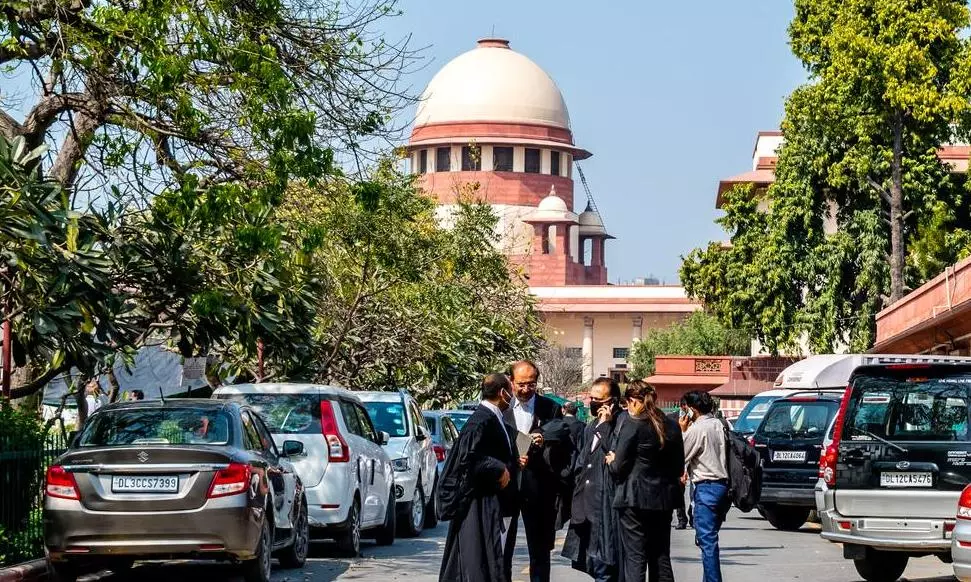
SC flags limits on religious autonomy during Sabarimala hearing
Supreme Court’s nine-judge bench examines balance between religious autonomy and constitutional rights amid ongoing Sabarimala and worship entry debates

A nine-judge Constitution bench of the Supreme Court on Tuesday (April 28) drew a firm line between the autonomy of religious institutions and the need for order, remarking that management rights cannot slip into a free-for-all.
The development came during the hearing of a batch of petitions on gender-based restrictions at places of worship, including the long-running dispute over entry to Kerala’s Sabarimala temple. The court signalled that institutional control must operate within a defined framework.
Examines scope of religious freedom
The bench, led by Chief Justice Surya Kant and comprising Justices B V Nagarathna, M M Sundresh, Ahsanuddin Amanullah, Aravind Kumar, Augustine George Masih, Prasanna B Varale, R Mahadevan, and Joymalya Bagchi, was examining the wider contours of religious freedom across faiths.
Also Read: Sabarimala case: Why every faith has a stake in the nine-judge SC Bench?
During the hearing, advocate Nizam Pasha, appearing for Peerzada Syed Altamash Nizami, direct ancestral descendent in Chisti Nizami lineage associated with the dargah of Hazrat Khwaja Nizamuddin Aulia, argued that a dargah is a place where a saint is buried.
Sufi practices and denominational identity
He further stated that "Within Islam, there are differing views regarding the status of saints after death, but in the Sufi system of belief, there is deep reverence attached to the place where a saint is interred.”
Also Read: Sabarimala case: SC rejects ‘WhatsApp Varsity’ inputs, stresses limits of personal opinions
"The Sufi system of belief in India consists of several major orders, including the Chishtiya, Qadriya, Naqshbandiya and Suhrawardiya. The present case concerns the Chishtiya order. This system, I submit, clearly constitutes a religious denomination. If one looks at the teachings attributed to Hazrat Nizamuddin Auliya, there is emphasis on adherence to Islamic practices such as roza, namaz, hajj, zakat, and above all, faith," he added.
Regulation versus unrestrained management
Elaborating further, Pasha stated that the right to regulate entry in a religious institution is part of management.
At this point, Justice Amanullah said the right to manage cannot mean the absence of structure, and for everything, there has to be a modality.
"There cannot be anarchy. Take a dargah or a temple. There will be elements associated with the institution, the manner of worship, and the sequence in which things are done. Somebody has to regulate that,” he said.
Also Read: Sabarimala hearing: SC asks if Constitution protects devotees barred from touching the deity
"It cannot be that everyone says I will do whatever I want, or that the gates remain open at all times without any control. So the question is, who is that body which manages. That is where protection comes in, because regulation is necessary. At the same time, it cannot transgress constitutional limitations. There cannot be discrimination on the broad constitutional parameters," said Justice Amanullah said, adding that every institution must have norms and it cannot be individually determined by each person. The hearing is underway.
Court’s earlier view on essential practices
The top court earlier said it was very difficult, if not impossible, for a judicial forum to define parameters to declare a particular practice of a religious denomination as essential and non-essential.
During an earlier hearing, the bench confronted another facet of the same conflict, whether devotion can be curtailed by ritual boundaries. Responding to submissions from the Sabarimala temple’s chief priest, Justice Amanullah posed a pointed question about constitutional protection for worshippers denied access.
Also Read: Sabarimala case: To declare belief of millions as wrong is tough, says SC
“When I go to a temple, my fundamental belief is that he is the Lord, he is my creator, he has created me, right? I go there with one hundred per cent belief. I am totally devoted, absolutely nothing impure in my heart. And there, I am told that because of a birth, a lineage, a certain situation, permanently you are not allowed to touch the deity. Now, will the Constitution not come to the rescue?”
Unresolved balance and past verdict
The court has yet to reconcile these competing claims, devotion on one hand, denominational integrity on the other, but its recent observations suggest that neither can operate in isolation from constitutional scrutiny.
A five-judge Constitution bench, by a 4:1 majority verdict in September 2018, lifted a ban that prevented women between the ages of 10 and 50 years from entering the Sabarimala Ayyappa temple and held that the centuries-old Hindu religious practice was illegal and unconstitutional.
(With agency inputs)