








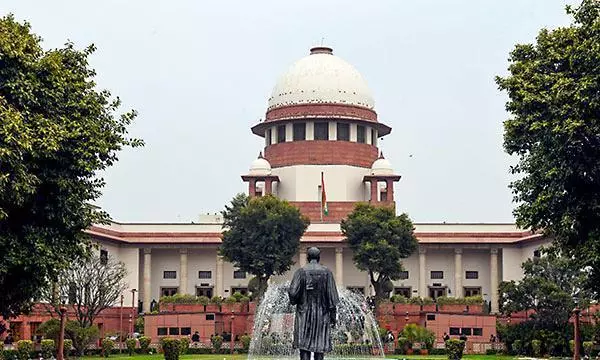
SC stays UGC regulation pertaining to definition of caste discrimination
The new regulations mandating all higher education institutions to form "equity committees" to look into discrimination complaints were notified on Jan 13

The Supreme Court on Thursday (January 29) stayed the University Grants Commission (Promotion of Equity in Higher Education Institutions) Regulations, 2026, stating that the regulations were prima facie "vague" and are "capable of misuse".
The stay order was issued by a bench of Chief Justice of India Surya Kant and Justice Joymalya Bagchi during a hearing of three writ petitions challenging the constitutionality of the 2026 Regulations as being discriminatory towards "general classes".
‘UGC regulations be examined by committee’
The bench stated that Regulations be examined by a committee of eminent jurists. Issuing a notice to the Centre in this regard and the University Grants Commission on the petitions returnable on March 19, the court further stated that till then the regulations are kept in abeyance, adding that meanwhile the 2012 UGC Regulations will continue to be operational.
Also Read: Will UGC rollback cost BJP Uttar Pradesh? Political impact decoded | AI With Sanket
The CJI sought Solicitor General of India Tushar Mehta’s response on the issue. "Mr SG, we would like to have your response. Today we do not want to pass any order...some committee should be there with eminent jurists...have 2-3 persons...who understand social values and the ailments society is facing. How entire society should grow...how people are going to behave outside campus if we create this...they must apply their mind,” stated the CJI as quoted by Live Law.
‘Does the regulation address all kinds of discrimination’
Responding to the submission made by advocate Vishnu Shankar Jain, appearing for one of the petitioners, the CJI asked whether Regulation 3(e) would address all forms of discrimination.
Also Read: Padma Shri for ex-JNU VC Jagadesh Kumar reignites debate over his academic legacy
"When a student of south India, suppose he gets admission in an institution of north India, or vice versa, and some kind of sarcastic insulting or humiliating comments are made against such student, and the caste identity of the victim and the attackers are not known, will this provision (Regulation 3(e)) address the issue," stated the CJI.
CJI on ragging
The CJI also asked whether the UGC regulations address the issue of ragging, adding that most harassments take place over the senior-junior divide.
The CJI also questioned the remedial provision proposed in the guideline in the form of separate hostels for different castes.
"For god's sake, don't do this! We all used to stay together...There are inter-caste marriages also," CJI Kant said.
"One point is Art 15(4) empowers the state to make special laws for SCs, STs...but if 2012 regulations spoke of a more widespread, all-inclusive policy...why should there be a regression in a protective, ameliorative framework? Principle of non-regression also pervades," said Justice Bagchi.