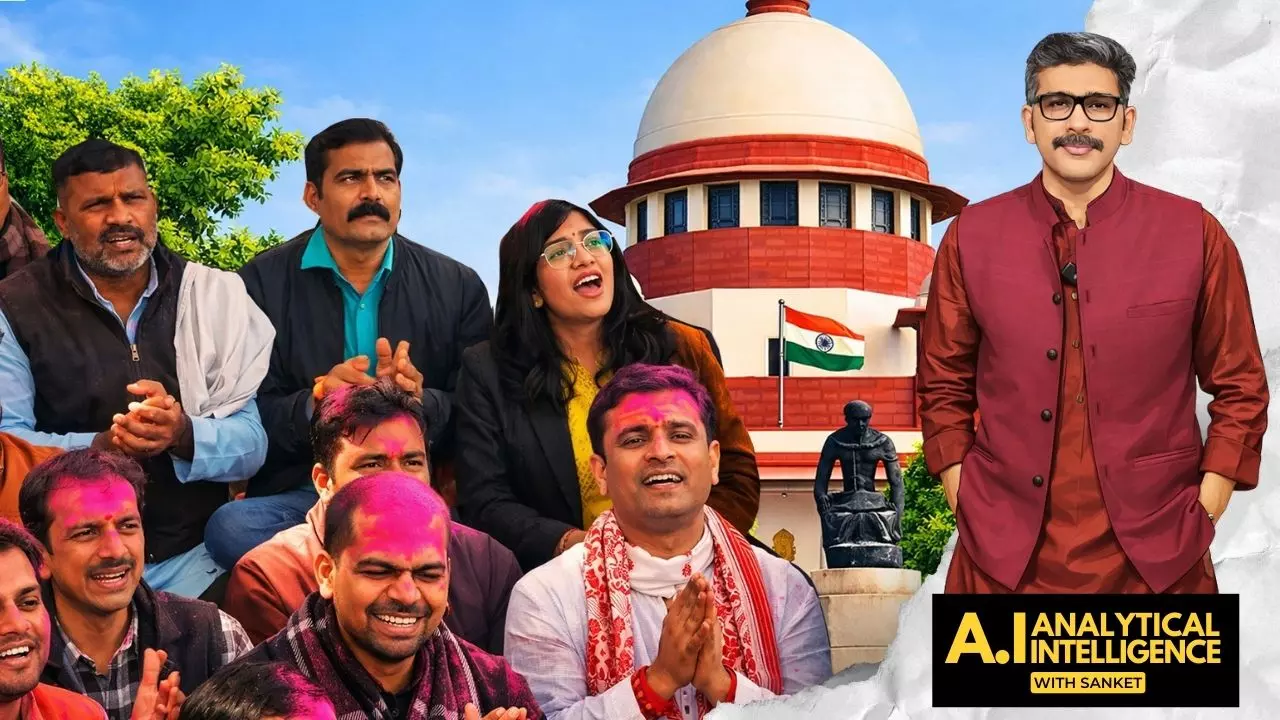
Supreme Court stay on UGC Equity Rule | Justice Vs Injustice decoded| AI with Sanket
As the apex court stays UGC equity rules, flags risks of social division and vague drafting — what the order implies for campuses, students, and the future of anti-discrimination policy

The Federal's Aranya Shankar and senior legal journalist V Venkatesan recently discussed the Supreme Court’s decision to keep the University Grants Commission (UGC) (Promotion of Equity in Higher Education Institutions) Regulations, 2026, in abeyance, after they triggered a national debate on who can access the grievance redressal system in cases of discrimination on campus.
The discussion, anchored by Sanket Upadhyay, located the stay within a longer legal and policy timeline: the older 2012 framework remains in force, while the 2026 regulations — notified on January 13 — have been paused pending further scrutiny and possible redrafting before the next hearing on March 19.
Also read: Why some sections of society are protesting against UGC's equity rules | AI with Sanket
At the centre of the controversy is whether the new drafting could be read as excluding “general category” complainants in a regulation framed to curb discrimination, and whether the court’s intervention is meant to prevent social division while the language is clarified.
What the bench flagged
A bench of Chief Justice of India Surya Kant and Justice Joymalya Bagchi heard a batch of petitions challenging the 2026 regulations, after they sparked protests and competing claims about fairness and inclusion in higher education.
The anchor said the court warned of “dangerous consequences” and the risk of society being divided if the rules were implemented in their present form, adding the bench viewed the drafting as vulnerable to exploitation.
The discussion also focused on the bench questioning why Regulation 3(c) was needed when Regulation 3(e) already carried a broader definition of discrimination.
The core legal dispute
The petitioners’ primary objection, as discussed on the show, was directed at Regulation 3(c) — the clause defining “caste-based discrimination” — which they argued was framed in a way that limited the grievance mechanism to complaints involving SCs, STs and OBCs, allegedly excluding those outside these categories.
Also read: Will UGC rollback cost BJP Uttar Pradesh? Political impact decoded | AI With Sanket
The host framed the challenge in constitutional terms, saying the petitioners relied on Article 14 to argue that selective access to institutional protection amounts to impermissible discrimination by the State.
The show also referenced arguments made in the top court by Advocate Vishnu Jain and Senior Advocate Indira Jaising, including concerns that “discrimination within discrimination” could emerge from the way categories are defined.
Venkatesan’s reading of the text
Venkatesan argued on the show that the claim of exclusion becomes less persuasive when the regulations are read as a whole. He said Regulation 3(e) defines discrimination broadly for “any stakeholder” on grounds, including religion, race, caste, gender, place of birth, and disability — thereby covering complainants outside SC/ST/OBC categories.
He said the separate definition for caste-based discrimination in 3(c) can be understood as a targeted provision responding to historical disadvantage, while 3(e) operates as the wider umbrella clause.
Also read: Gita Gopinath’s pollution warning to India: Will bad air hurt investments? AI With Sanket
The expert also pointed to the duties placed on institutions in the regulations, saying they require higher educational institutions to eradicate discrimination irrespective of whether a person belongs to reserved categories or not, as he read it.
Why 'only' became a flashpoint
A key part of the discussion was the court’s discomfort with drafting language — especially the repeated legal debate around the word “only” in the definition of caste-based discrimination.
Venkatesan said the constitutional phrasing in Article 15(1) — “on grounds only of…” — is typically read alongside “or any of them”, and argued that leaving out “any of them” could create interpretive confusion.
He suggested the bench’s concern may be less about the idea of a separate protection clause and more about whether the phrasing is tight enough to avoid misuse, overbreadth, or misreading.
Campus realities and segregation fears
The host read out court observations about discrimination persisting even after decades, including references to regional hostility and ragging targeting students from the south and the northeast, and warnings against any drift towards segregation in hostels or institutions.
Also read: J&K medical institute shut amid right-wing protest: Being Muslim a crime? AI With Sanket
Shankar said that reactions on campuses are not uniform, but that many who supported the intent of the regulations also believed the drafting needed greater clarity.
She said the debate on whether the regulations should have been stayed — rather than reviewed while remaining operational — has become an immediate point of contention for those who see the regulations as a step towards stronger protections.
Why the 2026 update happened
Venkatesan linked the regulatory push to the absence of a comprehensive anti-discrimination law in India, arguing that guidelines and delegated legislation have been used to fill a policy vacuum.
He referenced the continuing public debate around the need for a broader equality framework and mentioned that calls have been made for an equality commission model to address multiple forms of discrimination through a single, structured grievance mechanism.
Also read: Maran's 'divisive' comment: Why North-bashing may not work electorally
The discussion also referred to the Supreme Court’s earlier engagement with the issue through petitions related to Rohith Vemula and Payal Tadvi, and the argument that previous frameworks were seen as inadequate to address discrimination-linked distress and campus outcomes.
What happens next
The host pressed for clarity on timelines and whether redrafting could get trapped in bureaucratic delay. Venkatesan said the period of abeyance is not indefinite, with the case listed for March 19, and that the respondents can seek vacation of the stay if revised language satisfies the court.
He argued that wording is central to how laws are tested and applied, pointing to how vague drafting can raise concerns about misuse and uncertainty — issues that courts often treat seriously in constitutional review.
The discussion closed with the political reactions beginning to surface, including the anchor referencing statements attributed to Bharatiya Janata Party MP Nishikant Dubey, and raising questions about whether unclear drafting can become a tool for blame-shifting between institutions.
The content above has been transcribed from video using a fine-tuned AI model. To ensure accuracy, quality, and editorial integrity, we employ a Human-In-The-Loop (HITL) process. While AI assists in creating the initial draft, our experienced editorial team carefully reviews, edits, and refines the content before publication. At The Federal, we combine the efficiency of AI with the expertise of human editors to deliver reliable and insightful journalism.