








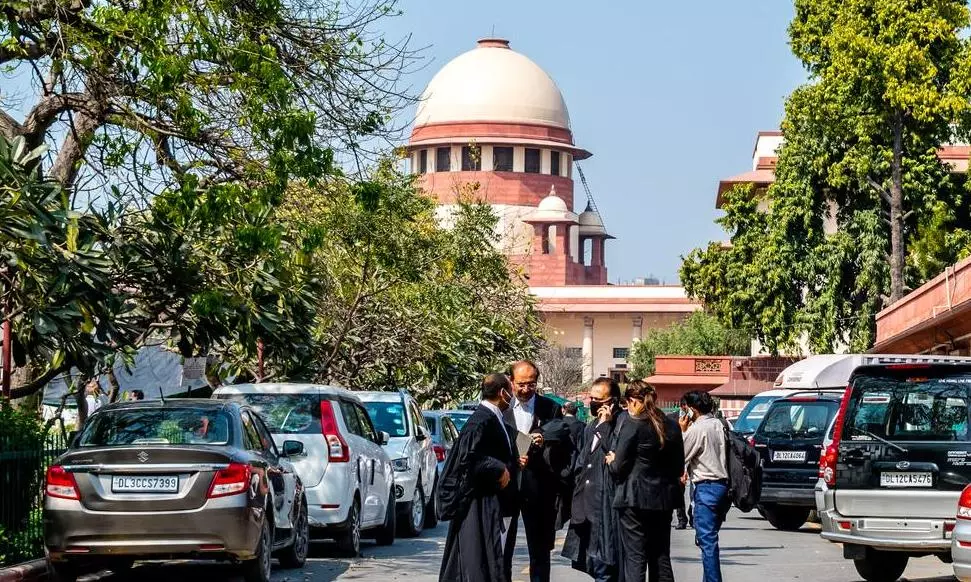
SC orders virtual hearings, work from home amid fuel conservation measures
The Supreme Court has mandated virtual hearings, judge car-pooling, and partial work-from-home for staff following the Centre’s fuel conservation advisory

The Supreme Court on Friday (May 15) rolled out a set of immediate administrative measures, including mandatory virtual hearings in specified categories of matters, car-pooling arrangements among judges, and limited work-from-home provisions for Registry staff, in response to the Centre’s advisory on fuel conservation.
In a circular dated May 15, Supreme Court Secretary General Bharat Parashar stated that the directions were being implemented pursuant to an Office Memorandum issued on May 12 by the Department of Personnel and Training, following the fuel supply concerns arising out of the ongoing US-Iran conflict.
Virtual hearings mandated
Under the revised arrangement, all matters listed on miscellaneous days, including Mondays and Fridays, along with cases scheduled during the Court’s partial working days, will be taken up exclusively through video-conferencing until further orders.
The circular directed the Registry to ensure timely circulation of video-conferencing links, uninterrupted connectivity during proceedings, and immediate technical assistance so that judicial functioning is not affected.
Also Read: Work from home again? Modi’s fuel-saving appeal draws smiles and frowns
“Matters listed on miscellaneous days (i.e. on Mondays, Fridays, or such other days as declared to be miscellaneous), and matters listed during the Court's partial working days, shall be heard by video-conferencing only,” stated the circular.
“The Registry shall ensure that links for the video-conferencing are sent in a timely manner, maintain stable video-conferencing facilities and extend timely technical assistance so as to avoid any inconvenience to the Hon'ble Court,” it added.
Judges opt for car-pooling
The circular further noted that Supreme Court judges have "unanimously resolved" to encourage car-pooling arrangements among themselves as part of the conservation measures.
Also Read: Why Infosys asked employees to track power consumption at home while working
“To ensure optimum utilization of fuel, the Hon'ble Judges of the Supreme Court have unanimously resolved to encourage car-pooling arrangements amongst themselves,” stated the circular.
Registry staff work-from-home
In addition, the Court has permitted up to 50 per cent of employees in each branch or section of the Registry to work remotely for not more than two days in a week.
At the same time, the circular made it clear that adequate staff strength must remain physically present in office to ensure that day-to-day functioning is not disrupted. Registrars have been instructed to prepare weekly duty rosters in advance.
Also Read: Why PM Modi urged Indians to avoid buying gold; experts decode
Employees availing the remote working arrangement have also been directed to remain accessible over telephone and to report to office at short notice whenever required.
“Till further orders, up to 50% of staff in each branch/section of the Registry are permitted to work from home for up to two days per week, provided that the remaining staff remain available in the office to ensure uninterrupted functioning,” stated the circular.
Administrative discretion retained
Officers in charge have been asked to ensure timely completion of all assigned work.
The circular also gives Registry officials the authority to curtail or suitably modify the work-from-home arrangement in branches where the nature of duties makes such an arrangement impractical.