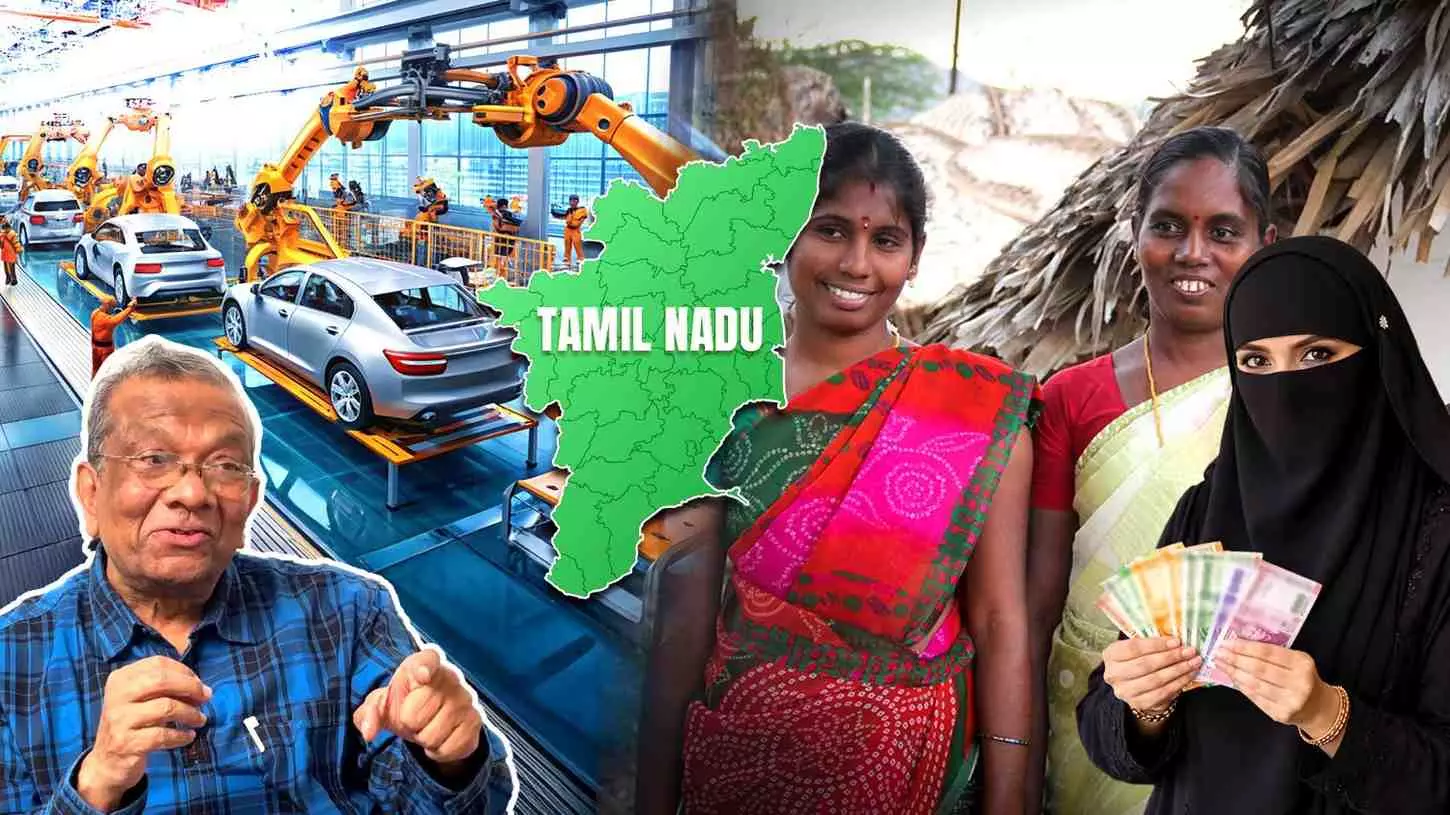
Tamil Nadu's boom is built to last, says economist
Prabhakar Krishnamurthy unpacks the state's 11.2 pc economic growth, welfare spending debate and what it will take to reach a $1-trillion economy by 2031

Tamil Nadu is growing faster than almost anyone expected. With real GDP expanding at 11.2 per cent and the state government setting its sights on a $1-trillion economy by 2031, the numbers are hard to ignore — but so are the questions they raise. Is the growth sustainable? Are welfare schemes creating dependency or opportunity? And who is actually benefiting?
To make sense of it all, The Federal spoke to Prabhakar Krishnamurthy, an economist and Oxford University scholar, on the findings of the state's latest economic survey and what the budget outlook reveals about Tamil Nadu's ambitions — and its blind spots.
Edited excerpts:
Tamil Nadu has recorded double-digit growth in 2024-25 and aims to become a $1-trillion economy by 2031. What factors drove this performance and how sustainable is it?
To find this, the general public can use the exponential growth formula. If you divide 70 by 11%, it comes to roughly six years. Therefore, by continuously growing at this rate, within six years, you can achieve a $1-trillion economy.
This is not a political gimmick. Nominal GDP growth is around 16%, while real growth is 11.2%. Nominal growth refers to rupee value growth.
Yes, it is sustainable because many organisations prefer Tamil Nadu for setting up factories. One major reason is power. Around 55.5% of electricity is generated through renewable sources such as wind and solar. This energy mix attracts companies.
Pollution levels are lower compared to North India, where nearly 75% of power comes from coal. Coal is dirty energy, and many countries are moving away from it. Pollution sometimes crosses extremely high levels there, whereas Tamil Nadu benefits from renewable energy and its coastline.
If a European automobile company manufactures using coal-based power, it has to pay carbon tax. With renewable energy, that cost reduces. Hence, renewable power improves growth prospects.
Electric vehicle penetration in Tamil Nadu is already around 16%. Within three years, it may reach 50–60%. Pollution levels will reduce further. (American economist) Gita Gopinath has emphasised that pollution control must be prioritised.
Industrial expansion, including investments by Hyundai Motor Company, will create employment and support sustainability. But these outcomes depend on strong social infrastructure.
What do you mean by social infrastructure, especially in the context of welfare spending and cash transfers?
Social infrastructure includes direct expenditure such as cash transfers. For example, ₹5,000 support for women through direct benefit transfer schemes. Some argue that cash transfers make people lazy. This argument was made by Jagdish Bhagwati through what is called the laziness hypothesis.
If people become lazy, growth will fall. But growth has increased from 0.04% during the COVID period to 11.2% now. That shows people are not becoming lazy; they are getting more opportunities.
My research shows that women’s labour force participation increased by 4% within one-and-a-half years. Free transportation improved mobility and safety, enabling women to access employment.
Tamil Nadu’s per capita income is significantly higher than the national average. What does this indicate about income distribution and productivity?
Tamil Nadu’s per capita income is 1.77 times the national average and has reached around ₹4.71 lakh. When the population is divided into income segments, the top 20% naturally earn more. But Tamil Nadu addresses inequality through social investment, such as paying students to pursue education.
The state provides ₹1,000 incentives for boys and girls to continue their education. This has raised enrolment to around 47%, which improves employment potential.
My study shows more people are gradually entering higher income categories because they use these subsidies for education and employment. For example, in one particular area, there are around 6,000 graduates today, whereas 25 years ago there were very few. Many are now employed in good organisations.
In Tamil Nadu, upward mobility from the lowest to the highest income level can happen within 30 years. In states like Uttar Pradesh and Bihar, it may take much longer. Social investment is also improving health indicators such as maternal and child mortality.
What are the major health and demographic trends affecting the workforce?
Now, the major issue is non-communicable diseases like diabetes. The government is spending around ₹20,000 crore to address such diseases. Life expectancy in Tamil Nadu is around 73.5 years, among the highest in India. People remain active and continue working even after 60.
Manufacturing contributes significantly to Tamil Nadu’s growth. Does this indicate low unemployment compared to other states?
Across India, manufacturing has been shrinking, but in Tamil Nadu, it contributes about 33% to GDP. Around 15% of India’s manufacturing workforce is located here.
Dependence on agriculture has reduced to about 12%. Moving labour from agriculture to manufacturing increases productivity because agriculture yields only 4–6% income and depends heavily on weather.
Mechanisation also becomes easier when labour shifts away from agriculture. However, employment challenges remain. For every three educated persons, only one gets employment. Sometimes you even see professionals working in gig sectors. This paradox must be addressed through new industrial clusters and special economic zones.
Electronics manufacturing is expanding rapidly. One in five iPhones produced in India comes from Tamil Nadu. Women are playing a key role because electronics work requires precision. But education quality must improve through design labs and skill-based training.
Despite strong growth, what structural challenges must Tamil Nadu address?
Industrialisation is spreading across all 38 districts, which is a positive sign. Unlike concentration in cities such as Bengaluru, Tamil Nadu’s growth is geographically diffused.
The chief of Zoho Corporation is building technology initiatives in rural areas using local youth. This helps avoid the middle-income trap. However, only around 44% of women are in formal employment. Work-life balance is crucial. Creches must be made compulsory in workplaces. Maternity leave has been extended to 12 months, which is a positive step.
Primary education also needs improvement because high fees in private schools are a concern. Tamil Nadu spends nearly ₹50,000 crore on school education, which is significantly higher than the national levels.
Healthcare access and patient-friendly systems must also improve.
Tamil Nadu has attracted strong FDI despite global volatility. What explains this trend?
Investors prefer low pollution, stable law and order, and ease of doing business. The rule of law is critical for investment. Tax systems also need simplification to help industries operate smoothly.
There is strong interest from foreign investors, including companies from Vietnam, looking to set up electric vehicle manufacturing.
How does Tamil Nadu compare with northern states like Uttar Pradesh in terms of growth models?
Uttar Pradesh has improved but still has higher multidimensional poverty at around 20%, whereas Tamil Nadu’s is about 1.34%.
Rapid industrialisation requires social harmony and strong law and order. Tamil Nadu’s manufacturing ecosystem—especially automobiles and electronics—provides a model.
Some states receive higher central funds, but long-term sustainability depends on social equality and industrial depth.
The content above has been transcribed from video using a fine-tuned AI model. To ensure accuracy, quality, and editorial integrity, we employ a Human-In-The-Loop (HITL) process. While AI assists in creating the initial draft, our experienced editorial team carefully reviews, edits, and refines the content before publication. At The Federal, we combine the efficiency of AI with the expertise of human editors to deliver reliable and insightful journalism.