Poll strategist explains the 8 pc 'anti-incumbency’ threat for DMK | Interview
Exit polls most predict an edge for DMK-led alliance. A political strategist breaks down why exit polls may be missing ground realities - are we heading for a surprise?

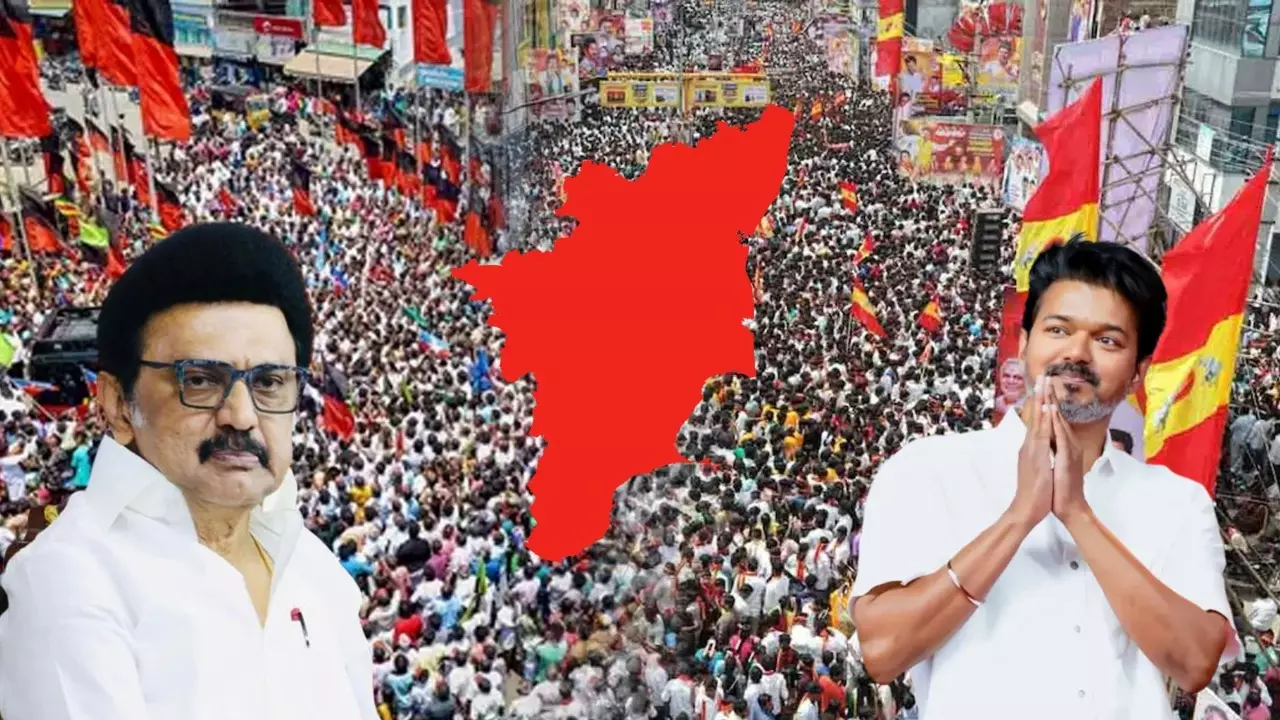
Exit polls for the 2026 Tamil Nadu Assembly elections largely favour the DMK-led alliance, but election strategist M Stalin argues that a consistent anti-incumbency trend — averaging an 8 per cent vote drop for ruling parties — could reshape outcomes.
He also questions whether surveys have fully captured shifting voter behaviour, especially with new entrants like TVK. The Federal spoke to strategist M Stalin about exit polls, vote swings, party strategies, and why predictions often go wrong.
What is your initial reading of the exit polls for the 2026 Tamil Nadu Assembly elections?
I have gone through all the exit poll results, and most of them favour the current government, the DMK alliance. But we need to look at historical patterns. Whenever DMK has faced elections as an incumbent — whether from 1996 to 2001 or 2006 to 2011 — they have seen a reduction in vote share, almost 10 per cent in some cases. On average, there is an 8 per cent reduction from their previous performance.
Also read: Exit polls predict BJP win in Assam, edge in Bengal; DMK to return in TN, UDF to take Kerala
This is something we must take seriously. That 8 per cent does not remain static — it becomes swing votes and goes to whichever party is likely to win. So we cannot call it “DMK votes”; it is essentially anti-incumbency votes.
Where do these anti-incumbency votes go, especially with new players like TVK entering the fray?
Historically, these votes have gone to the AIADMK. But when a new factor enters — like Vijay’s TVK — a portion of this anti-incumbency vote gets diverted.
So the votes TVK gets are not purely its own. They are drawn from anti-incumbency sentiments that would otherwise have gone to the AIADMK or DMK. Since 1996, we have seen new entrants like MDMK and PMK. Typically, they capture around 8–12 per ent of the votes. Vijay could potentially cross that, given his popularity.
However, I feel exit polls have not fully accounted for parties like NTK, which had around 8 per cent vote share in 2024. These votes are ideological — rooted in Tamil identity and Seeman’s appeal — and may not automatically shift to TVK.
What are the prospects for TVK in this election, based on your ground surveys?
The perception around TVK has evolved in phases. When Vijay first announced his party, expectations were very high. After his initial campaign events and subsequent developments, including the Karur incident, the perception shifted.
When AIADMK became more active on the ground, it was felt that TVK’s vote share might reduce. Earlier, there was talk of Vijay sweeping the elections, but after the manifesto, some early supporters took a step back. His stance on subsidies and freebies became a major talking point.
But after voting, ground feedback was surprising. It is not just youth voting for him — people across demographics are supporting him. Even in rural areas, women aged 45 to 60 showed strong alignment with Vijay, influenced by his film persona.
Also read: Rise of a third force and what it means for TN’s political future|Exit polls 2026
So the idea that TVK’s impact is limited to urban areas is not accurate. And if that assumption is wrong, then the logic that DMK dominates urban pockets while AIADMK suffers due to TVK also becomes questionable.
Many surveys suggest AIADMK will see an increase in vote share. What factors are driving this?
AIADMK had a strong manifesto this time. They released it early and with confidence. It combined populist schemes with policy-level promises.
For example, the announcement of a free bus travel for men created a strong buzz on the ground. During campaigns, many men spoke about it positively. While public transport benefits women more in scale, this announcement resonated emotionally with male voters.
Also, AIADMK managed to consolidate its alliances quickly and effectively. While DMK has historically maintained a strong alliance structure, AIADMK’s ability to mobilise its base and communicate its promises gave it an edge in vote share perception.
Do manifesto promises really influence voter behaviour?
Yes, definitely. Manifestos play a guiding role. For instance, DMK’s earlier announcement of financial assistance for women eventually translated into policy action.
Manifestos create direction and expectations. Even if not fully implemented, they shape voter perception and trust. This time, AIADMK’s manifesto clearly had an impact on the ground.
Also read: Vijay's political gamble: Big crowds, bigger questions
You’ve worked with multiple political leaders. Have you observed changes in campaign styles, especially targeting younger voters?
Yes, but this is not entirely new. Politicians have always adapted to the times. What has changed is the scale and visibility due to social media and internet penetration. Leaders today are more conscious about how they present themselves — the language they use, the platforms they choose. The so-called “Gen Z approach” is about meeting voters where they are.
From my experience, one common trait among leaders is discipline and willingness to listen. Despite demanding schedules, they remain highly committed. The idea that politicians lack discipline is completely wrong. As strategists, we help them adapt to trends — how to communicate, how to present themselves — because reaching people is as important as the message itself.
How have alliance dynamics influenced the electoral landscape?
Alliances play a critical role. BJP has been actively building its cadre in Tamil Nadu, even contesting independently in 2024 to test its strength.
On the other hand, Congress largely depends on DMK’s organisational strength. It has not independently tested its ground presence in recent years.
The perception of BJP as anti-Tamil has existed, but it has reduced over time as people engage more with facts and narratives. BJP has also leveraged the “double engine government” narrative during campaigns. Overall, BJP appears to be investing more in building its base, while Congress relies on its alliance partner.
Why do exit polls and surveys often go wrong?
Voters today are far more aware than before. Social media has changed how information is consumed and understood.
When surveyors approach voters, many do not give honest answers. Some respond sarcastically, some deliberately mislead, and others simply refuse to reveal their choice. There is also a perception that their responses may be used to shape media narratives.
People are now aware of how narratives are constructed. Earlier, political parties relied on traditional media channels. Today, leaders like Vijay and Seeman have bypassed that through social media, building organic engagement.
This shift makes it harder for surveys to capture the real mood. That is why we saw significant deviations even in 2024 exit polls.
The content above has been transcribed from video using a fine-tuned AI model. To ensure accuracy, quality, and editorial integrity, we employ a Human-In-The-Loop (HITL) process. While AI assists in creating the initial draft, our experienced editorial team carefully reviews, edits, and refines the content before publication. At The Federal, we combine the efficiency of AI with the expertise of human editors to deliver reliable and insightful journalism.