Budget 2026 for Tamil Nadu
Budget 2026 puts Tamil Nadu in spotlight with rare earth and rail push
From rare earth corridors to high-speed rail and eco-tourism trails, Budget 2026 lays out multiple promises for poll-bound Tamil Nadu. Will they deliver real gains?

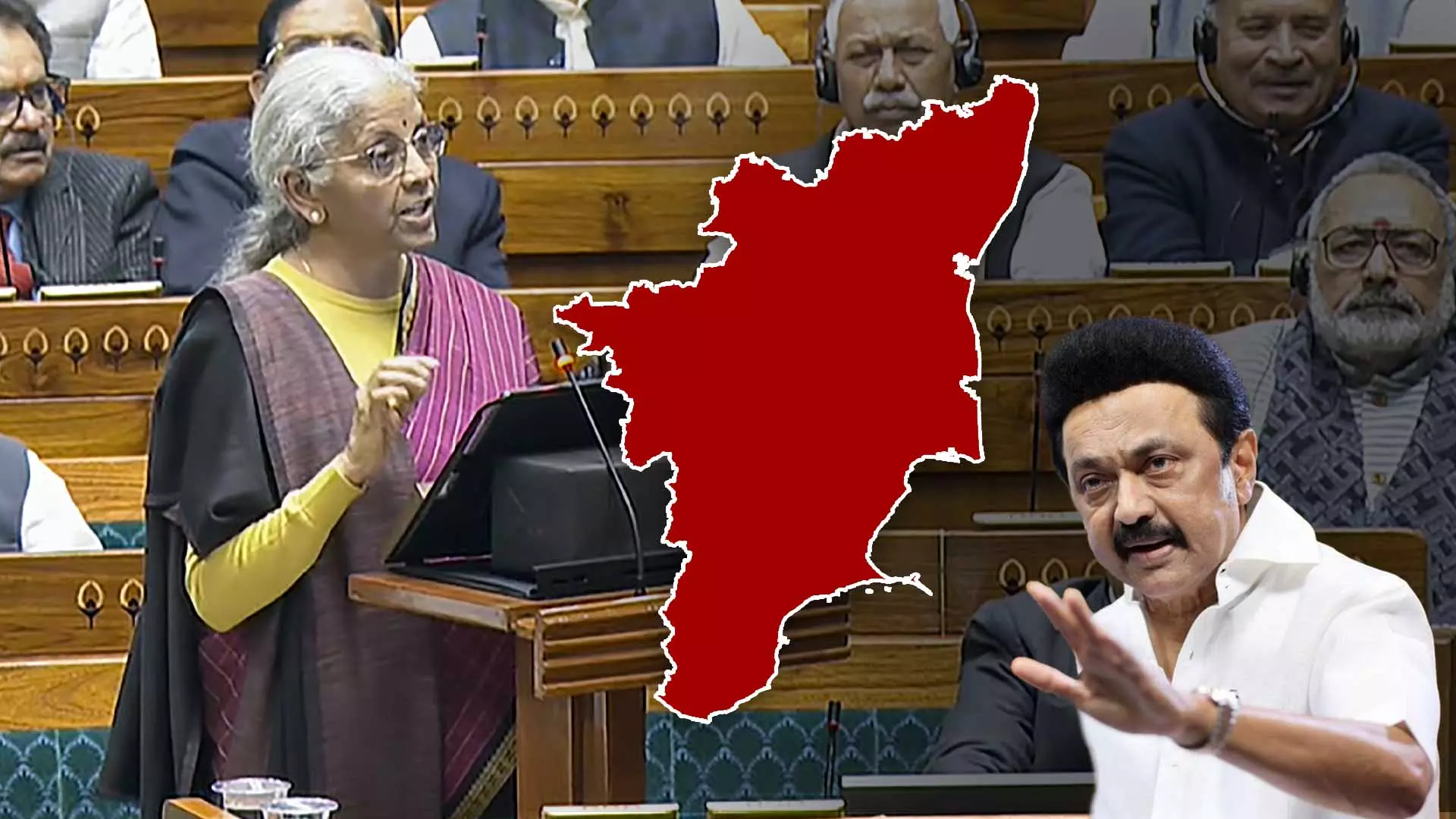
Tamil Nadu, heading into Assembly elections, has emerged as one of the key states highlighted in Union Budget 2026, presented by Finance Minister Nirmala Sitharaman. A Tamilian herself, Sitharaman announced a series of proposals that could have economic and political implications for the state, even as the ruling DMK and opposition parties watch closely.
Among the major announcements is the creation of a dedicated rare earth mineral corridor, with Tamil Nadu named as one of four mineral-rich states to benefit. The proposal aims to strengthen India’s domestic capacity in critical minerals that are increasingly central to global supply chains.
The budget also places emphasis on infrastructure, tourism, and agriculture, with Tamil Nadu featuring in multiple national-level initiatives. While some of the state government’s pre-budget demands found mention, others were left out, raising questions about implementation and follow-through.
Rare earth push
One of the most significant proposals for Tamil Nadu is the establishment of a rare earth mineral corridor covering the entire value chain. According to the budget announcement, the corridor will focus on mining, processing, research, and manufacturing of permanent magnets.
Sitharaman has announced support for these states to establish corridors focused on the full value chain. This starts from mining and processing and goes up to R&D and manufacturing.
Rare earth minerals and permanent magnets are in high global demand, with applications in clean energy, electronics, defence, and electric vehicles. India currently depends heavily on imports, particularly from China. The proposed corridor is expected to reduce this dependency and strengthen domestic manufacturing.
Tamil Nadu’s inclusion is linked to its coastal mineral deposits and strong industrial base. The corridor could potentially generate employment and attract investment in high-technology manufacturing sectors within the state.
Rail corridors
Infrastructure development is another area where Tamil Nadu features prominently. The budget proposes seven high-speed rail corridors connecting major cities across India. While specific details are yet to be announced, Chennai has been identified as a hub for two routes — Chennai–Bengaluru and Chennai–Hyderabad.
These corridors are expected to offer faster connectivity, reduced travel time, improved logistics, and a boost for exports. If implemented as proposed, they could strengthen Tamil Nadu’s position as a major industrial and logistics hub in southern India.
The emphasis on rail connectivity aligns with broader national goals of enhancing inter-city mobility and supporting trade through improved transport infrastructure.
Tourism and agriculture
The budget also outlines sector-specific schemes that include Tamil Nadu. A scheme to promote coconut cultivation has been announced for Tamil Nadu and other coastal states, aimed at replacing non-productive trees with high-yielding saplings to improve farm productivity and farmer incomes.
In tourism, Sitharaman announced plans to develop ecologically sensitive trekking and hiking trails in select regions. These include Pothigai Malai in Tamil Nadu, along with locations in Himachal Pradesh, Uttarakhand, Jammu and Kashmir, Andhra Pradesh’s Araku Valley, and others.
Tamil Nadu will also be part of coastal turtle trails, alongside Odisha, Karnataka, and Kerala, focusing on nesting sites. In addition, Pulicat Lake, located on the Tamil Nadu–Andhra Pradesh border, has been identified for the development of bird-watching trails.
Political questions
Ahead of the budget, Tamil Nadu Chief Minister MK Stalin had outlined a list of expectations, including increased funding for metro rail projects in Coimbatore and Madurai, railway expansion, higher education allocations, and support under the Jal Jeevan Mission.
While some of these demands found mention in the budget speech, others did not. Even where proposals were announced, questions remain over timelines, funding commitments, and actual execution on the ground.
As Tamil Nadu moves closer to Assembly elections, the political and economic impact of Union Budget 2026 will be closely scrutinised. Will these announcements translate into tangible benefits for the state, or remain headline promises?
The content above has been transcribed from video using a fine-tuned AI model. To ensure accuracy, quality, and editorial integrity, we employ a Human-In-The-Loop (HITL) process. While AI assists in creating the initial draft, our experienced editorial team carefully reviews, edits, and refines the content before publication. At The Federal, we combine the efficiency of AI with the expertise of human editors to deliver reliable and insightful journalism.