








A techie, a space scientist, an ex-IB chief: 6 experts in Modi’s exam reforms task force
PM Modi says task force led by Infosys co-founder Nandan Nilekani will ensure the exam system is trustworthy, transparent, and that technology is used optimally

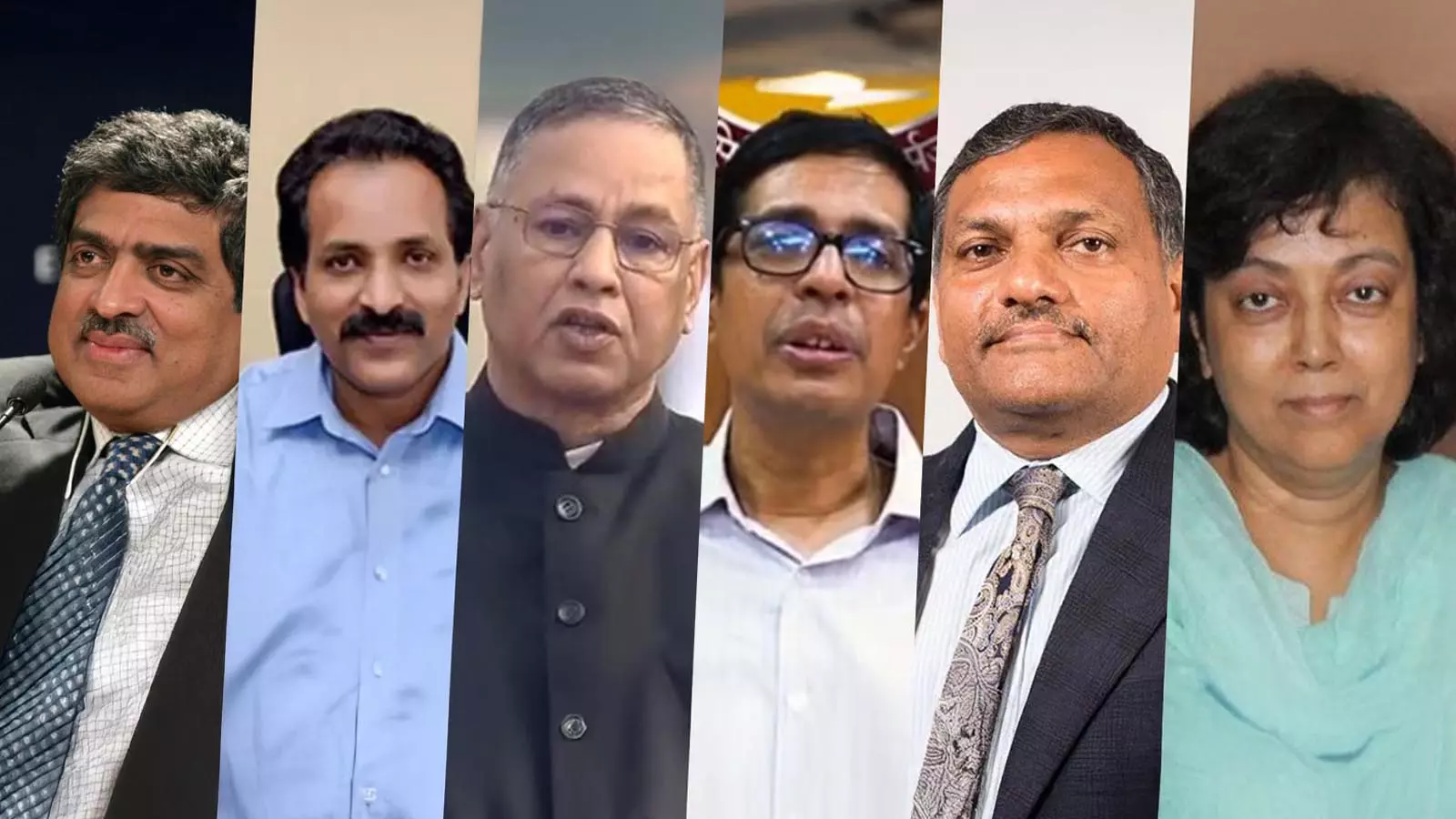
A techie, a space scientist, an intelligence officer, an IITian, a bureaucrat, and a logistics expert. A team of six sharp minds, bringing experience and expertise from varied fields, is part of the government’s high-powered task force, formed to recommend reforms to ensure a leak-proof examination system.
As part of his government’s damage control measures to placate thousands of students protesting across the country against the paper leaks in various entrance examinations, Prime Minister Narendra Modi on Sunday (July 26) announced the task force headed by Infosys co-founder Nandan Nilekani.
‘Task force to make optimal use of technology’
The task force has been entrusted to revive the exam system through the maximum use of technology and ensure examinations conducted by the National Testing Agency (NTA) are trustworthy and transparent.
Announcing the task force, Modi said those "who played with the future of the students" have been put in jails, and the government is going to bring a new bill on Monday in Parliament to have a strong law against examination paper leaks.
"But we will have to think about the future. To make sure our examination system is trustworthy, transparent and the technology is used optimally, we have decided to constitute a high-powered committee headed by world-renowned technology expert Nandan Nilekani," he added.
Also read: Why Karnataka is pushing to replace NEET with its own CET
The prime minister said the task force has been set up keeping all these aspects in mind.
"It will focus on examination reforms. As soon as we get the report, we will implement its suggestions to ensure future examination trustworthy," he said.
What members bring to the table?
Besides Nilekani, other members of the task force are former chairman of ISRO S Somanath, former director of the Intelligence Bureau, Tapan Deka, director of IIT Chennai, V Kamakoti, former education secretary Anita Karwal, and former bureaucrat and logistics expert Amrit Lal Meena.
Nandan Nilekani, Infosys co-founder, Aadhaar architect
Nilekani, the former chairman of Unique Identification Authority of India, is well-known as the architect of Aadhaar and is the person behind India’s digital public infrastructure ecosystem. He is currently a non-executive chairman of Infosys.
An ex-IITian, Nilekani brings his technical expertise to the task force and may be able to develop an end-to-end encrypted platform for the examination system and lead the digital transformation of the examination system.
S Somnath, former ISRO chairman
An aerospace engineer, S Somnath who has over three decades of experience in the discipline, has helmed India’s ambitious space programmes including the Chandrayaan-3 lunar mission.
Also read: ‘CJP protests may have ended, but youth movement is far from over’ | Interview
He brings experience in managing highly complex and zero-failure systems and may focus on operational excellence of the exam system. He can help in designing fool-proof logistics and multi-layered checks to ensure that the entire system doesn’t crumble if one system (like a paper leak) goes wrong.
Tapan Deka, former IB chief
An IPS officer of the Himachal Pradesh cadre, Deka, who hails from Assam, was the director of Intelligence Bureau from June 2022 to June 2026.
In his career, he has played a key role in counter terrorism operations in Jammu and Kashmir and the Northeast, and mostly importantly in the 26/11 Mumbai attacks.
With his expertise concentrated in national security and intelligence, Deka can help bolster the security framework of the exam system to protect it from leaks, hacking and threats on the inside.
V Kamakoti, IIT-M director
A computer scientist, Kamakoti has been serving as the director of IIT Madras since January 2022. He heads the Centre-funded Microprocessor Development Program and the Information Security Education and Awareness Program at IIT Madras. He is also a member of the National Security Advisory Board.
He would represent the academic and research community on the task force.
Also read: Abhijeet Dipke, Saurav Das, Ashutosh Ranka: Who are these ‘cockroaches’ who took on govt?
With his expertise in computer science, Kamakoti can recommend ways to protect software and server infrastructure from cyberattacks while also lending AI and machine learning applications for exam setting, evaluations, and anomaly detections in results.
Anita Karwal, former education secretary
A pass out of Delhi’s Lady Shri Ram College, the 1988 Gujarat-cadre IAS officer brings her experience in school education to the task force.
In a career spanning over 36 years, she has served as the chairperson of CBSE (2017-2021) and later as secretary of Department of School Education and Literacy. In her latter stint, she was instrumental in the formulation of the National Education Policy (NEP) 2020 and the National Curriculum Framework.
Her experience in school and higher education governance can help the task force envisage structural and policy reforms including in the NTA itself.
Amrit Lal Meena, logistics and public administration expert
Meena, who retired as the chief secretary of Bihar, is an expert in supply chain and logistics.
A 1989-batch IAS officer of the Bihar cadre, Meena, in his 36-year-long career, also worked in the Ministry of Commerce and Industry as Special Secretary, Logistics.
Also read: The unmaking of Brand Modi: How ‘56-inch chested’ PM bowed to youth power
He can provide perspectives to identify and plug security and distribution chain vulnerabilities and ensure safe and tamper-proof movement of question paper, from the printing press to the examination halls.
Centre to introduce Bill
Modi said that for the future of students, the government of India has been continuously taking different steps.
The Centre is scheduled to introduce a bill in the Lok Sabha on Monday to strengthen the anti-paper leak law. The Public Examinations (Prevention of Unfair Means) Amendment Bill, 2026, proposes setting up fast-track courts in every state for paper leak cases and completion of investigations within two months.
It also has provisions for enhanced punishment, including imprisonment of up to 10 years and fines of up to Rs 50 lakh for individuals involved in paper leaks. Organised crimes related to paper leaks could attract fines of up to Rs 10 crore.