








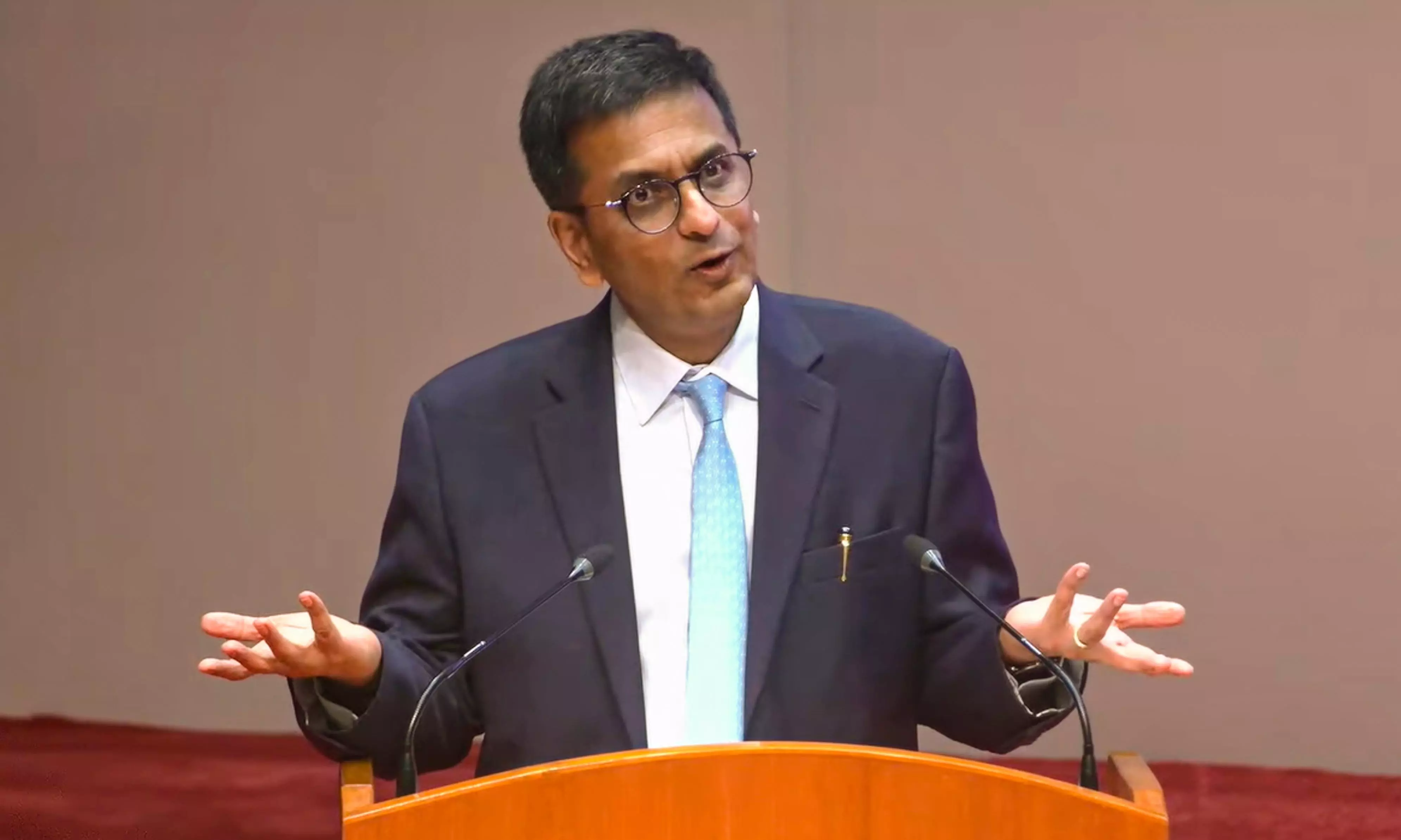
Umar Khalid case: Denial of bail can't be punishment, says ex-CJI Chandrachud
Commenting on Umar Khalid’s case, ex-CJI DY Chandrachud says bail must be the rule and presumption of innocence upheld

Former Chief Justice of India (CJI) DY Chandrachud has said that granting bail should be the rule unless it proves to be impossible following a rigorous trial, while commenting on the repeated denial of bail to activist Umar Khalid, who has been in jail since September 2023.
Elaborating further, the former CJI further stated that the large number of laws in the country, particularly those relating to national security, have substituted the presumption of innocence until proven guilty with almost a presumption of guilt, adding that partial detention cannot become a form of punishment.
‘Partial detention can’t be punishment’
“Bail, before the Constitution, should be a matter of right. Our law is founded on one presumption that every accused is innocent until they are proven guilty at a trial. Pretrial detention cannot be a form of punishment. If someone is jailed for five to seven years before trial and then is acquitted finally, how would you compensate for that lost time?” said Chandrachud.
Also Read: 'Jail is my life now': Umar Khalid after Supreme Court denies bail
“The bail is denied when the accused may repeat the offence, tamper with the evidence, or flee. If these three exceptions are not made out, bail has to be the rule. Now the problem which we are facing today is this, a lot of our laws, particularly those relating to national security, have turned the law on its head by substituting the presumption of innocence with almost a presumption of guilt,” he added as quoted by the Hindustan Times. The former CJI made the remarks on Sunday (January 19) at the 19th Jaipur Literature Festival.
‘Article 21 includes right to speedy trial’
The former CJI argued that one of the “serious problems” with the criminal justice system in India is the prosecution’s inability to complete trials within a reasonable time, adding that Article 21 of the Constitution includes the right to speedy trial.
Also Read: 2020 Delhi riots: Why SC denied bail to Umar Khalid, Sharjeel Imam
“Now, one of the serious problems of the criminal justice administration in India is the inability of our prosecutions to conclude trials within a reasonable period of time. If that is so, you have one fundamental right, which is the right to life. Article 21 includes the right to a speedy trial,” said the former CJI.
“I am very clear in my mind that unless the well-settled exceptions are made out in a particular case, the accused is entitled to bail. I’m not criticising my court. You must necessarily take into consideration that they have the right to an expeditious trial, and if an expeditious trial is not possible under present conditions, then bail should be the rule, not an exception,” he added.
‘Public distrust of the system’
Chandrachud further stated that during his tenure as the CJI, courts disposed of over 24,000 bail pleas, adding that a “public distrust” of the system, which instils fear among judges, particularly in lower courts, of scrutiny and then deters them from granting bail even in simple cases and encourages referrals to higher courts instead.
Also Read: ‘We are all thinking of you’: NYC Mayor Zohran Mamdani writes to Umar Khalid
“The net result is that the Supreme Court now handles 70,000 cases per year. No Supreme Court—except perhaps Brazil’s-deals with such volume. But how do we answer this general culture of distrust for public authority? That’s the problem. I don’t have an answer for it, but that’s the reason why there is a general reluctance,” said Chandrachud.
On collegium system
The former CJI also defended the collegium system, stating that most of the criticism against it was misplaced.
“Most of the criticism regarding the collegium system is misplaced. The process of appointing judges takes place at different levels. It is vetted in the High Courts. After the recommendations are vetted in the High Court, they are considered by the state governments. State governments are not necessarily the governments that are in power in the centre; the file is then vetted by the Intelligence Bureau for a character check,” he said.
The government of India comes back with its inputs, and finally, the file goes to the Supreme Court of India. I think the answer to your question at present is greater transparency,” he added.