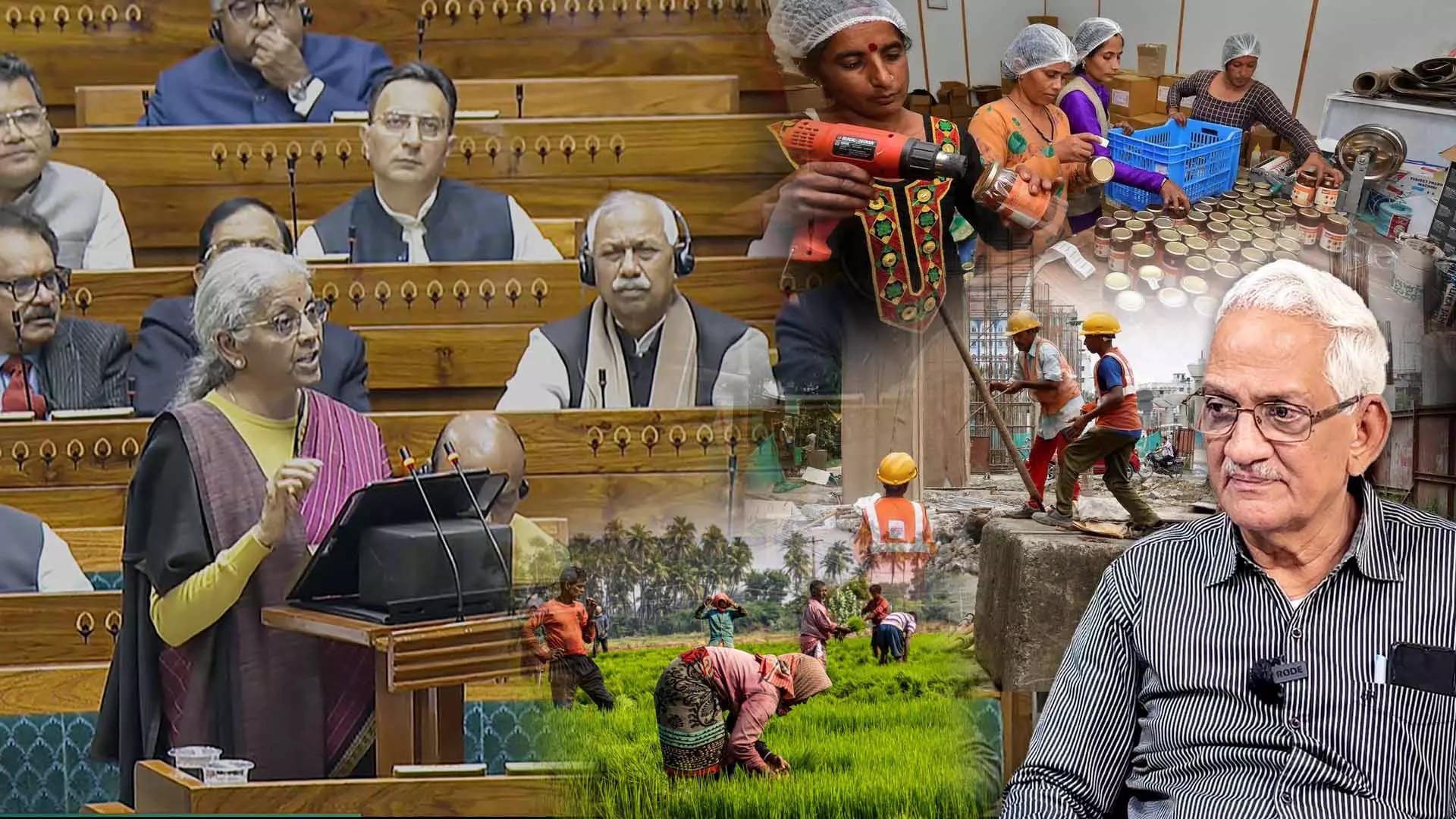
Budget 2026 falls short on jobs, skilling won’t fix unemployment | Interview
Economist Venkatesh Atreya says Budget 2026 ignores structural unemployment, rural distress, and fiscal federalism, relying instead on skilling and centralised control

“Skilling programmes are not an answer to unemployment,” says economist Venkatesh Atreya, arguing that Union Budget 2026 fails to address structural joblessness, rural distress, and the erosion of fiscal federalism. He warns that conditional transfers, shrinking real expenditure, and neglect of agriculture and employment schemes could deepen inequality. The Federal spoke to Atreya to unpack what Budget 2026 really means for jobs, farmers, states, and ordinary citizens beyond headline announcements.
I don’t think this budget clearly shows where jobs will come from, how rural poverty will be addressed, or how youth empowerment will actually happen. Skilling has been talked about repeatedly over the last few budgets, but skilling is not a substitute for employment. Under the most favourable circumstances, skilling may increase the probability of getting a job, but by itself it does not create jobs. Unemployment in India is structural and widespread, particularly in rural areas.
Skilling programmes are being projected as a solution, but that is misleading. These programmes may work for those who already have some education and need a specific additional skill, but what about the vast young population that has no employment opportunities at all? Official figures don’t capture the real extent of joblessness. Corporates already exploit this system by hiring engineering graduates as apprentices, paying them a pittance for two years, and then letting them go. Parents sell land to educate their children, only for them to be discarded later. Calling this employment generation is simply not correct.
If the government is serious about employment, it must create a strong demand stimulus. It must put purchasing power in the hands of the people and improve demand for goods and services. Temporary measures like lowering GST rates near festive seasons help only a small section of society. They do not address the broader problem of inadequate demand across the economy.
In absolute numbers, transfers may increase, but that is misleading. If you look at what states are constitutionally entitled to versus what they actually receive, the picture is very different. For example, the budgeted estimate of tax revenue transfer to states was around ₹14.22 lakh crore, but the revised estimate was lower, at about ₹13.92 lakh crore. Even the budgeted transfer did not take place. This is not charity. Devolution is a constitutional obligation under the Finance Commission framework.
The Union government imposes conditions that make states eligible or ineligible for transfers. Take the National Education Policy. If a state does not accept it, it does not receive grants under schemes like Samagra Shiksha. Tamil Nadu, Kerala, and Karnataka have all pointed this out. Southern states have consistently argued that the Centre is not fulfilling its constitutional obligations. Even the 16th Finance Commission has retained devolution at 41 per cent, meaning 59 per cent remains with the Union government. This severely constrains states, which bear the bulk of expenditure responsibilities.
Untied funds to states must increase. States should decide how money flows to local bodies. Devolution, decentralisation, and democratisation are essential. Proximity matters. Local governments understand local needs better. Even if state governments are not perfect, democracy requires empowering them rather than centralising control.
Not at all. The government talks about high-value crops like coconut, sandalwood, cocoa, cashew, almonds, and walnuts, but these account for a very small share of India’s agricultural output. Meanwhile, the urea subsidy is declining. Nutrient-based subsidies are also being reduced. There is no serious attempt to address rural distress, which would require remunerative minimum support prices and sustained employment programmes.
Rural distress-driven migration continues because farmers do not get remunerative prices and rural employment guarantees are being weakened. Minimum support prices as recommended by the Swaminathan Commission have not been implemented. The Mahatma Gandhi National Rural Employment Guarantee Act (MGNREGA) has effectively been hollowed out. Employment under the scheme has been declining, and allocations are now discretionary rather than demand-driven. This pushes people deeper into distress.
In principle, supporting women’s marketing initiatives is not wrong. But these measures are a drop in the ocean. They will not transform women’s economic position. Marketing support should be decentralised. The Union government should provide funds to states and let them implement such programmes. Kerala’s Kudumbashree model shows how women’s self-help groups can be empowered through financing, marketing, and institutional support. What we see in this budget is largely tokenism.
No. There is talk of AI in agriculture and incentives for certain crops, but there is no meaningful increase in support. Subsidies are declining in real terms. Rural jobs, food security, rural education, and healthcare have been ignored. Rural distress is not being arrested. The claims made in the budget speech do not align with the numbers.
Corporate tax contributes only about 18 per cent of total government receipts, while personal income tax contributes around 21 per cent and GST about 15 per cent. This means individuals pay more income tax than corporations. Corporate tax rates were cut from 30 per cent to 22 per cent in 2019, and new firms pay as little as 15 percent. This is among the lowest globally. The government has forgone massive revenue and then turns around to tax ordinary people more heavily.
Because revenues are constrained, the government borrows instead of taxing the rich. Interest payments on past debt account for around 20 per cent of total expenditure. That means 20–30 paise of every rupee goes to interest payments, largely to wealthy lenders, not the poor. People talk endlessly about subsidies, but subsidies account for only about 6 per cent of expenditure. What we really have is corporate welfare through tax concessions and interest payments to the rich.
It creates an unequal tax system that deepens inequality. The poor pay through GST on essential goods, while the rich benefit from lower taxes and interest payments. Instead of taxing wealth effectively and investing in development, the government borrows from the rich and pays them interest. This strategy is neither justifiable nor sustainable.
The content above has been transcribed from video using a fine-tuned AI model. To ensure accuracy, quality, and editorial integrity, we employ a Human-In-The-Loop (HITL) process. While AI assists in creating the initial draft, our experienced editorial team carefully reviews, edits, and refines the content before publication. At The Federal, we combine the efficiency of AI with the expertise of human editors to deliver reliable and insightful journalism.