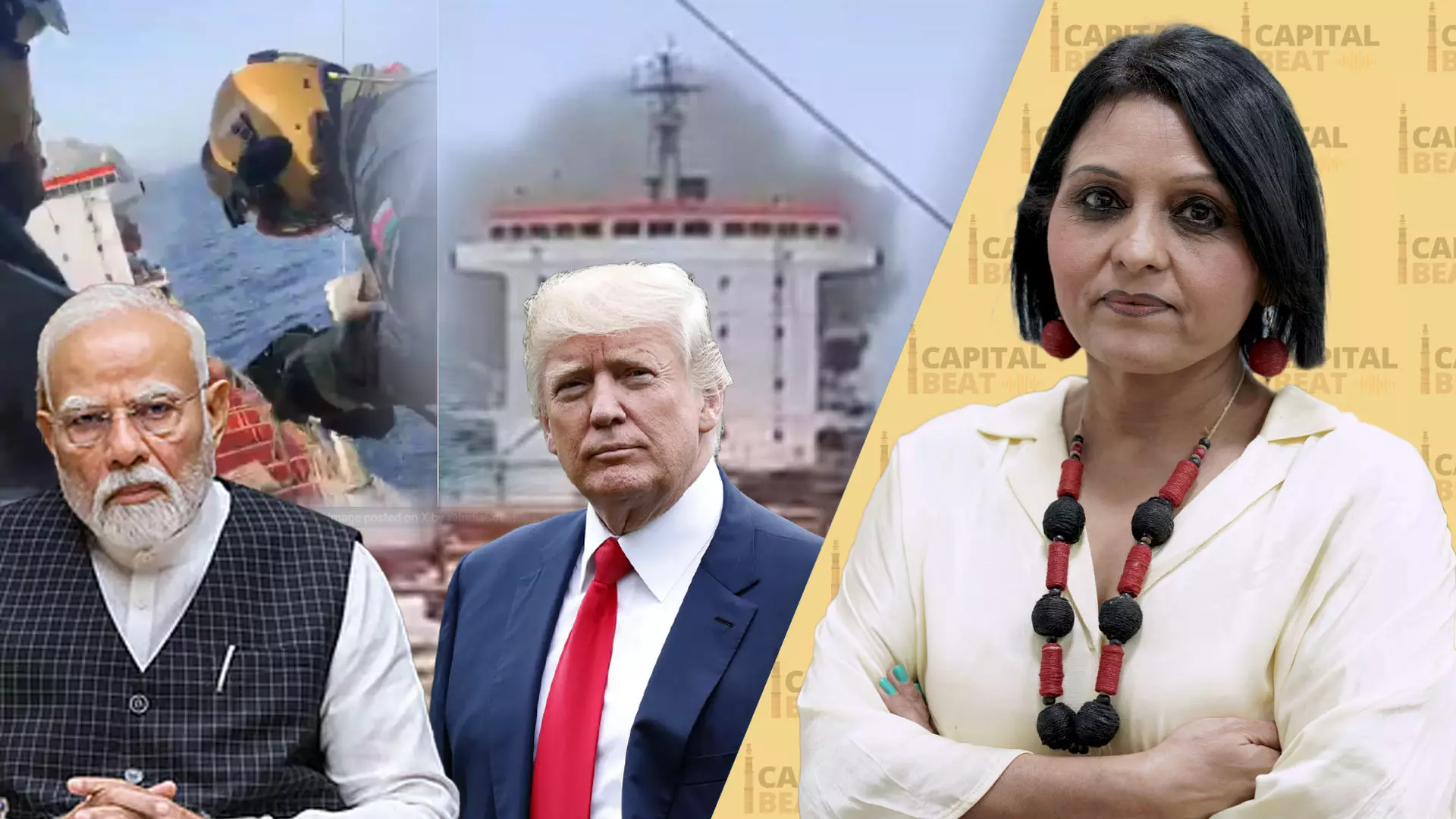
Indian crew rescued off Oman; why's MEA mum on US missile attack? | Capital Beat
Experts call out New Delhi for failing to directly name or condemn Washington after the attack disabled a vessel carrying 24 Indian nationals

A US missile strike on a tanker carrying 24 Indian crew members off the coast of Oman on Monday (June 8) has triggered sharp criticism of the Indian government's response, with foreign policy experts questioning why New Delhi stopped short of directly commenting on Washington's role in the incident.
Also read: ‘We will get a deal’: Trump calls PM Modi ‘good friend’ amid trade talks
In this episode of Capital Beat, The Federal spoke with veteran journalist and international affairs expert Sanjay Kapoor, senior journalist Seema Guha, and Middle East Expert, Professor Aftab Kamal Pasha, who discussed the implications of the attack, India's diplomatic posture, and the broader geopolitical tensions involving Iran, the US, and India's energy security.
According to the Ministry of External Affairs (MEA), the Palau-flagged vessel MT Marivex was disabled off the coast of Oman after an exchange of communication with the US Navy. All 24 crew members aboard were Indian nationals and were rescued safely by Omani authorities.
No direct mention of US
Ministry of External Affairs (MEA) spokesperson Randhir Jaiswal said in a statement that India had been in touch with Omani authorities, the Ministry of Shipping, the Maritime Rescue Coordination Centre (MRCC), and other stakeholders to ensure the crew's rescue and safety.
The MEA thanked the Oman government for its prompt assistance and said Indian officials remained in contact with the rescued seafarers.
Also read: RBI flags West Asia conflict, El Nino risks as threats to India’s growth outlook
However, the statement did not directly mention the US or criticise the missile strike that disabled the vessel, a point that became a central focus of the discussion.
Kapoor argued that the situation was more complex than it initially appeared.
According to him, the vessel belonged to an Indian company and had allegedly been warned multiple times by US authorities before the strike. He suggested that the ship's operations were linked to efforts to transport Iranian oil through indirect routes, a practice that Washington strongly opposes under its sanctions regime.
Did US give India a message on Iran?
Kapoor noted that the MEA spokesperson avoided directly naming the United States in his remarks.
He argued that if India believed the vessel was operating legitimately, New Delhi could have intervened diplomatically after earlier warnings were issued by American authorities.
"The fact that the bombing had been done by the Americans was not even mentioned," Kapoor observed, adding that the government's response appeared cautious.
He also highlighted that it was Oman, and not the US, that ultimately carried out the rescue operation after the strike.
The discussion then turned to whether Washington was attempting to send a broader message to India regarding trade and energy links with Iran.
Also read: US retreat, Israel’s isolation, India’s dilemma: Gulf crisis exposed more than limits of force
Kapoor said the US clearly wants India and other countries to comply with sanctions imposed on Iran and restrictions affecting Russian oil exports.
At the same time, he argued that India's energy needs make such compliance difficult, given its dependence on imported oil and the strategic importance of shipping routes through the Strait of Hormuz.
Why no criticism of US, expert asks
Kapoor described the situation as part of a larger challenge facing India.
He suggested that several smaller companies operating from India's western coast have been involved in energy trade linked to sanctioned regions, allowing a degree of plausible deniability while helping secure energy supplies.
According to him, New Delhi has often remained publicly silent on such operations while continuing to pursue its energy interests.
Pasha took a much stronger position.
He questioned why India had not publicly criticised Washingtoneven though Indian nationals were aboard the vessel when it was struck.
Pasha contrasted the government's response with earlier incidents in the region involving Indian citizens and argued that New Delhi should have directly addressed the US action.
He said any government seeking to protect its citizens should have summoned the American ambassador and demanded an explanation.
Pasha further argued that the vessel was reportedly in international waters at the time of the strike and questioned whether sufficient evidence had been presented to justify the attack.
India's reluctance hurt its image?
The discussion broadened into a wider critique of India's foreign policy approach.
Pasha claimed that New Delhi has become increasingly reluctant to publicly disagree with either the US or Israel on international issues.
He cited India's positions on conflicts involving Gaza, Lebanon and Iran, arguing that the government has avoided direct criticism of Washington and its allies.
Also read: The duplicity behind Trump's push to disarm Iran
According to Pasha, this reluctance has weakened India's image as an independent global actor and diminished the strategic autonomy that New Delhi traditionally sought to maintain.
He contrasted the current situation with earlier decades of Indian diplomacy, when leaders such as Jawaharlal Nehru played prominent roles in international affairs and were consulted by world leaders on major global issues.
The panel also discussed the implications of India's growing strategic partnership with the US.
Pasha argued that Washington increasingly expects India to align with its positions on issues ranging from energy imports to regional security.
He questioned whether India was receiving sufficient benefits in return for such alignment.
Accountability questions
Returning to the tanker incident, the panellists repeatedly raised concerns about accountability.
The host questioned whether New Delhi would respond differently if Indian crew members had been injured or killed in the strike.
Kapoor agreed that India should be more willing to defend its citizens when incidents involving foreign powers occur.
However, he also reiterated that the circumstances surrounding the vessel's operations complicated the issue.
He argued that the government appeared to be maintaining a degree of distance from the vessel's activities while simultaneously avoiding a confrontation with Washington.
Also read: US-Iran interim deal may be hailed, but imponderables loom
According to Kapoor, the result was an ambiguous response that satisfied neither critics of the US nor those seeking a clearer assertion of Indian sovereignty.
He said New Delhi needed to think more carefully about balancing its relationships with both Washington and Tehran, particularly given India's historical ties with Iran and its dependence on regional energy routes.
Future implications
As the discussion concluded, Kapoor said the incident highlighted broader questions about the nature of the India-US relationship.
While acknowledging close ties between the two countries, he argued that a genuine partnership should include respect for Indian interests and the safety of Indian citizens abroad.
He maintained that India must be prepared to speak more firmly when its nationals are affected by the actions of foreign governments.
The panel agreed that the rescue of all 24 crew members was a positive outcome. However, they argued that the incident raises significant questions about energy security, sanctions enforcement, maritime safety, and the extent to which India is willing to publicly challenge major partners when its citizens are involved.
The content above has been transcribed from video using a fine-tuned AI model. To ensure accuracy, quality, and editorial integrity, we employ a Human-In-The-Loop (HITL) process. While AI assists in creating the initial draft, our experienced editorial team carefully reviews, edits, and refines the content before publication. At The Federal, we combine the efficiency of AI with the expertise of human editors to deliver reliable and insightful journalism.