Vance’s jibe and Rubio’s visit: A test for India-US strained ties
New Delhi’s sharp response to the US vice-president comes amid fresh uncertainty over Indian tech workers and tariff threats over Russian oil, ahead of US Secretary of State Marco Rubio’s expected visit

US Secretary of State Marco Rubio is expected to visit India this month, though the date and details of his programme have not been announced. His visit comes at a time when Indian companies and professionals face fresh uncertainty in the US, while the threat of punitive tariffs over India’s purchases of Russian oil continues to hang over bilateral ties.
Can New Delhi and Washington sustain their strategic partnership when their economic and geopolitical interests increasingly diverge?
The latest move by the Trump administration came on Thursday (October 8), when the US Department of Labor suspended Microsoft, Adobe, Cognizant, Infosys, Tata Consultancy Services, Wipro, HCLTech and Capgemini from the Permanent Labour Certification (PERM) programme, effectively preventing them from sponsoring foreign workers for employment-based green cards.
Vance’s remarks
The restrictions apply to the green card process and are separate from the H-1B visa programme. While the suspension may have limited immediate operational impact on Indian IT companies, US Vice President JD Vance’s remarks following the announcement have added to the irritation in New Delhi.
Also read: With 'friends' like America, India is learning the cost
Vance accused Microsoft of laying off American workers while continuing to hire foreign employees. “For every American worker the company had laid off, it had replaced that worker with one and a half foreign indentured servants,” he claimed.
MEA hits back
The remarks prompted an unusually sharp response from India’s Ministry of External Affairs (MEA), which generally avoids public criticism of the US. Describing the wording as “unwarranted”, the MEA said that resorting to terminology carrying painful historical and colonial connotations was deeply offensive. It also reminded Washington that the US itself had been shaped by generations of immigrants.
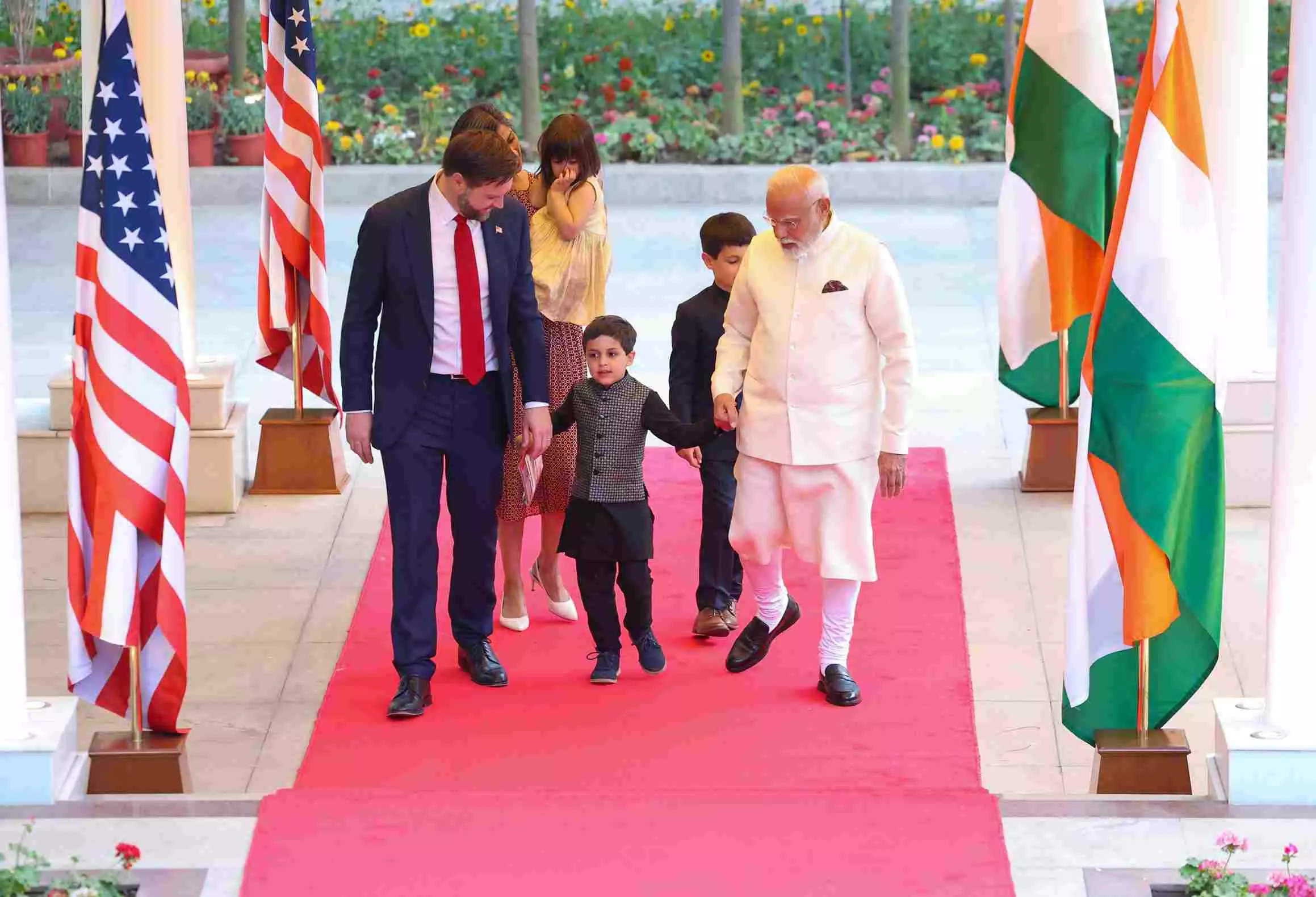
Vance and his Indian-born wife, Usha, visited India with their children last April and were hosted by Prime Minister Narendra Modi, who personally showed the family around his home and garden. The contrast between that warm reception and the Vance’s latest remarks is striking. More broadly, the episode suggests that New Delhi is increasingly willing to push back publicly against Washington when it believes Indian interests or dignity are at stake.
‘India’s messaging is clear’
“There has been a hardening of stance, and New Delhi is making sure it is seen as standing up to American pressure,” says Harsh Pant, vice president at the Delhi-based Observer Research Foundation. He points to criticism from the Opposition parties as well as the government’s increasingly forthright response to Washington on a range of issues. “America remains an important partner, but the Modi government is sending out the message that India’s core interests will not be compromised,” Pant says.
Also read: Indo-US ties: The Trump turbulence may not be temporary
New Delhi, he adds, is signalling that it “will not buckle under pressure from the US”. He believes US President Donald Trump is “doing long-term damage” to India-US ties.
India-US long term ties
The immigration row is only one part of the problem. The tariff threat of up to 100 per cent on countries buying Russian oil and gas, authorised under legislation signed by Trump, presents a more consequential strategic challenge. India has repeatedly defended its energy purchases on the grounds of national interest and energy security. For New Delhi, the question is how to protect these interests without further damaging ties with Washington.
The US remains important to India’s development, providing access to a lucrative market, investment, and advanced technology. With relations under strain, the challenge for New Delhi is to protect its interests while preserving a partnership it continues to need.
Managing differences
Rubio’s visit will offer an opportunity to examine how Washington intends to reconcile its strategic partnership with India with policies that impose costs on Indian companies and constrain New Delhi’s choices. Whether the visit produces greater clarity on the Russian-oil sanctions threat remains to be seen.
Also read: Russian oil sanctions sword hangs over already-fraught India-US ties
Meanwhile, a bilateral trade deal remains elusive, with the US pressing India to open up its agricultural sector. Defence cooperation and military exercises continue, and there is talk of Trump attending a Quad meeting early next year. Modi is also expected to travel to the US for the G20 summit in December.
These continuing engagements underline why neither side can easily walk away from the relationship. But strategic convergence does not mean that economic and geopolitical differences will disappear. The challenge for both governments is to manage those differences without allowing them to erode a partnership that remains important to both.