








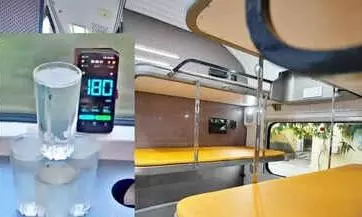
While the existing Vande Bharat services operate at a maximum speed of 160 kmph, the sleeper variant has been designed for speeds up to 180 kmph. However, actual operating speeds will depend on track capabilities across the Indian railway network. Photo: X| @ashvaishnav
New Vande Bharat Sleeper train clocks 180 kmph; Vaishnaw posts video of test run
Railway Minister Ashwini Vaishnaw shares video of stability test as Indian Railways prepares to launch 16-coach semi-high-speed overnight trains in 2026

As part of its push to transform overnight travel, Indian Railways is preparing to roll out the first Vande Bharat Sleeper train, designed to travel at speeds up to 180 kmph, in the new year.
While the existing Vande Bharat services operate at a maximum speed of 160 kmph, the sleeper variant has been designed for speeds up to 180 kmph. However, actual operating speeds will depend on track capabilities across the Indian railway network, said reports.
These sleeper trains will be equipped with advanced safety features, including the indigenous KAVACH anti-collision system, and – like the chair car version – will incorporate regenerative braking technology to boost energy efficiency.
Also read: New Ernakulam-Bengaluru Vande Bharat starts; controversy erupts over RSS song
Railway Minister Ashwini Vaishnaw on Tuesday (December 31) shared a video on social media showcasing the Vande Bharat Sleeper train clocking 180 kmph along the Kota–Nagda route, and demonstrating its stability features with a “water test".
“Vande Bharat Sleeper tested today by Commissioner Railway Safety. It ran at 180 kmph between Kota Nagda section. And our own water test demonstrated the technological features of this new generation train,” Vaishnaw wrote in the post on X (formerly Twitter),
The minister’s video, shot from inside the train, showed its speed hitting 182 kmph on a mobile screen, while a stack of water-filled glasses stayed perfectly balanced without spilling – underscoring the train’s stability.
The features
The first two prototypes of the Vande Bharat sleeper have 16 coaches, including 11 air-conditioned three-tier coaches, four four air-conditioned two-tier coaches, and one air-conditioned first class coach.
Designed as a semi-speed service, it is based on design elements from European rolling stock, the sleeper train will offer cushioned berths to improve comfort along with redesigned upper berth access.
Passenger amenities include low-intensity night lighting, audio announcements supported by visual display systems, CCTV surveillance, and modular pantry arrangements.
Also read: PM Modi flags off 4 new Vande Bharat trains from Varanasi
The trains will have advanced bio-vacuum toilets similar to those used in aircraft. Facilities will include an accessible toilet for persons with disabilities, a baby care baby care unit, and shower cubicles with hot water in the AC first class coach.
Besides featuring safety systems such as the indigenous KAVACH anti-collision technology, like the chair car version, the sleeper variant will also boast regenerative braking to enhance energy efficiency.
More sleeper trains
These Vande Bharat Sleeper trains are being manufactured by BEML, in partnership with the Integral Coach Factory (ICF). It is all set to make 10 train sets, and another 10 sets are being developed by Kinet, a joint venture between Indian and Russian partners.
Additionally, a consortium of Titagarh Rail Systems and BHEL has secured a contract to manufacture 80 sleeper variants. Separately, ICF is also undertaking the development of its own in-house sleeper version of the Vande Bharat train.
Redefining rail travel
According to the government, the Vande Bharat trains currently operating on the Indian Railways are classified as semi-high-speed services, built with a design speed of 180 kmph but permitted to run at a maximum of 160 kmph. An earlier statement from the railway ministry explained that the train’s average speed is influenced by factors such as track geometry, scheduled stoppages, and ongoing maintenance along the route.
Meanwhile, in its year-end review, the railways ministry added that the Vande Bharat sleeper trains, soon to be introduced for AC class travellers, are expected to redefine long-distance rail travel, significantly reducing journey times, beginning with high-demand routes and eventually expanding across the network.
Vande Bharat trains
Further, the Ministry said that as on 26th of this month, a total of 164 Vande Bharat train services are running across the Indian Railways network.
The Dhampur-Srinagar-Baramulla Rail Link (USBRL), a 272-kilometre project, was completed and dedicated in 2025. It comprises 36 major tunnels and 943 bridges, reflecting exceptional engineering in one of the most challenging terrains in the world. The 51-kilometre Bairabi-Sairang broad-gauge line in Mizoram was inaugurated in September 2025, placing Aizawl on India’s rail map for the first time.
To overhaul its long-distance rail travel, the railways plans to introduce more than 200 sleeper trains over the next few years.