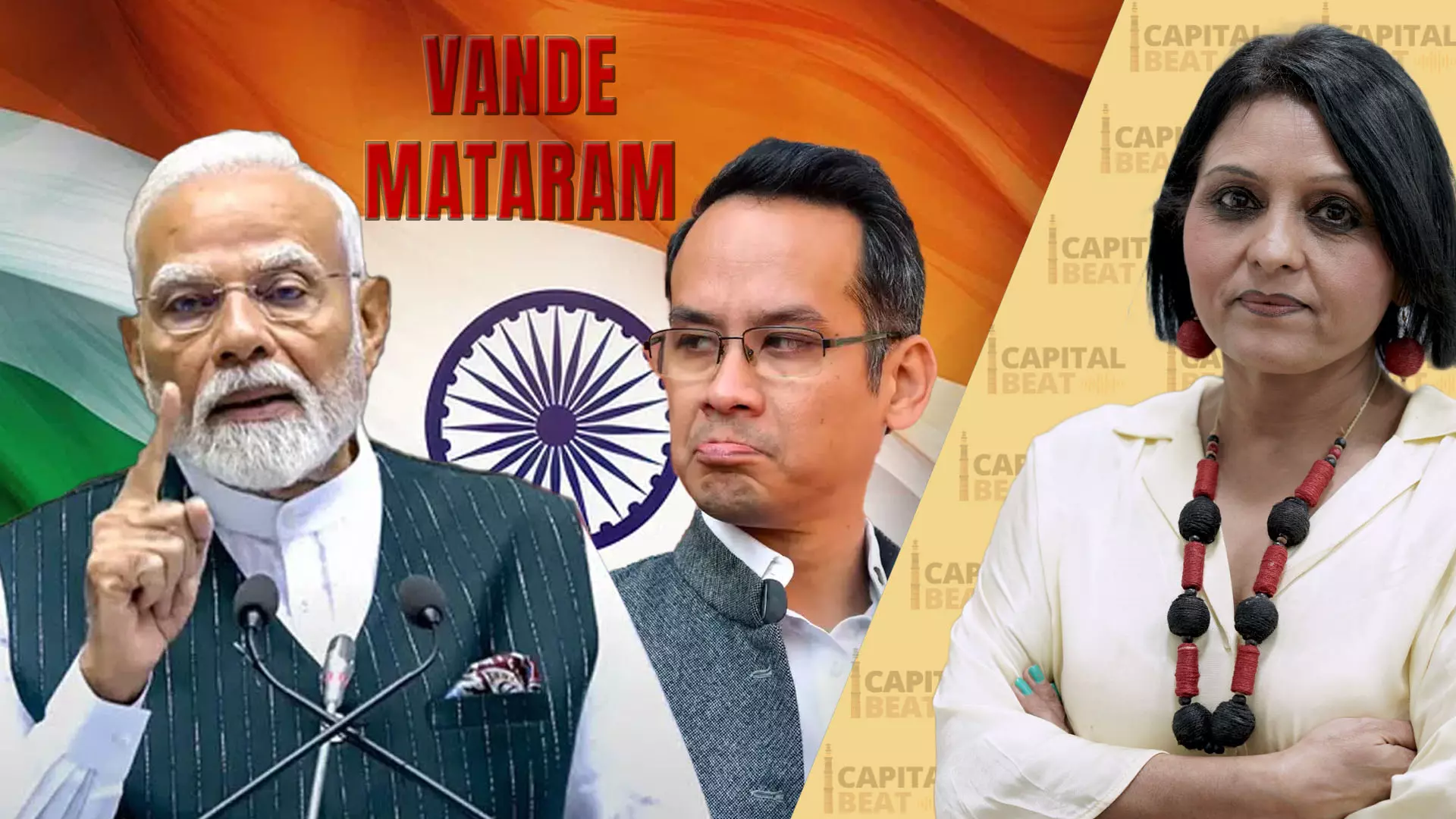
Vande Mataram debate in Parliament: Historian questions Modi govt | Capital Beat
History, politics and Vande Mataram: What’s really behind the debate?

The Federal spoke to historian Mridula Mukherjee in this Capital Beat episode on Prime Minister Narendra Modi’s Vande Mataram speech in Parliament, the political use of history, and what the renewed debate over the national song reveals about Indian democracy today.
Why do you think the government chose to hold a special discussion on a 150-year-old song now?
The answer is very simple. As with everything else, the only thing this government consistently does is politicise issues and use every opportunity for sectarian political gain. There is little sense of a national purpose or a serious reflection on what the nation actually needs at this moment.
Right now, thousands of people are stranded at airports after the virtual collapse of IndiGo’s operations. There has been a terrible tragedy in Goa. Delhi’s pollution is killing people. India’s ranking on the Global Hunger Index has fallen to levels comparable to sub-Saharan countries.
Instead of focusing Parliament’s attention on these urgent concerns, the government has chosen to rake up a controversy about a song which is already accepted as the national song – not the national anthem – by the Constitution, by Parliament and by the people of India. Nobody is objecting to Vande Mataram. The controversy being revived today concerns an issue that was resolved decades ago by the tallest leaders of the freedom struggle.
Also read: Modi refers to Vande Mataram creator as ‘Bankim da’; TMC up in arms
What was the original controversy over Vande Mataram, and how was it resolved during the freedom movement?
When objections arose to singing all the stanzas of Vande Mataram, the matter went to the highest level of leadership. Mahatma Gandhi and other top Congress leaders even consulted Rabindranath Tagore for his considered opinion.
Tagore pointed out that some stanzas clearly invoke the Hindu Goddess Durga and offer obeisance to her. If someone is not a Hindu or does not worship Durga, that person has every right to say they do not wish to recite those lines. At the same time, there are stanzas – especially the first – that are non-sectarian and non-denominational and can be sung by everyone without difficulty.
On that basis, a balanced solution was found: accept the song as a national song, but do not insist that everyone must sing all stanzas, especially those with explicitly religious content. This settled the matter for many decades. Gandhi’s recorded view from a 1939 Congress Working Committee (CWC) meeting in Wardha is very clear: nobody should be forced to say anything that offends their conscience.
Also read: PM Modi says Congress split Vande Mataram stanzas in line with Muslim League
How did Mahatma Gandhi view Vande Mataram and the way it was being used?
Gandhi acknowledged the emotional power of Vande Mataram. He recognised that it was a deeply evocative song which energised people and inspired the freedom struggle. Nobody denied that.
But he was equally clear that compulsion had no place in a democratic movement. He warned that “evil days” were approaching when Vande Mataram was being projected as a “Hindu song”. That, in his view, was the wrong direction. For him, the issue was not whether the song was beautiful or powerful; the issue was whether people of all faiths could recite it without violating their religious beliefs.
Gandhi taught that sentiments of all communities must be respected. If Muslims, or members of any other faith, were uncomfortable invoking a Hindu goddess, their concerns had to be taken seriously. This is central to the Indian idea of secularism – not hurting the religious sentiments of others and finding a common ground that everyone can share.
Also read: IndiGo flight cancellations ‘credit negative’, says Moody’s; slams planning lapses
Prime Minister Modi quoted Gandhi’s praise of Vande Mataram and suggested it should have been the national anthem. How do you read that?
There may well be an early comment by Gandhi suggesting Vande Mataram was so popular that it could have been the national anthem. No one disputes that the song was beloved and that it played a great role in the freedom struggle.
However, the core issue has never been about denying its importance. It is about the specific stanzas that invoke Durga. Vande Mataram first appeared in Bankim Chandra Chattopadhyay’s Bengali novel Anandamath. In Bengal, Durga is a deeply revered deity and Durga Puja is central to cultural life. In that context, the invocation felt natural.
But when you consider India’s diversity, it is obvious that people who do not worship Durga might not feel comfortable reciting those lines as a national duty. There is enough in the non-sectarian stanzas for everyone to sing together. The compromise reached during the freedom movement was based on that understanding. To now pick one statement of Gandhi and ignore the full history of the debate is to misrepresent his position.
The Prime Minister linked Jawaharlal Nehru and the Congress to “dividing” the song under pressure from the Muslim League. How accurate is that framing?
This is rhetoric, not history. It was not Nehru’s personal decision. The issue was discussed by the Congress Working Committee, which at that time included leaders such as Rajendra Prasad, Sardar Vallabhbhai Patel, Maulana Abul Kalam Azad, Subhas Chandra Bose and others. Gandhi himself was present.
Nobody in that leadership “devalued” the national song. The Congress was the party that first gave Vande Mataram a national platform. Rabindranath Tagore sang it at a Congress session in the 1890s. Later, Jana Gana Mana was also first sung at a Congress session in 1911.
When Muslim objections arose, they were not dismissed as merely Muslim League politics. Rajendra Prasad, for example, wrote to Patel saying that a large number of Muslims were finding it difficult to accept certain parts of the song. The Congress had to decide whether it wanted to alienate Muslims at a time when unity was vital for the freedom struggle.
Muslim League politics was certainly communal, but the Congress’s response was to remove genuine grievances that could be shared by ordinary Muslims. That is not “kneeling” before the Muslim League; it is trying to defeat the British policy of divide and rule by keeping the people together.
Do you think this debate is aimed at sending a political message to Hindu voters in West Bengal?
Partly, yes. In India today, almost everything is done with the next election in mind, even if it is a state election. Politics moves from one poll to the next, constantly searching for issues that can divide and polarise people.
In this context, invoking Vande Mataram’s Bengali origins and the figure of Bankim Chandra Chattopadhyay is clearly designed with West Bengal in mind. But it is short-sighted to try and pit Rabindranath Tagore against Bankim.
The Congress’s historical decision on how to treat Vande Mataram was taken after consulting Tagore, precisely because it is a Sanskritised Bengali song and he was best placed to interpret it. He gave a considered opinion that some parts could legitimately be objected to by Muslims. Are we now going to say that Tagore was wrong and current political leaders are right? That is a risky argument to make in Bengal.
Today, the Prime Minister accused Congress of making “tukde-tukde” of Vande Mataram. How do you respond to that charge?
It is very easy to use phrases like “tukde-tukde” for effect. The reality is that part of the song was adopted as the national song and nobody banned the rest of it. Those who want to sing all the stanzas are free to do so. Those who do not wish to recite the religious verses are equally free to stop at the earlier stanzas.
This is not “breaking” the song. It is recognising that a democratic nation cannot force every citizen to participate in religious invocations that may not be part of their faith. Nationalism is not about compelling uniformity; it is about creating a common civic space in which everyone can breathe easily.
BJP leaders argue that young people must understand the “power” and “energy” of Vande Mataram. Are they at least correct on that count?
The rhetoric about educating the younger generation sounds very noble, but needs to be examined closely. Not long ago, the same government announced a day to “commemorate the horrors of Partition” and framed history in terms that clearly deepened communal wounds rather than healing them.
There is a way to teach history that encourages reflection: for example, by asking what led to people being divided and what should be avoided so those mistakes are not repeated. But what we see instead is the use of history as a tool to polarise people and sharpen divisions.
A party that calls itself “nationalist” must have national unity as its central goal. Alienating a minority as large as 200 million Muslims is not a path to unity. Nor is creating anxiety among Christians and other communities by constantly raising issues that touch their identities. The real test of nationalism is whether people of all denominations feel like equal citizens.
You listed many current crises — aviation chaos, pollution, economic concerns. How does this debate look in that wider context?
At a time when India faces a serious aviation crisis, with passengers stranded for days, when pollution levels are choking cities, and when our hunger and health indicators are deeply worrying, Parliament is spending hours debating a controversy that was settled long ago.
Institutions such as the International Monetary Fund (IMF) have raised concerns about the quality and credibility of India’s official data, effectively grading it down. This is a severe blow for a country that once had one of the world’s most respected statistical systems, built by experts like PC Mahalanobis.
There are also critical issues such as tariff disputes with the United States and broader economic challenges. These are the matters that deserve serious, sustained attention from a government that calls itself nationalist and claims to act in the national interest.
Do you think this long discussion on Vande Mataram will help the country, help the BJP, or could it backfire politically?
The pattern is familiar. When things get difficult, the default option is to ramp up polarisation. In previous campaigns, we have seen issues raised about clothing, food, and fearmongering about how “they” will steal your buffalo or your mangalsutra. The goal is to frighten and divide people.
West Bengal is clearly a tough battleground for the ruling party. Mamata Banerjee remains a strong political force. That is why there is an element of desperation in the way such issues are being pushed. But trying to pit Bankim Chandra Chattopadhyay against Rabindranath Tagore, or to force Bengalis into such a false choice, may end up exposing a lack of understanding of Bengal’s intellectual and cultural traditions.
The larger concern goes beyond one election. When every decision is driven by the logic of staying in power and expanding power, the basic responsibilities of governance suffer. A ruling party must not only win elections; it must also run the country, keep people united, and address their everyday problems with seriousness and honesty.
(The content above has been transcribed from video using a fine-tuned AI model. To ensure accuracy, quality, and editorial integrity, we employ a Human-In-The-Loop (HITL) process. While AI assists in creating the initial draft, our experienced editorial team carefully reviews, edits, and refines the content before publication. At The Federal, we combine the efficiency of AI with the expertise of human editors to deliver reliable and insightful journalism.)