








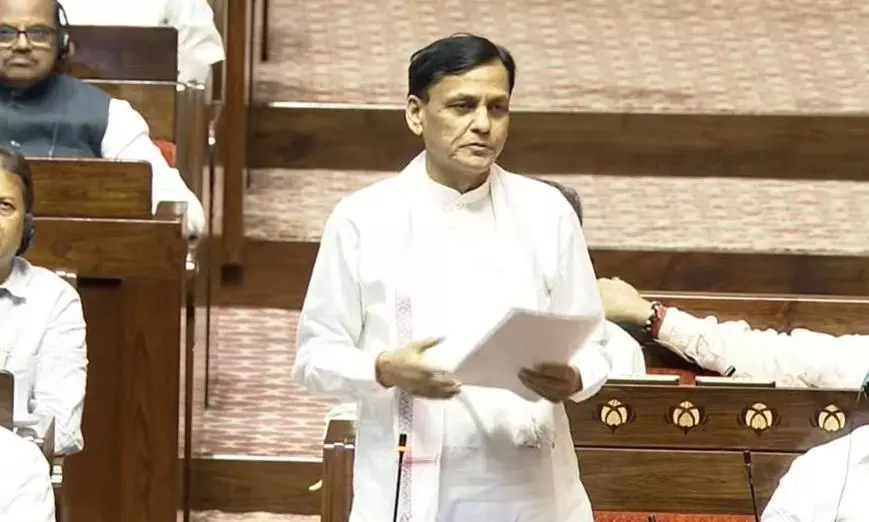
The amendment gives Vande Mataram the same statutory protection already available to the national anthem, Jana Gana Mana. Photo: @sansad_tv
Vande Mataram: What you can face for insulting the National Song if new law takes effect
Vande Mataram will get protection under the National Honour Act after the Rajya Sabha passed the Bill. Deliberate insults could attract up to three years in jail

The Rajya Sabha on Wednesday (July 29) passed the Prevention of Insults to National Honour (Amendment) Bill, 2026, bringing Vande Mataram under the Prevention of Insults to National Honour Act, 1971.
If its passed in the Lok Sabha and becomes a law, deliberately insulting the national song, preventing its singing, or disrupting an assembly during its rendition could attract a prison term of up to three years, a fine, or both.
Protection extended to national song
The Bill was cleared by a voice vote during a stormy session of the Upper House. Opposition members repeatedly raised slogans, demanding a statement from Union Home Minister Amit Shah over the alleged police excess against protesters demonstrating in Delhi over the NEET paper leak. The protests continued during the discussion, and Opposition parties eventually walked out.
Also Read: Full 6-stanza Vande Mataram played at Vijay’s swearing-in, could spark protocol debate
The amendment gives Vande Mataram the same statutory protection already available to the national anthem, Jana Gana Mana. Until now, the 1971 law protected the National Flag, the Constitution of India and the national anthem. The latest amendment adds the national song to that list.
Wider legal consequences
If the legislation comes into force, anyone who intentionally stops the singing of Vande Mataram, disturbs a gathering while it is being sung, or commits an act treated as disrespect towards the national song could face criminal prosecution.
Also Read: Owaisi opposes equal status for Vande Mataram and national anthem, BJP hits back
The law also has penal provisions for acts of disrespect involving protected national symbols, with penalties of up to three years in jail.
The government introduced the amendment during the 150th anniversary year of Vande Mataram. Written by Bankim Chandra Chattopadhyay and later included in his novel Anandamath, the song became closely associated with India's freedom movement and is officially recognised as the country's national song.
Political divide, legal debate
Replying to the debate, Minister of State for Home Affairs Nityanand Rai accused the Congress of disrespecting the national song through what he described as appeasement politics.
Also Read: Will Vande Mataram order for madrasas deepen communal fault lines in Bengal? | Capital Beat
Referring to freedom fighters who went to the gallows with Vande Mataram on their lips, he said, "One cannot understand the Congress' opposition to Vande Mataram...The country's youth are watching, and the people of the country will teach them a lesson."
‘Needed for Ek Bharat, Shreshta Bharat’
Rai also said Vande Mataram is needed for the promise of "Ek Bharat, Shreshta Bharat."
The amendment is also likely to trigger discussion on how expressions such as "insult" and "obstruction" will be interpreted in practice, and whether the law clearly separates deliberate disruption of the singing of Vande Mataram from an individual's decision not to participate, reported India Today.
(With agency inputs)