vijay and Gandhi
Vijay’s suit sparks debate on politics, identity and symbolism
From Gandhi's loincloth to Vijay's black jacket, Indian politicians have always legislated through cloth. A hundred years of ideology dressed up as fashion

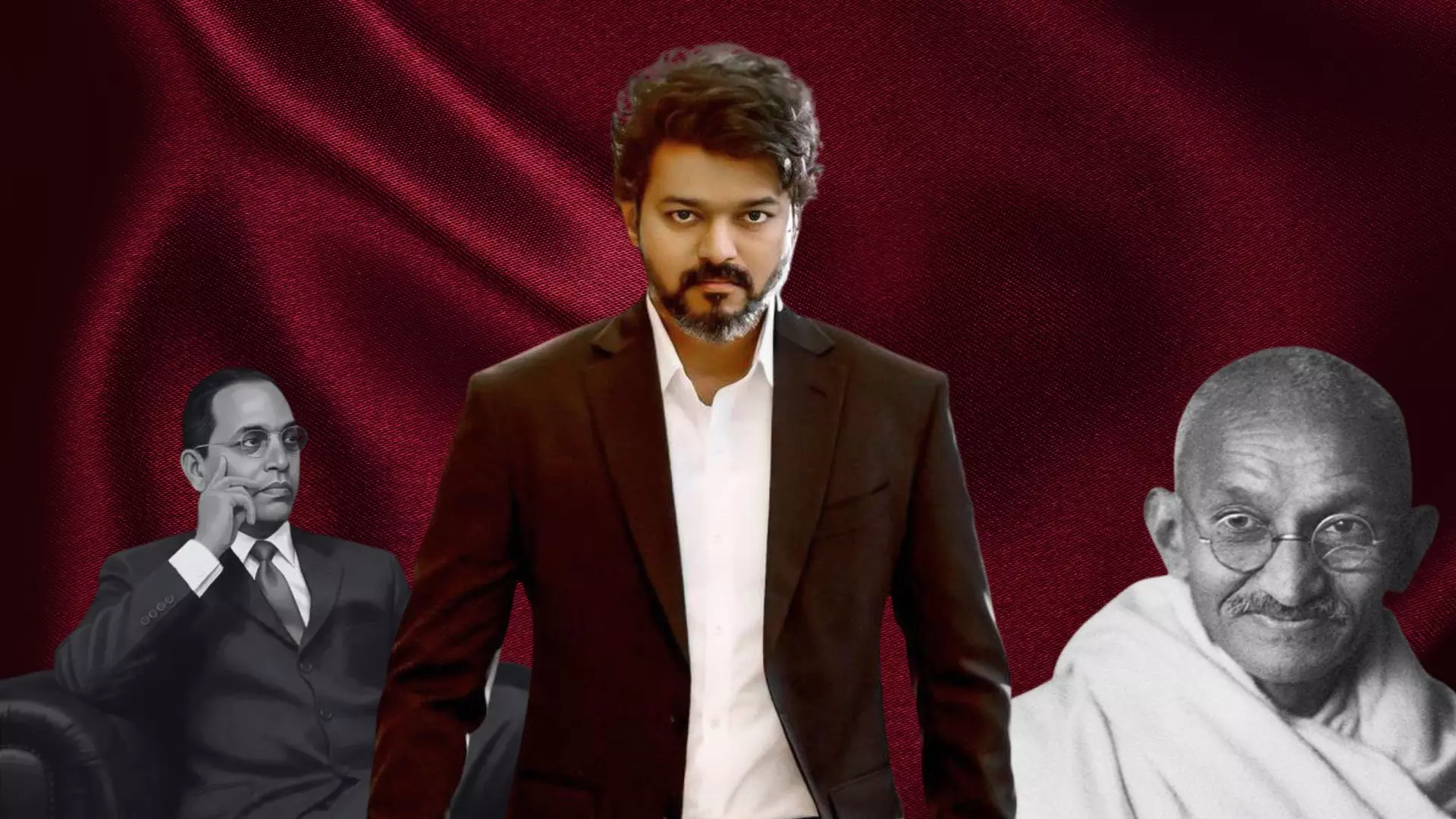
When Joseph Vijay walked into the Tamil Nadu Assembly as its Chief Minister, the first debate was not about policy. It was about the suit. A black jacket, black trousers, white shirt beneath. Matte finish. No tie. Collar open. In a chamber where white fabric has historically been the political uniform, the visual was an immediate rupture. To understand what that rupture meant, you have to go back to a train journey — and trace every garment in between.
In September 1921, Mohandas Gandhi boarded a train from Madras to Madurai. He was making the case for khadi, pleading with fellow passengers to wear it. They told him they were too poor to afford it. He looked around at millions of Indians in loincloths barely four inches wide and felt the weight — literal and moral — of his own clothing. The next morning, on West Masi Street in Madurai, he stepped into public view in a simple dhoti and shawl. He never went back.
Also Read: Vijay’s appointment of Radhan Pandit tells stars were always over Dravidam
That house stands today as a Khadi Emporium. The open ground where he first appeared has been named Gandhi Pottal. A quiet statue marks the spot. But the real monument Gandhi built that morning was not made of stone. It was a grammar — a way of reading the body as political text — that Indian public life has been writing in ever since.
Default code
Gandhi's Madurai choice set the parameters for Indian political self-presentation for generations. White. Simple. The message embedded in the fabric: I am not above the people I serve. It was an act of renouncement performed publicly, and in a civilisation that codes renouncement as holy, it carried enormous moral authority.
The lineage is long. Jawaharlal Nehru worked the Nehru jacket into an international silhouette — distinctly Indian, but refined enough for diplomatic theatre. Lal Bahadur Shastri stripped even that away, appearing in simple kurtas that communicated humility without artifice. In Tamil Nadu, Kamaraj wore plain khadi until his last day, with no flourish and no concession to ceremony. The cloth was the position.
This consensus held its shape for decades. White, desi, simple. I belong to the soil. I serve the people.
Black shirt and the three-piece suit
But there was never only one conversation happening.
Running alongside Gandhi's legacy — and in direct, deliberate argument with it — was another tradition. B.R. Ambedkar wore a three-piece suit every single day of his public life. Not occasionally. Not for formal occasions. Every day. The writer Arundhati Roy frames the contrast with precision: "Gandhi discarded his Western suit and put on a dhoti to dress like the poorest of the poor. Ambedkar, born unmoneyed and Untouchable, denied the right to wear clothes that privileged-caste people wore, showed his defiance by wearing a three-piece suit."
The distinction is foundational. Gandhi had privilege to renounce, and renouncement was the gesture. Ambedkar had nothing to renounce — he was born at the bottom of a hierarchy that denied him everything. His suit was not aspiration. It was reclamation. An insistence on claiming what the caste order had refused him. Where Gandhi's dhoti said I choose to come down to you, Ambedkar's suit said I refuse to stay where you put me. Pa Ranjith would later invoke this difference through dialogue in Kabali, bringing the argument to a mass audience that hadn't necessarily framed it in those terms.
Also Read: Why Tamil Nadu’s new coalition government is standing on thin ice
In Tamil Nadu, Periyar's black shirt carried a similarly precise ideological charge. It was not fashion, and it was not mourning. It was a direct rejection of Brahminical order, a colour chosen to name what it was fighting. Black, in Tamil Nadu's political memory, has carried that weight for nearly a century. When the DMK was formed, Annadurai chose to move away from it — the party's evolution required a broader tent. But the frequency never disappeared from the room.
What emerged as the Tamil politician's baseline was the kara veshti, a dhoti with a thin border, worn with a shirt. Simple, regional, democratic. And then M.G. Ramachandran, who understood something that neither the khadi tradition nor the Ambedkarite tradition had fully reckoned with: the power of spectacle. MGR's fur cap, dark glasses, and meticulously maintained silhouette were not a departure from political costume. They were its logical extension into cinema, and cinema's extension back into politics. His costume said I am your hero. Here. Always. The gap between the screen and the stage was closed by a wardrobe.
21st century update
Narendra Modi has performed perhaps the most successful synthesis in recent Indian political dressing. His kurtas are premium — in fabric, cut, and finish — and his jacket, which came to be called the Modi jacket internationally, became a global political silhouette. It is unmistakably Indian, and unmistakably aspirational. The desi identity survives, but it has been updated for a country that no longer wants to signal poverty as proof of virtue. Modi's clothes say: Indian, modern, strong. The renouncement tradition has been replaced by a pride tradition — same cloth, different meaning.
Rahul Gandhi's evolution runs in a different direction. He has moved from the Congress white kurta to a polo t-shirt and cargo pants. The polo is clean without being ceremonial. The cargo pants signal utility, movement, practicality. Together, the message is legible: I want to work, not preside. It is a younger grammar — less invested in ritual, more interested in function. Less interested in representing the people symbolically and more interested in being among them physically.
Assembly rupture
Which brings us back to the suit. What Vijay wore when he walked into the Tamil Nadu Assembly was not a misstep, a nauve choice, or an actor's reflex. It was, whether consciously assembled or not, a statement with multiple frequencies operating simultaneously.
The black, in a room of white, creates immediate visual separation. In Tamil Nadu's political register, black echoes Periyar — it carries the memory of defiance, of naming the adversary. The matte finish refuses the performative gloss that ceremonial clothing usually insists on. The absent tie declines the uniform of institutional establishment. The open collar declines to ask for permission.
Each choice subtracts something from the grammar of power as it has historically been worn in that building. The suit doesn't say I am one of you. It doesn't say I renounce privilege. It doesn't say I am your hero from the screen. It says something closer to: I am beginning something that doesn't yet have a name.
Also Read: Why Vijay's TVK win doesn't mark the end of Dravidian politics in TN
And then, what Vijay did inside that suit matters as much as the suit itself. He reached out to every senior politician in the room — including M.K. Stalin, the leader of a party he had called Theeya Shakthi during his campaign. That embrace, extended in that jacket, was a signal layered on a signal. The costume said rupture; the gesture said openness. The tension between the two is where the actual political meaning lives.
Body as text
Gandhi chose cloth to enact what he believed. Ambedkar chose cloth to reclaim what was denied. Periyar chose a colour to name what he was fighting. MGR chose a silhouette to collapse the distance between myth and governance. Modi chose fabric that could carry both tradition and aspiration simultaneously.
In a democracy where the overwhelming majority of citizens will never read a party manifesto or sit through a policy speech, the body is the text. What a politician wears is their first speech — delivered before a word is spoken, legible across literacy levels, across languages, across the length of a television broadcast.
Vijay's first speech, delivered in black and white in a building that has heard a century of political cloth, was this: something new is beginning here. Whether what follows the suit is equal to it — that is the question his politics, and not his wardrobe, will have to answer.
The content above has been transcribed from video using a fine-tuned AI model. To ensure accuracy, quality, and editorial integrity, we employ a Human-In-The-Loop (HITL) process. While AI assists in creating the initial draft, our experienced editorial team carefully reviews, edits, and refines the content before publication. At The Federal, we combine the efficiency of AI with the expertise of human editors to deliver reliable and insightful journalism.