When being a ‘Kashmiri’ is forced to override all other identities, a community feels targeted
Hundreds of Kashmiri youth complain of immense stress, uncertainty over their studies or career after being harassed, write Tauseef Ahmad and Sajid Raina

Battling heavy smog and the Delhi winter, Arsalan Ahmad, a 23-year-old student of International Affairs at Jamia Milia University, stepped out for a shave on 11 November. He sat on a swivel chair, facing the mirror when a stranger sitting next to him casually asked, “Are you a terrorist?”
Unsure of what to make of the offensive question, Ahmad decided to ignore it. But the stranger quickly filled in on the news from the previous night. A white hatchback had exploded near Red Fort in Old Delhi. About 10 people were killed and 30 or so were injured. This was news to Ahmad, who had spent the evening away from his phone.
Also read: After Red Fort blast, India’s porous coasts vulnerable to 26/11 terror attacks
Initially, the investigation suspected a suicide attack but news channels were quick to link it to raids conducted by Jammu and Kashmir Police and Haryana Police in Faridabad, in the National Capital Region, where they had seized explosive material just day prior.
About a week later, National Investigation Agency, India’s counter-terrorism agency, named Umar Un Nabi, a 29-year-old assistant professor in the general medicine department at Al-Falah University in Faridabad, as the alleged suicide bomber. Nabi was from Pulwama district in Kashmir. In successive weeks, other Kashmiris were also identified as being linked to the blast.
Although he didn’t recognise the man in the salon, the stranger seemed to know that Ahmad hailed from Kashmir. “He asked me to leave Delhi or be beaten up,” said Ahmad, who immediately rushed to his room a few meters away, locked it up and left for Kashmir.
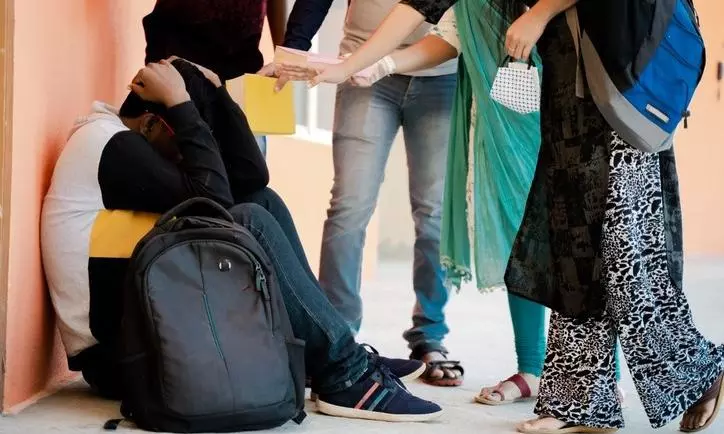
Ahmad is one of hundreds of Kashmiri youth who were threatened, evicted or harassed on campus after the Red Fort blast in November.
Also read: Delhi blast probe: Main accused planned to recruit women; NIA seizes cash
This year has been particularly hard on him and other Kashmiri youth studying or working in parts of northern India. After the terror attacks in Pahalgam in April, India and Pakistan fired missiles across the border. Since Kashmiris were suspected of being a part of the attack on tourists in Pahalgam, many Kashmiris in parts of north India were attacked and profiled even back then.
In November, across cities like Kanpur and Meerut, security agencies asked college administrators to share the details of Kashmiri students with them. Claiming it was for security arrangements ahead of the New Year and Republic Day celebrations, the Gurugram police asked several housing societies, house owners, and paying guest accommodations to submit details of residents from Jammu and Kashmir staying with them.
Forty-four workers from Jammu and Kashmir who were on their way to Arunachal Pradesh for work were detained by locals at a railway station in Assam’s Tinsukia.
It is regular procedure when conducting investigations to question those connected to the suspects, said a senior Delhi police official under condition of anonymity, as he is not authorised to speak to the media on this case. “In this case, we questioned everyone we thought was connected to the suspects directly or indirectly,” he said, “and we would do that whether the person was a Bihari or a Maharashtrian or anyone else.”
Also read: Kashmiri students urge Modi to ensure their safety post Red Fort blast
“A particular community is being targeted after the attack,” said Nasir Khuehami, National Convenor, Jammu and Kashmir Students Association, and while addressing the media on 18 November, he urged Prime Minister Narendra Modi to “call off the vilification” of Kashmiris.
One identity above all others
Mental health professionals Mentality spoke to said that in high-stress situations like this, if individuals are picked out because of the primacy of one of their identities that almost obliterates all other identities, it can have severe impacts on their mental health.
In this case, Kashmiri students were singled out for being Kashmiri primarily, over their other identities like that of being a friend, sibling, or offspring.
“When young people are reduced to one identity,” said a Srinagar-based mental health professional, who requested anonymity as he fears repercussions, “especially an identity that brings them under suspicion, they start monitoring their own behaviour.”
Zainab Bukhari, 24, is an MA Economics student at Ashoka University, Delhi. “I want to complete my degree and feel like a normal student, and also want to feel safe,’’ she said. But was forced to return to her hometown, Baramulla, in November, “I do not know how to balance both.”
Such a dilemma puts young Kashmiris constantly on edge. Ishfaq Ahmad, 24, a computer science student at Faridabad’s Lingaya’s Vidyapeeth, said he deleted social media applications after the blast. “I felt I should not write anything or like any post,” he said. “Even neutral content may be misunderstood. I stopped interacting in class because I felt others may think I have something to do with the incident,” he added.
Also read: Omar Abdullah condemns Delhi blast, says ‘Not every Kashmiri is a terrorist’
Kashmiri students are easily identified due to their language and surnames, said Mushtaq Ahmad, a professor of political science at University of Kashmir.
Due to decades of conflict, a sluggish economy, and lack of private industries, Kashmiri youth are forced to look for opportunities outside the region. “Students want exposure, internships, and access to wider markets,” said Prof. Ahmad. “But when they face profiling outside, it creates a dilemma: They are forced to balance aspiration with safety,” he said. This conflict, he added, affects decision-making, appetite, and concentration.
Manifestations of being a ‘Kashmiri’ first
When young adults internalise suspicion, it shows up as disturbed sleep, irritability, withdrawal from social activities, or avoidance of news, said a Srinagar-based clinical psychologist, who requested anonymity as he fears repercussions for speaking to the media about a sensitive issue.
Ubaid Ahmad, a second-year engineering student from Kanpur, said he left the city within 24 hours of the blast. For a few days, he avoided watching news “because every channel showed the blast again and again.”
Since he was forced to return home, he said, he had been keeping his phone on silent mode most of the day. “When relatives visit, I do not sit with them for too long. I cannot explain why this is happening, but it started after the incident,” he said. He said he caught himself getting irritated over “small things.”
“I simply could not focus on my classes after [the incident],” he added.
A mental health worker from Baramulla, who works with students and young adults said that Kashmiris are targeted more often than other populations, enough to make traumatic memories seem real. “When a fresh incident happens, old memories come back,” he said. He wanted his identity hidden for fear that it might have repercussions.
Jammu and Kashmir has seen violent insurgency, war, political repression, and regular shelling across the border for over three and a half decades now. “This violence is all that most Kashmiri youth have seen in their lifetimes,” said the mental health worker.
Two students who stay in a hostel in Meerut, said they began sleeping with their bags packed, after the bomb blast. One of them, Adil Ahmad, who refused to give more details fearing he might be targeted for speaking to the media, said he checks his phone many times a day. “Every message makes me anxious,” he said, as he expects it to be from his university seeking verification papers.
Dr Waseem Mir, a senior doctor at Government Medical College, Handwara, said that the Kashmiri community has been targeted so often that they have now internalised the fear. “If even one student is attacked or threatened, the entire student community feels unsafe automatically,” he said.
Social media makes matters worse
Abdul Basut is doing a post-graduation course in Conflict Analysis and Peacebuilding from Delhi’s Jamia Millia Islamia University. He said social media influencers and mainstream TV channels paint all Kashmiris in a particular light.
In some viral videos, Kashmiris all over India were threatened too. “When our parents see videos threatening Kashmiri students, they ask us to come back immediately,” Basut said, adding that the students take the panic and anxiety back to their homes. “We feel the impact of every attack even when we have no role in it.”
Basita Khan, a nursing student in Lucknow, stopped studying two days after the blast. “I kept reading the same page,” she said. Her parents called her every hour to check on her safety.
Families react to the media first, and students then adjust their movements, Basut said. “It makes us question where we belong.”
This piece is republished with permission from Mentality.