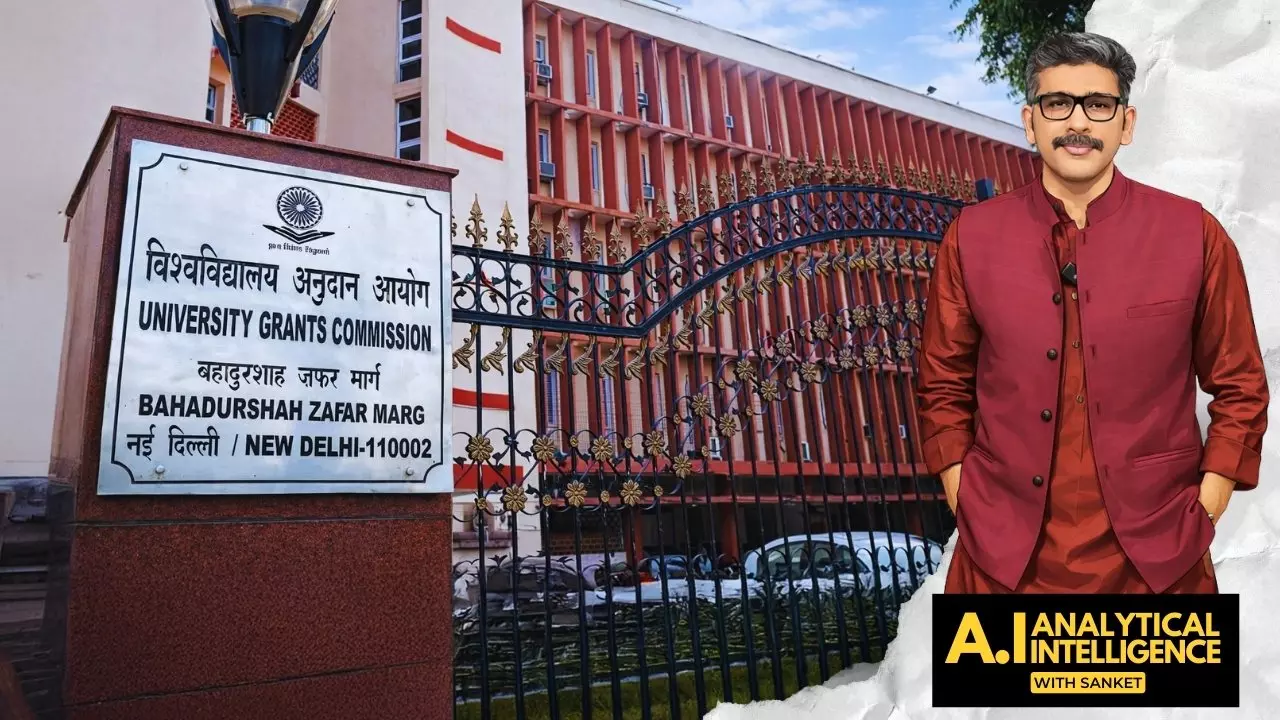
The biggest protests are coming from general category students, though objections exist from multiple sides.
Why some sections of society are protesting against UGC's equity rules | AI with Sanket
UGC’s equity rules are in effect, but protests grow over 'reverse bias' fears and missing safeguards — what has changed?

The Federal spoke to Aranya Shankar to understand what are the UGC’s new equity regulations on campuses, why general category students are protesting, and how this controversy is being confused with a separate, pending overhaul proposal around higher education funding and regulation.
What is this new UGC rule change?
It is called the University Grants Commission Promotion of Equity in Higher Education Institutions Regulations, 2026. Equity regulations have existed since 2012, but this is not a sudden move. It is linked to a long campaign following cases such as Rohith Vemula and Payal Tadvi, and a court process pushing higher educational institutions to address discrimination more effectively.
The new rules aim to eradicate discrimination across categories such as caste, class, gender, economically-weaker sections, religion, place of birth, and more. What is new is that the definition of discrimination is broadened: it includes not only explicit acts, but also implicit acts of bias.
What structures do the new rules require on campuses?
Every higher educational institution must have an Equal Opportunity Centre to frame policies and initiatives to ensure equal opportunity and reduce discrimination.
Under the Equal Opportunity Centre, the UGC has mandated an Equity Committee. It is a 10-member committee chaired by the head of the institution (ex-officio). The committee includes faculty, non-teaching staff, civil society representatives, student representatives, and the Equal Opportunity Centre coordinator as member secretary.
Also Read: New UGC rules are a disaster; education needs to go back to State List
The rules also introduce Equity Squads and Equity Ambassadors. The Equity Squad functions like a mobile vigilance unit visiting “vulnerable” campus spaces. Equity Ambassadors are nodal officers in hostels/departments and report to the Equal Opportunity Centre coordinator.
What happens when a discrimination complaint comes in?
The rules create a defined timeline.
A complaint can also come via a 24/7 equity helpline, including confidential complaints. Once a complaint is received, the Equity Committee must meet within 24 hours. It then has 15 working days to submit a report to the head of the institution. After receiving the report, the head of the institution has seven days to initiate action, and if there is a criminal angle, the matter can be reported to the police.
There are penalties for non-compliance with timelines, including action such as being debarred from UGC schemes or restrictions linked to degree-related functions, as described in the discussion.
Who has objections to this rule change, and why?
The biggest protests, as discussed, are coming from general category students, though objections exist from multiple sides.
The main objections raised are:
The broadened definition of discrimination covers implicit bias, and students argue “it can include anything” and could invite complaints without sufficient grounding.
The Equity Committee’s mandatory representation lists OBC, SC, ST, women, and persons with disabilities, but does not explicitly mention “general category", which critics say makes the mechanism one-sided.
Also Read: UP PCS officer resigns in protest against ‘insult to Brahmins’, UGC rules
There are concerns that timelines (15 days to resolve, seven days to initiate action) may push institutions into rushed, procedural action “for the sake of it".
The counter-argument is that representation for marginalised groups is intentionally specified to reduce bias in grievance handling, and that the committee is still 10 members, leaving scope for inclusion beyond the listed categories.
Was there a change related to false complaints?
Yes. The discussion refers to a 2025 draft regulation that included a clause on false complaints, including fines and possible disciplinary action for serious or repeated false complaints. That clause is described as having faced objections at the time, and it is said to have been removed in the current notified regulations - fuelling fears about malicious complaints.
At the same time, it is stated that an appeal mechanism has existed since 2012, and continues.
Has the UGC equity rule already come into effect?
Yes. It is stated that it came into effect immediately upon notification.
Has there been an official response to the 'reverse discrimination' allegation?
It is said there has been no institutional response from the UGC or the ministry at the time of the discussion. A political response referenced in the interview is from BJP MP Nishikant Dubey, who is described as rejecting the allegation and saying any such issues would be dealt with.
Also Read: Teachers, students, Opposition MPs flag centralisation, reduced funding in VBSA Bill
Another political reference in the discussion is to Shiv Sena (UBT) MP Priyanka Chaturvedi raising similar allegations.
If someone fears misuse, is there any grievance redressal?
The appeal route is described as still available. A person can approach the ombudsman within 30 days of receiving the report. The ombudsman is expected to make efforts to dispose of the appeal within 30 days (shortened from 90 days mentioned for the older framework in the discussion).
Does this rule protect only SC/ST/OBC students, or is it broader?
The rules are discussed as being framed as anti-discrimination, and “religion” is mentioned within the definition of discrimination. However, the committee composition emphasises caste groups (OBC/SC/ST) along with women and persons with disabilities. Aranya Shankar's position is that the mechanism is predominantly caste-focused, but potentially broader in who can approach it.
Are HECI/VBSA and the UGC equity rules the same issue?
No. The discussion separates them clearly.
The UGC equity rules are already notified and in force. The HECI/VBSA issue is described as a separate bill proposal: the Higher Education Commission of India idea reworked and renamed as the Viksit Bharat Shiksha Adhishthan (VBSA) Bill.
Also Read: Why academic experts are up in arms over UGC’s new curriculum draft
The concern highlighted is that VBSA would replace multiple bodies with a central apex commission and remove grant disbursal from the regulator, placing funding decisions with the Ministry of Education. It is also described as highly centralised and lacking state representation, which is why critics call it a threat to federalism - since education is on the Concurrent List.
(The content above has been transcribed from video using a fine-tuned AI model. To ensure accuracy, quality, and editorial integrity, we employ a Human-In-The-Loop (HITL) process. While AI assists in creating the initial draft, our experienced editorial team carefully reviews, edits, and refines the content before publication. At The Federal, we combine the efficiency of AI with the expertise of human editors to deliver reliable and insightful journalism.)