Women’s quota debate over Parliament expansion
Women’s quota linked to massive Parliament expansion, warns Radha Kumar
Writer-policy analyst questions Centre’s push, calls census-delimitation linkage artificial and warns of a hurried structural overhaul

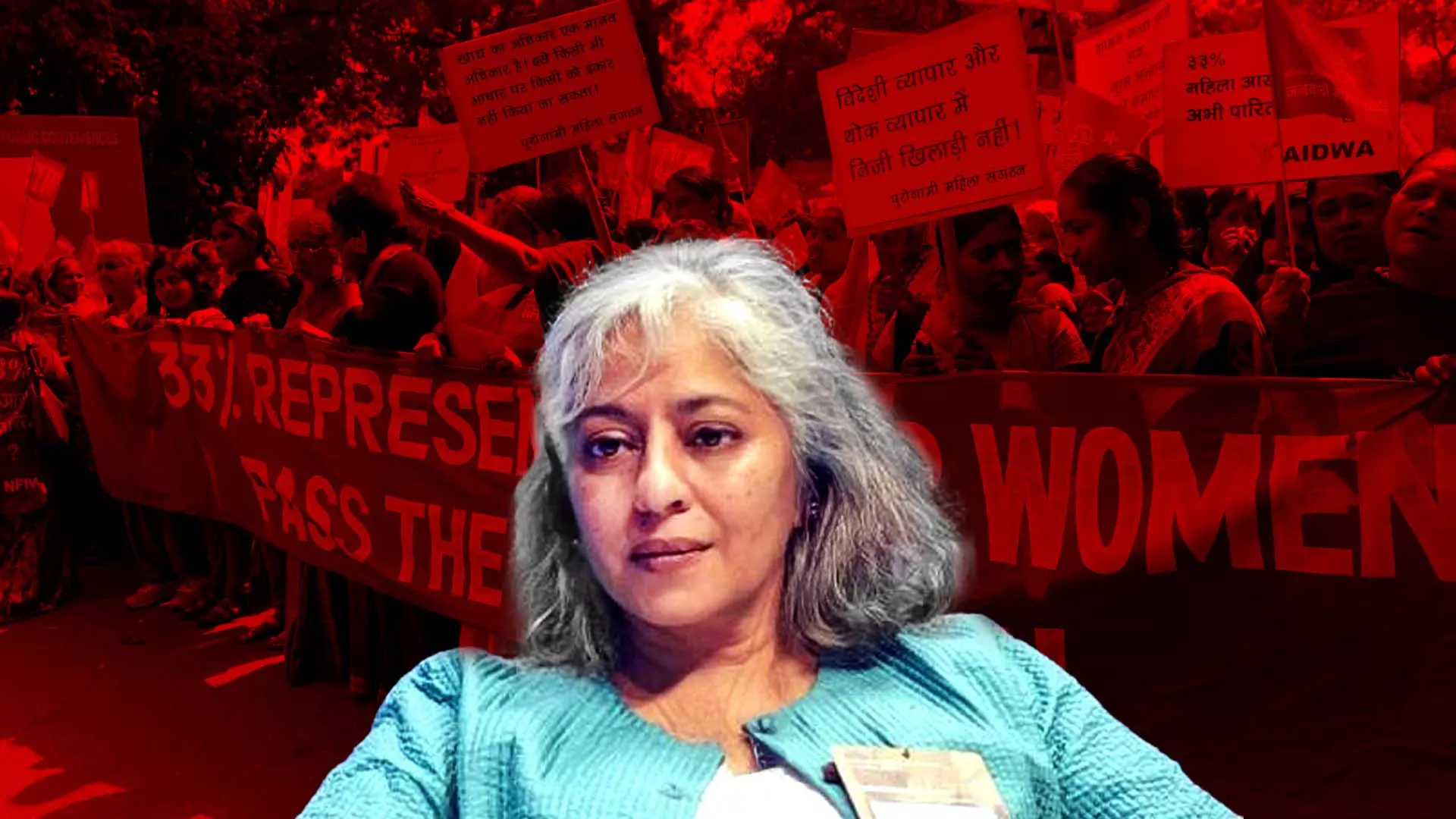
“There is absolutely no connection between women’s reservation and delimitation or census—this linkage is completely artificial,” said Radha Kumar, writer and policy analyst in an interview with The Federal, warning that the government may be using the women’s quota as a vehicle to push a massive expansion of legislatures.
As Parliament prepares for a crucial session on April 16 to April 18, to debate sweeping structural changes, concerns are mounting over transparency, timing, and democratic process. The Federal spoke to Kumar, writer and policy analyst, on the implications of the proposed reforms and the politics behind them. Edited excerpts:
Is the government’s primary focus women’s reservation or expanding legislatures?
I would say first and foremost they are using the issue of women’s reservation to expand Parliament and the state assemblies. That has been the intention for a very long time. According to Professor JN Devi, the RSS has long been committed to a Lok Sabha of more than 800, though I cannot personally testify to that.
They are using women’s reservation because they know Opposition parties cannot oppose it. Logically, there is no connection between women’s reservation and population counts, census results, or delimitation. Women’s reservation is a flat 33 per cent. If it were linked to population, it would be closer to 48–49 per cent.
So, this is a completely artificial linkage created to ensure expansion and delimitation alongside the implementation of women’s reservation.
If there is no linkage, why is the government tying these issues together?
The argument appears to be that male parliamentarians feel women’s reservation can only be implemented if the House is expanded. They say otherwise seats are being “taken away” from men, which is a ludicrous argument because general seats are open to both men and women.
Also read: PM Modi pushes women’s reservation rollout for 2029 Lok Sabha elections
Another argument is that many MPs have “nurtured” their constituencies, and it would be unfair to them. But the data does not support this—only about 216 out of 543 MPs have been re-elected. The rest are first-timers, and even the BJP rotates candidates.
These arguments are essentially a form of male chauvinism and discrimination against women, but they cannot be stated openly.
Why is the government now pushing for implementation by 2029 instead of later?
Part of it is to gain advantage in the ongoing state elections and possibly in upcoming elections like those in Uttar Pradesh. It allows them to claim they have delivered what others could not.
There is also a question about the timeline. According to the home ministry, provisional census results could be ready by December 2027, which leaves time for delimitation before 2029. However, there may be doubts about meeting that timeline.
Another issue is whether delimitation should be based on provisional or final census data. Final data may only be available between 2028 and 2030, which is why many assumed implementation would happen by 2034.
So, there is a push to use the 2011 census instead, partly to avoid complications from newer data.
Is the use of the 2011 census linked to avoiding caste data debates?
Yes, that is one likely reason. The 2011 census included caste data, but the results were never released. There is concern that releasing such data could trigger demands for expanded caste-based reservations.
The government may want to avoid that debate, especially since caste dynamics are already sensitive and politically complex.
What are the risks of expanding Parliament to over 800 seats?
A Lok Sabha of 816 members would leave very little scope for deliberative discussion. It would make it easier to rush legislation without debate.
Expansion itself requires a full, separate discussion. What should be the criteria? On what basis should seats be increased? These are serious questions that have not been addressed.
Also read: Is Revanth’s delimitation formula for fair South representation reasonable?
Delimitation also requires careful debate. Recent examples in Jammu and Kashmir and Assam show that criteria can be violated, leading to concerns about gerrymandering.
Can delimitation be used to marginalise certain communities?
Yes, it has already happened. In Assam, several constituencies with significant Muslim populations have effectively disappeared after delimitation.
In Jammu and Kashmir, new constituencies have been created in ways that appear to favour certain communities, sometimes ignoring geography and administrative convenience.
Such actions raise serious concerns about fairness and representation, especially since delimitation decisions cannot be challenged in court.
Why do you say the public is disillusioned with legislatures?
There has been a significant deterioration in how legislatures function. Many state assemblies meet only for a few days, limiting opportunities to raise public concerns.
The power has increasingly shifted to the executive, with legislators having less influence. People are aware of issues like corruption, the role of money and muscle in elections, and the weakening of institutional checks.
This has led to growing dissatisfaction with elected representatives and democratic processes.
Will expanding legislatures worsen the quality of parliamentary functioning?
It could. Even with 543 members, Parliament is not functioning effectively because debate is often curtailed.
Also read: Opposition suspects 'hidden agenda' as Centre delinks women's reservation from 2027 census
In other democracies like the UK or the European Parliament, larger legislatures work because rules are followed, debates are allowed, and Oppo
sition voices are heard. In India, the issue is not just size but functioning. Without reforms in how Parliament operates, expansion could make things worse.
Is the Opposition being politically cornered on this issue?
Yes, it is a difficult position. If they oppose the bill, they risk being labelled anti-women.
However, they can support women’s reservation while opposing its linkage with expansion and delimitation. They should demand that these issues be discussed separately.
It is also problematic that such a major reform is being pushed during state elections. This has never been done before and raises questions about intent.
How should women’s reservation be implemented instead?
Women’s reservation can be implemented without expansion. It should simply be 33 per cent of the existing seats.
There should be a clear timeline set for implementation rather than linking it to census and delimitation.
The process of identifying reserved seats should involve state-level committees with representation based on vote share. This would be more equitable than leaving decisions solely to the Election Commission.
Rotation of reserved seats can be considered, but these are details that require proper debate.
The content above has been transcribed from video using a fine-tuned AI model. To ensure accuracy, quality, and editorial integrity, we employ a Human-In-The-Loop (HITL) process. While AI assists in creating the initial draft, our experienced editorial team carefully reviews, edits, and refines the content before publication. At The Federal, we combine the efficiency of AI with the expertise of human editors to deliver reliable and insightful journalism.