Mark Tully obit: The journalist who taught India to the BBC
From Emergency-era defiance to Mother Teresa’s funeral, a former colleague reflects on Mark Tully’s life, values and impact on Indian journalism

A day before he passed away, Mark Tully's condition was described by his partner Gillian Wright as “stable but critical.” I was intrigued by Gilly’s message on WhatsApp, but knowing how she would be feeling, I decided not to question her any further. Perhaps she was trying to put up a brave face, knowing the inevitable was near.
Mark was 90 and had not been well for a while. His love for everything Indian was part of the problem. Gilly would often complain of health problems caused by his love for Indian curries, but Mark was unfazed.
Also read | Trump files $10 billion defamation suit against BBC over January 6 documentary
His ability to take the rough with the smooth with that same unfailing smile made him what he was. Nothing really mattered; it was all part of life.
The BBC’s human face
For me and many of my South Asian colleagues who made a name working for the BBC at a time when it was the “go-to media option” for millions across the subcontinent, Mark was the father figure, the mentor and the teacher who made it all possible. He believed in South Asian talent, trusted our regional expertise and never imposed himself on us, unlike some of the overrated bigfoots arriving from London with the know-all swagger. At the end of the day, Mark was a deeply humble man who knew the huge complexities of the region could be handled by the BBC only if the London bigwigs trusted the field correspondents in the regions. At the same time, he taught us how to ‘market’ our stories, how to fit them into the big picture. We became global by remaining local, grounded but aware of why something here mattered for audiences elsewhere.
When Mark's second-in-command in the BBC Delhi bureau, Satish Jacob, another great friend and colleague, walked me into his office-cum-residence at 1, Nizamuddin in Delhi one summer afternoon in 1986, I had expected a British burra sahib in a suit. To my surprise, I found a smiling man in a kurta-pyjama asking me in Hindi, “BBC mein kaam karenge?” Mark made an extra effort to give us the feel that the BBC was as much ours as his — and for that feeling to prevail, he would relentlessly stress the value of the language services in radio as the key to the BBC’s global outreach and acceptability. His despatches, when used in these language services, made him a media icon from Peshawar to Yangon — a voice audiences could trust. Mark read Indian newspapers closely and marked out good regional reporters whose coverage stood out. They would then be approached and offered stringerships. When they had shaped up well, they would be asked to join the staff. Mark prioritised regional network expansion and then trained us to BBC standards, both through formal training sessions and hands-on everyday counselling. He was a network builder par excellence.
A rebel with principles
There were some other contemporaries of Mark Tully who felt the same way — William Crawley, the historian David Page and the late Alexander Thomson. They had their differences, but for us in the field, they provided a unique media ecosystem where talent and capability mattered, where a big story in your region could effortlessly sail into the global headlines with ease. When your boss(es) understands the region, it becomes so much easier to do that.
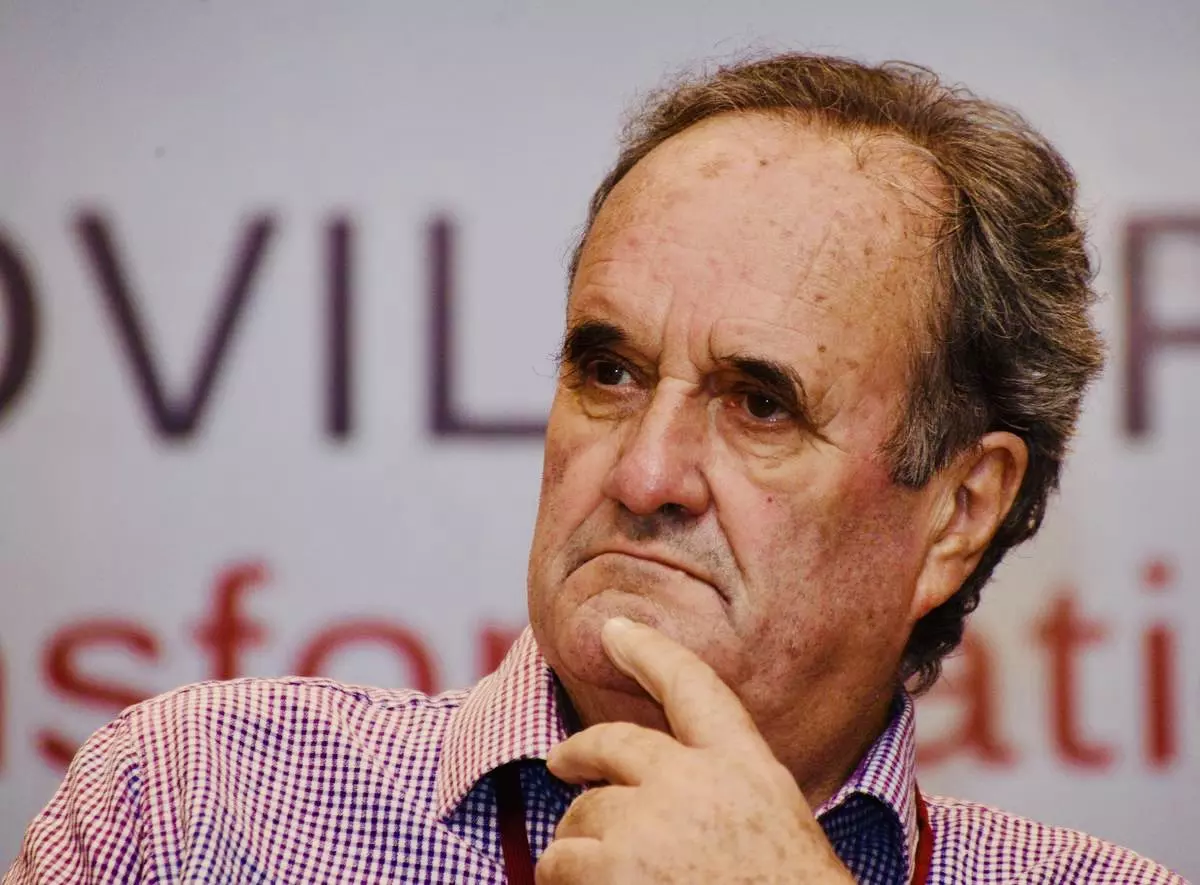
The author with Mark Tully, the BBC legend who mentored a generation of South Asian journalists.
Mark Tully studied theology at Cambridge, but, thankfully for the world of broadcasting, he did not end up in the Church. He was the BBC's longest-serving South Asia bureau chief — 20 years at the helm, 30 years in all. He would have gone much higher in the BBC but decided to stay back in Delhi. “I am much more interested in India and the region than in climbing the BBC ladder,” he would famously say.
Stories of Mark's exploits abound, and, honestly, they are far too many. It would make for a book by itself. He left the BBC in a huff in 1994 after falling out with its new cost-conscious management when he famously said, “The BBC has been invaded by accountants.”
Standing up to power
At the heart of the differences was Mark’s reluctance to be seen as an ‘also-ran’. He wanted the BBC to break big stories, come up with scoops, do great documentaries — something that audiences would talk about for years to come and remember. He wanted to lead the pack but failed to convince the ‘accountants’ he hated so much that the pursuit of quality cost money, and if they were not willing to understand, he would leave but not compromise.
Mark also would not compromise on professional integrity. He refused to budge during the Emergency by playing it down and was thrown out by Indira Gandhi's government, only to return as a hero.
Also read | BBC bosses Tim Davie, Deborah Turness resign over Trump speech edit row
Mark left the BBC, but the organisation often found itself compelled to fall back on his expertise. When I scooped the story of Mother Teresa's death and the BBC decided to do a whole day of live coverage of her funeral in Kolkata, they brought in Mark Tully as the expert and Nik Gowing as the lead anchor. Nik had been anchoring the coverage of Princess Diana's death for a week before Mother Teresa's death. As both met up with me at our makeshift studio in Hotel Peerless, Mark asked me to take them to the Calcutta Coffee House for "an adda with the Dadas." "Nik needs to get Diana out of his system and get a hang of Calcutta, and I need to catch up," Mark said.
A master storyteller
The next day, the BBC's coverage of Mother Teresa's funeral was actually a real insight into the unique city for a global audience and stood out against other foreign media. On Mark's insistence, I had to even get a Ramkrishna Mission monk and a Muslim Imam to the BBC makeshift studios to discuss the legacy of Mother Teresa and the city that made her.
That is how Mark worked.
Thorough research, endless recces to get the feel of the subject, talk to everyone relevant for the story, but most important of all, his uncanny ability to tell the story in simple language for a mass audience in a way all would understand.
In the last few years, as I met Mark during my visits to Delhi for the occasional lecture, he would feel sorry at the demise of the BBC as a global media power. And he would deeply worry about India and its future. Deeply mourned by his former colleagues and tens of thousands of friends, Mark will go to his grave with no 'full stops'. A life lived in full and with honour.