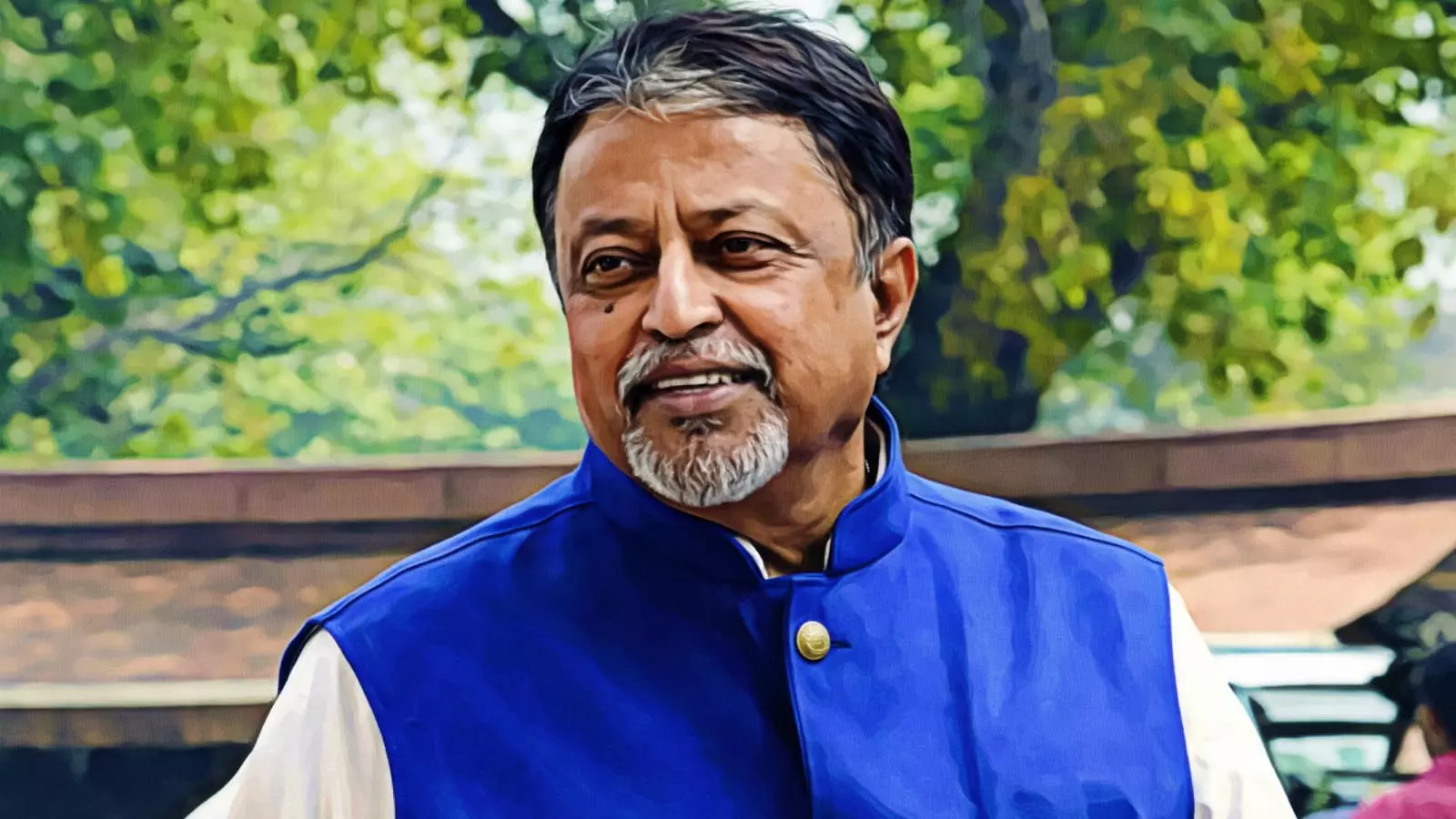
Mukul Roy obit: 'Chanakya of Bengal politics', a Test cricket connoisseur
From TMC’s chief organiser to BJP tactician, Mukul Roy shaped Bengal politics for decades, navigating power shifts, controversy and personal loss

He once called Test cricket his sanctuary. Even at the height of his political career, Mukul Roy could be found sneaking into Eden Gardens to watch a Test match. He would be completely absorbed in the rhythms of the sport’s longer format, where calculated resilience and outthinking the opponent matter far more than flashy hits or quick glory.
It was the same attention to detail and resilience that he manifested in navigating complex alliances, reading shifting political conditions, and timing his moves, which defined his politics far more than flamboyance. These were the traits that earned him the sobriquet “Chanakya of Bengal politics”. Though in politics, not all of his innings went smoothly.
Also Read: Mukul Roy, former railway minister and Bengal's 'Chanakya' dies
Roy, the man who once stood as Trinamool Congress' (TMC) second-in-command and briefly held the portfolio of railway minister, passed away at 71 in a private hospital in Salt Lake, Kolkata, in the early hours of Monday (February 23).
Born on 17 April 1954 in Kanchrapara, Bejpur, in Barrackpore’s industrial belt, Roy was the only son of Jugal and Rekha Roy, growing up in a modest middle-class household alongside four sisters.
His early life began modestly with schooling at Harneet High School in Kanchrapara and a chemistry honours degree from Rishi Bankim Chandra College in Naihati, after which he went on to earn a postgraduate degree in public administration from Madurai Kamaraj University, while simultaneously nurturing his twin passions for politics and cricket.
Rise in politics and TMC years
His political journey began with leftist student organisations, but the winds of change soon carried him into the Congress fold, under the patronage of Mrinal Singha, a local leader in Barrackpore.
For years, he remained a loyal follower, shuttling between the provincial town and Kolkata, yet never gaining significant prominence.
That changed in the 1990s with the rise of Mamata Banerjee, whom he joined as a trusted confidant, leaving the Congress behind.
Roy’s real influence emerged during the formation of the TMC. He became the party’s first national general secretary in 1997 and was instrumental in orchestrating its early expansion, bringing disgruntled leaders from other parties into the TMC fold.
His reputation as a kingmaker grew during Mamata’s ascent, as he played behind-the-scenes roles in major political negotiations, including the 2009 Congress-Trinamool alliance.
“Mukul da was a real organisational man. He had all the personal details, including phone numbers, of district, block, and booth-level leaders at his fingertips. He used to stay in touch with them regularly,” recalled Mukul Bairagya, a senior TMC leader.
So reliable and indispensable was he to the TMC supremo that in 2012, when railway minister Dinesh Trivedi was forced to resign over his reported differences with Mamata regarding a proposed hike in passenger fares, Roy was picked by her for the job, a move that underscored both his importance within the party and the bitter coalition politics surrounding his brief tenure. Roy immediately rolled back the hike, which was deemed "anti-poor" by his party.
Turbulence, BJP phase and legal battles
Yet politics is rarely a straight path. Roy’s career was marked by both brilliance and turbulence. In 2017, his political fortunes took a sharp turn when the TMC suspended him on charges of anti-party activities after he signalled his intent to resign from the party, an action linked by critics to the Narada sting operation and Saradha ponzi scam controversy that had engulfed TMC leaders at the time.
Some say that by 2014, with the rise of Abhishek Banerjee and the reorganisation of party hierarchies, Mukul found himself increasingly sidelined in the TMC.
He resigned from the Rajya Sabha in 2017 and formally joined the BJP, where he rose to become national vice president and was central to the BJP’s expanding campaign in West Bengal.
His role in recruiting defectors and orchestrating party switches was so prominent that observers often described his political method as mass organisational absorption and coercive poaching of elected representatives.
He was largely credited with orchestrating significant gains for the party in Bengal during the 2018 Panchayat and 2019 Lok Sabha elections.
Also Read: Six Bangladeshi nationals held in Tamil Nadu over terror plot; Opposition slams DMK
Yet even within the BJP, he struggled with its centralised power structure and reportedly did not campaign with full commitment in the 2021 Assembly elections.
His last few years in public life were marred by decline and controversy. After winning the Krishnanagar North seat on a BJP ticket in 2021 and then returning to the TMC weeks later, his MLA status was challenged under the anti-defection law.
In November 2025, the Calcutta High Court disqualified him from the state Assembly on retrospective grounds, a legal judgment that drew widespread attention as one of the more significant enforcement actions under the Tenth Schedule, though the Supreme Court later stayed that disqualification.
Even before the court directive came, his public appearances grew sparse, and those he made were often awkward, reflecting his deteriorating health and mental state.
Observers noted lapses in speech coherence and confusion in interviews, a stark contrast to the commanding presence he once projected.
Personal loss and legacy
In a way, Roy’s political life was a study in contrasts: the strategist who could engineer party expansions, the loyal aide who could fall out with his benefactor, and the ageing politician struggling with illness and public embarrassment.
“He was never a good orator or an administrator, but stood out as a strategist,” observed political commentator Amal Sarkar.
Personal tragedies compounded his political decline. The death of his wife, Krishna Roy, in 2019 further isolated him in his final years, confining him to his Kanchrapara home.
Yet his imprint on Bengal politics remains undeniable. He was instrumental in shaping both the TMC’s and the BJP’s rise, orchestrating electoral strategies, and redefining party alignments over decades.
His story is marked by ambition, loyalty, and power.
Also Read: The election is over; Mamata has already won: Monideepa Banerjee
Roy is survived by his son Shubhrangshu Roy, who confirmed his father’s passing. As news spread, politicians across party lines paused to acknowledge the complex legacy of a man who, for better or worse, reshaped the contours of West Bengal’s political landscape.
“The late Mukul Roy dedicated himself to the Trinamool Congress from its very inception. He served as a Union minister and commanded respect across all levels of the party. Later, he took a different path, but eventually returned. His contributions to Bengal politics and his organisational skills will not be forgotten. Political circles, regardless of party affiliation, will feel his absence,” Mamata Banerjee wrote in her condolence message on X.
His departure leaves a gap, reflecting both his achievements and the challenges he faced in a life at the heart of politics.