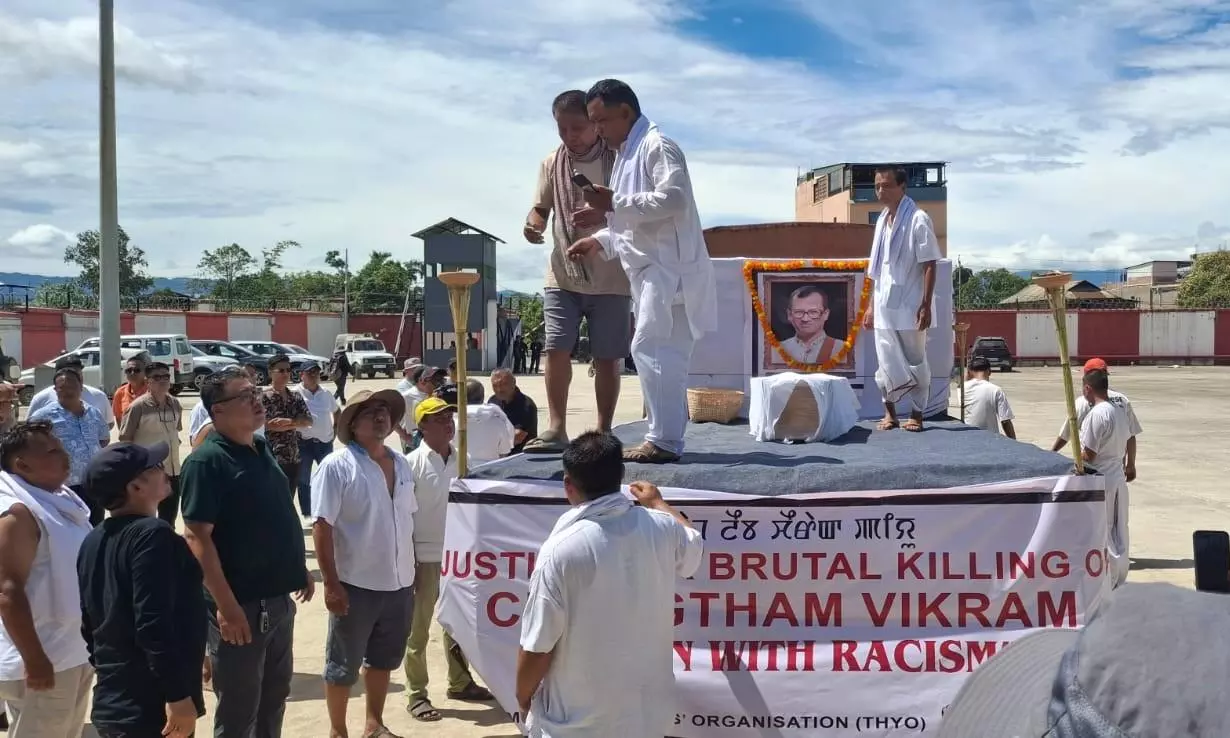
The mortal remains of Manipuri musician Chongtham Vikram at Imphal airport, Manipur.
Chongtham Vikram obit | 'He gave in totality, and we received him in pieces'
A pioneer of Manipuri rock, Vikram carried his music from the hills to Delhi, where he found both recognition and discrimination faced by many North East people

At the Imphal airport's cargo bay, we did not gather to celebrate a homecoming, but to mourn a death. Chongtham Vikram's body was on its way back to Manipur. It was not in a guitar case as he had transported his melodies across the country, nor was it on his two feet that had rhythmically walked the length of Manipur. It was in a coffin that was brought back to the red soil from which it had come.
Vikram's family members and friends stood motionless. Nobody seemed to have the strength of speech. What could be said? That he, the gentle giant who had showered Manipur with his music, had been beaten to death in Delhi? That his body had been abused and disfigured by people who should have respected him?
Also read: Manipuri musician lynched outside Delhi home; 7 dhaba staff, 1 juvenile held
I looked at their faces, etched with the shock of a death that had jolted Manipur to its core. They were not prepared; none of us was. How could we receive him in pieces when he had always given in totality? How could we accept that it was people who had beaten him and not illness, that it was hatred and not envy that had driven them to do it?
‘When we met’
It was 1987, when three boys from Manipur, backpacks slung over our shoulders and steel luggage with bedding materials, stood at the temporary interstate private bus terminal in the BOC Area of Imphal. My childhood friend Longjam Jagabanta introduced me to Chongtham Vikram that day, and we were all set to head for Shillong - Scotland of the East - to pursue our studies. Vikram's father was there not only to see off his son but also to accompany him on the journey, as we boarded the bus to a new destination for the two of them. I was already in Shillong studying my pre-university course and returning to my college. It was, however, their new destination.
None of us knew then that Vikram would go on to become an even a bigger legend - not in the classroom, but on the stage, with an electric guitar slung across his shoulder, making the six strings cry and sing, as he made history with his music, forever etched in the hearts of one and all in Manipur as the pioneer of Manipuri Rock. Even before he pursued Western music, he had already mastered the Hindustani music tradition.
Transition into music
Vikram was born into a music family, when Chongtham Ongbi Kamala Devi, his mother, took to singing in the film Matamgi Manipur (1972), the first-ever Manipuri feature film. Kamala Devi's melodious tunes drew people to Manipuri music and gave Manipur one of its first singing stars.
Also read: After Anjel Chakma’s death, NE students say core failure is lack of legal recognition
While his mother found stardom through music, Vikram took to the electric guitar to find his own space. A child prodigy, he had an unusual knack for music that came naturally to him, and he would spend long hours in his room, mastering each and every composition that came his way. Those who knew him in the early years paint a picture of a boyish-looking and energetic young man who always kept to himself - until he picked up the guitar.
The late 1980s witnessed a rock revolution in Manipur, and among the first to take up the challenge was Vikram, who soon became one of Manipur's leading lights on the electric guitar. He was the lead guitarist for three of Manipur's most popular rock bands of the time: Ultra Vires, Phoenix and Eastern Dark.
Ultra Vires formed the laboratory for Vikram's musical experiments, and it was here that he learned the intricacies of mastering the guitar and the sound of rock music.
Phoenix, the highly popular rock band of the time, made use of Vikram's genius as the lead guitarist. His bandmates would say Vikram was a perfectionist, sure of structural precision.
Eastern Dark provided another forum for Vikram to showcase his musical talents. Those who saw him perform during those days recall seeing a shy and retiring young man lose himself in his music on stage, creating magic with his fingers on the six strings of the guitar.
Between 2006 and 2009, Vikram shifted base to Delhi, where he spent close to two decades before returning home. The city made him a star, but he always longed for the hills of Manipur. Vikram performed extensively in Delhi, showcasing his guitar skills in shows that drew bigger crowds by the day.
Delhi's musical chapter
I am familiar with two bands he was associated with in Delhi. The first is called Fubar Ghetto, a jazz fusion band and another one called Spice Route. It was with both these bands that he experimented with an amazing show of talent for Jazz and Blues. Eleven years ago, it was a Delhi-based fusion-pop band featuring Chinmayi (vocals), Vikram, Varu, Shreyhans, and Anugrah. Their sound blends classical, folk, and contemporary Indian music.
I am aware of his notable collaboration with award-winning Rajasthani folk singer Mame Khan in the Rock 'n' Roots project, where the two combined their music to create magic on stage. Typical of Vikram, he created harmony out of diversity, bringing together Western rock and Indian folk music in a musical treat for the audience.
While performing was his passion, Vikram found more happiness in sharing his love for music through teaching. He was a visiting faculty at the prestigious Delhi School of Music, where his students would recount with glee the lessons on music theory, rendered in such an interesting manner by Vikram, that they would forget the world around them. Vikram was a man of multifaceted talents, most of which came out in his music. But those who knew him personally would describe him as a man who loved music and a man who always smiled.
A last dinner
I met him in Delhi in 2019. He invited me to his place for dinner. We spent the night talking about old times, before he asked me to come visit him again soon. I said yes but never could. I now miss him dearly.
The journey of Vikram from Manipur to Delhi was quite literally a journey of self-discovery. But it came at a price, and a price he paid by being visibly "different" in the eyes of the mainstream.
Also read: How Manipur unrest is flaring up again after deaths of children, Naga civilians
I write this piece, not just as a tribute to a friend and music mentor, but also as a lament for the countless young people from Manipur, Nagaland, Mizoram, Assam, Meghalaya, Arunachal Pradesh, Tripura and Manipur, who take up the long journey to the mainland, only to find home not so welcoming.
They are often mocked for their accent. They are stereotyped. They are also attacked. Too often, students and professionals from Manipur, Nagaland, Mizoram and other Northeastern states have been the victims of racial attacks in Mainland India. They are invisible to the country.
A call for justice
Vikram was never vocal on the issue. Perhaps it was a matter of pride for him that he didn't have to associate himself with people from the mainland who held such prejudices. But one cannot remain silent, as a friend of Vikram, nor can I write an obituary for him, ignoring the injustice done to him.
The truth is that the Indian government needs to realise that racial discrimination against people from the Northeast is a matter of national concern that needs to be addressed with urgency. For far too long, people from the Northeast have been treated as second-class citizens in a country that rightfully belongs to them. Vikram was a privileged case. He made it big on the national circuit. But for every Vikram, there are hundreds of others who remain in the shadows, still fighting to change the status quo.
To the government of India: Please recognise the problem and address it with all due diligence, for it is high time people from the Northeastern part of the country are given the respect they deserve. Create awareness amongst mainlanders of the problem, and help them understand the cultural and social sensitivities of the people from the Northeast.
Also read: New Delhi’s Manipur script: Is administrative trifurcation the endgame?
To Vikram's fellow musicians in Manipur and Delhi: Spread Vikram's message, so that discrimination is combated in all its forms, in all spheres of life.
‘Remembering a friend’
I am not claiming to be Vikram's best friend. We met in 1987, lost touch for two decades, and met again in Delhi, as middle-aged men. But I have been following his musical journey, as a fan, since those halcyon days of Manipuri rock music, when I first heard him play the guitar. I have seen him grow, and each phase of his life has brought with it a new discovery in the world of music. I am proud to say that I have known him when, and that fills me with pride.
We met again in 2019, at the place of Vikram's choice for dinner, in his home in Delhi. We talked about old times, as old friends, and he played beautiful music with his guitar. He spoke effusively about his students, and as I left, I promised to visit him again soon. During the last dinner with him, he did mention about certain people who mistook him as a musician who had intruded into their own fiefdom. He did tell me that they were musicians from other states in North India who thought that he was their professional rival. However, his musical outlook was universal.
Now, as I write this final piece, I find myself longing to meet this great man, to take part in one last conversation that will stay with me forever. But I know I will not be able to. The stars have decided otherwise.
Vikram's music will continue to touch the hearts and minds of people from all walks of life. His students will carry his legacy forward, with the same zeal and passion as he passed on to them. As his fan, I will continue to appreciate his music and spread his message, so that his contribution to Manipuri music is never forgotten. I hope Vikram's music continues to be played for many years to come, in Manipur, in Delhi, and beyond. And I hope, in the next world, he finds peace.
Adieu my friend.