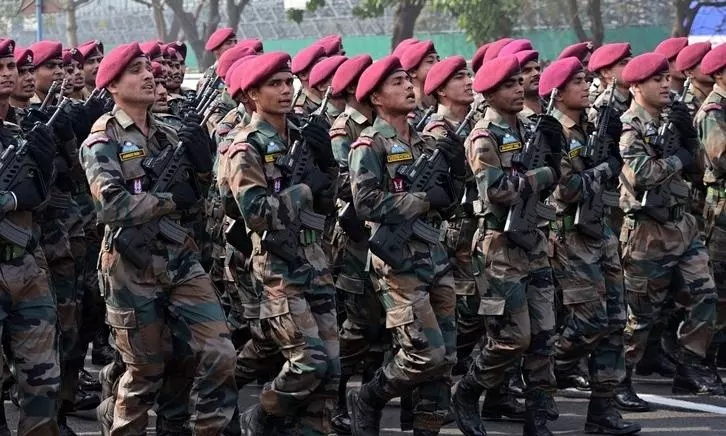
Rather than compromising on recruits, Centre should hike the defence budget to take care of military modernisation, operational sustenance and personnel costs
It is high time the Union government did a serious rethink on the controversial Agnipath scheme.
Given the political capital expended on it since the 2022 rollout, scrapping the scheme may be unrealistic. However, the retention rate of Agniveers should be increased from the current 25 per cent to at least 50 per cent, if not 75 per cent.
This course correction is now urgently required. By end-2026 or early-2027, the first batch of Agniveers in the Army, Navy and IAF will complete their four-year tenures. Under present terms, 75 per cent of them will be sent awaywithout pensions or ex-servicemen benefits.
Manpower shortage
With every passing year, this mass exit will further exacerbate the existing manpower shortages in the armed forces.
The already-overstretched Army, extensively deployed along the active borders with China and Pakistan as well as in counter-insurgency operations, for instance, faces a major shortage of about 1.8 lakh soldiers from its authorised strength.
The Army’s recent appeal to the youth in Punjab to join the Sikh Regiment in larger numbers indicates the diminishing lure of the olive green uniform as a first-choice option in traditional catchment areas, in the wake of the Agnipath scheme
Earlier, the Army used to recruit 60,000-70,000 soldiers annually to offset the numbers who retired every year. The recruitment, however, was first suspended during 2020-21 and 2021-22 due to the pandemic. Then, with the launch of Agnipath, the annual intake was initially slashed to 40,000 for the Army, and 3,000 each for the IAF and Navy.
Also read: Ex-Agniveers get 50 per cent reservation in BSF constable recruitment
While the Army increased the recruitment of Agniveers to 50,000 in 2025, it now plans to more than double it to 1.1 lakh this year onwards, to address the shortfall of combat-ready soldiers. A higher retention rate of 50 per cent to 75 per cent of already-trained soldiers will help mitigate this problem, while weeding out non-performers.
The Army’s recent appeal to the youth in Punjab to join the Sikh Regiment in larger numbers indicates the diminishing lure of the olive green uniform as a first-choice option in traditional catchment areas, in the wake of the Agnipath scheme.
Impacting efficiency
It was touted as a 'transformative scheme' to make the 14-lakh strong armed forces 'younger and fitter' by reducing the average age of soldiers from the existing 32 to 24-26 within six to seven years, while also ensuring tech-savvy personnel to meet the challenges of modern-day warfare.
Tweaks that Agnipath urgently needs
♦ Increase Agniveer retention to at least 50-75%
♦ Extend training duration for tech-intensive roles
♦ Ensure martyred Agniveers get same compensation as regular soldiers
♦ Prevent creation of two classes of soldiers
♦ Align recruitment with long-term operational needs
These are certainly goals to strive for. However, it’s an open secret that the primary driver was to slash the ballooning salary and pension bills that together consume over half the defence budget. Rather than compromising on the men behind the machines, the government should hike the defence budget to take care of both military modernisation and operational sustenance as well as personnel costs.
Moreover, modern warfare is increasingly all about technology now. It takes at least seven to eight years for military personnel to become fully combat-ready with the requisite hands-on experience, especially in the technology-intensive Navy and IAF. The armed forces can ill-afford to train Agniveers to handle sophisticated weapons and missiles, drone and counter-drone systems, only to discharge the bulk of them, just as they are on the cusp of gaining meaningful expertise.
Agniveers, incidentally, receive a truncated basic training of just six months instead of the earlier around 11 months.
Also read: Why Centre urging preference for ex-Agniveers in security jobs has triggered fear in Haryana
The high turnover rate, combined with the depleting number of field firing ranges, lack of adequate training ammunition and other such factors, will degrade long-term combat effectiveness and operational efficiency, despite the collusive threat posed by China and Pakistan, which was reinforced during Operation Sindoor last year.
No pilot
General M M Naravane, in his memoir Four Stars of Destiny (the publication has been blocked by the government), after retiring as the Army chief in April 2022, says his force had initially proposed only “a limited number (10 per cent)” of jawans be enrolled for short-term service.
But the PMO directed that not only should the entire intake (100 per cent) be on a short-service basis, but it would apply to IAF and Navy as well, which “came like a bolt from the blue” for the latter two. The Army later did argue that 75 per cent of the recruited jawans should be retained, but to no avail.
Ideally, such a radical shift should have been test-bedded through a pilot project instead of jumping headlong into it, making it the sole entry point for lower ranks.
Two classes of soldiers
Agnipath also undermines the all-important cohesion, camaraderie and regimental spirit of battalions, with two classes of soldiers, the Agniveers and the regular ones with higher salaries and annual leaves as well as pensions.
The Agniveers being demobilised, of course, have been promised a Seva Nidhi exit package of ₹11.71 lakh each, as well as lateral entry into central armed police forces, and a host of other organisations. The latter will need to be diligently implemented because actual absorption rates for ex-servicemen in other jobs has been dismally poor over the years.
The social risk of discharging thousands of `trained-to-kill’ youth into a stagnant job market cannot be ignored.
Also read: Operation Sindoor | Experience proved 'litmus test' for Agniveers: Report
The basic ethos of Indian soldiers revolves around `Naam, Namak and Nishaan’ (battalion’s reputation, fidelity, and ensign/colours). They fight against seemingly insurmountable odds, as they did while climbing up the formidable Kargil heights to take on well-entrenched Pakistani infiltrators in 1999.
Short-term or contractual employment will adversely impact this fighting spirit.
The armed forces certainly need to slash their non-operational flab. But if the Constitution can be amended well over a hundred times to reflect changing realities, the Agnipath scheme can – and should – be tweaked. It is imperative for national security.
(The Federal seeks to present views and opinions from all sides of the spectrum. The information, ideas or opinions in the articles are of the author and do not necessarily reflect the views of The Federal)