North and South Blocks, the seat of power for over a century, have been vacated as Modi drastically remakes Delhi and its landmarks to claim his place in history
For close to 500 years, the city that is now Delhi has been constantly renovated, reframed and rethought.
As part of this continuum, 100 years ago, Delhi acquired a distinct colonial character when Edwin Lutyens and Herbert Baker designed a new capital on the Raisina Hill and surrounding areas, which were part of Punjab, in their own imagination and, of course, as a show of colonial pride.
Delhi has many layers of architectural thinking and narratives like a palimpsest, each layer trying to outdo the other in grandeur, be it the Mughal, Imperial, Christian or Indian.
Hindu pride
Prime Minister Narendra Modi, too, jumped into this architectural broth about 10 years back, when he, in imperial style, ordered the remaking of the capital, maybe as an assertion of Hindu power over the Mughal and colonial. His favourite Gujarat architect, Bimal Patel, who did the Sabarmati waterfront project, not surprisingly got the contract for and was summoned to carry out the Hindu or Modi vision.
Also read | Beatles Ashram redo: Gujarat architect Bimal Patel bags another plum project
The main idea seems to be to have buildings that would mark Modi out as a maker of an aggressive Hindu India which would no longer lie in the shadow of Mughal enterprise or architecture. Purana Qila, Red Fort, India Gate, the North and South Blocks, the grand circular Parliament building with its Doric pillars, etc., would be just old stories pushed aside as a new India emerges all gleaming.
Renames and new looks
Of the many buildings and the boulevards which were being redone, some, like the Rajpath — renamed Karthavya Path — were opened a couple of years back.
The Rajpath has been renamed Karthavya Path. Image: iStock
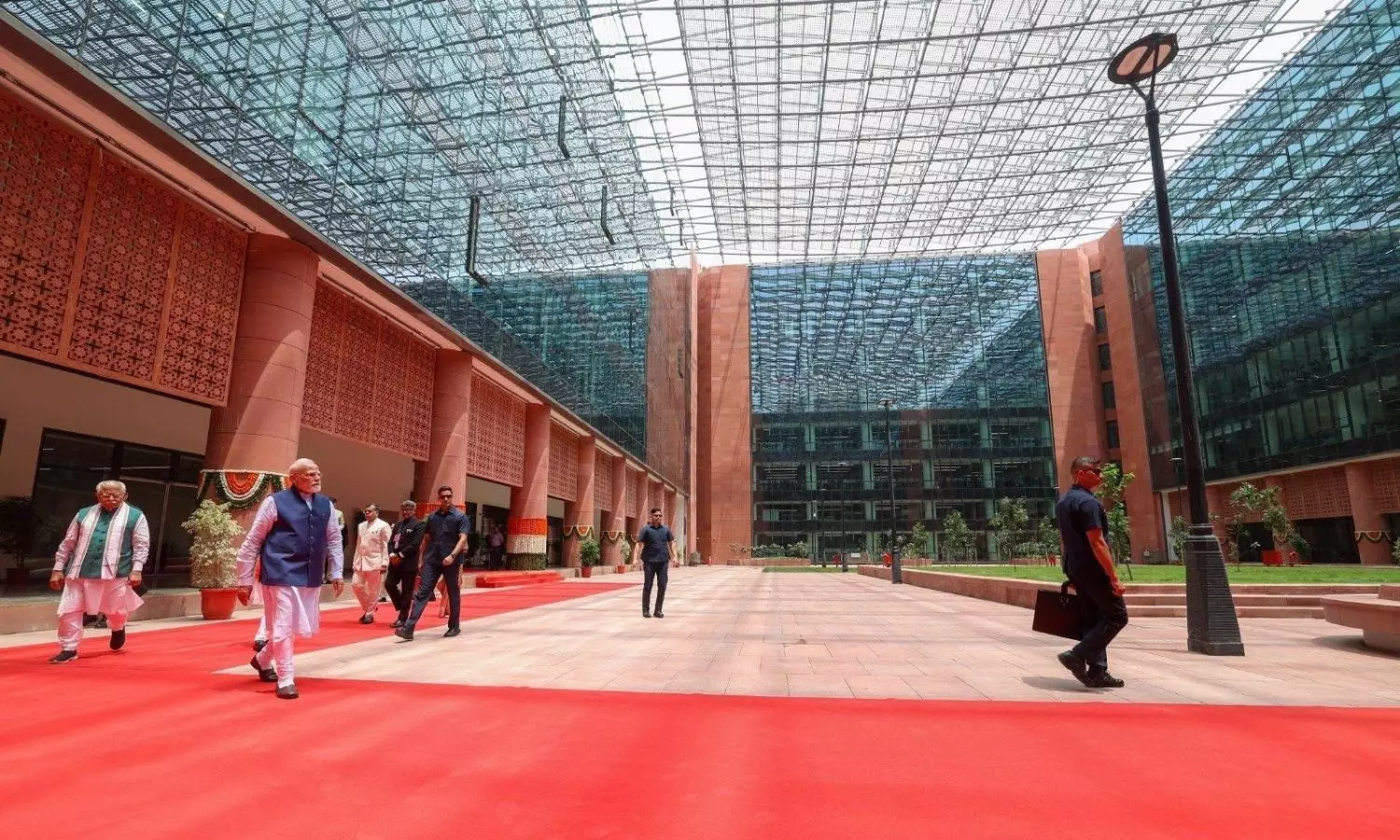
On all sides of this regal boulevard, buildings were being torn down and remade. Just a hundred metres away from Rajpath, on Janpath, the massive new glass and concrete box-like structure, the Kartavya Bhavan (close to 100 m long), has come up and started functioning, housing many departments which were earlier in Shastri Bhavan and the North Block .
Delhi's North Block. Image: Wikimedia Commons
Delhi's South Block. Image: Wikimedia Commons
Other offices in the North and South Blocks will now be shifted to another set of buildings being developed on Dara Shikoh Marg by the side of the Parliament complex, called Seeva Teerth, which houses buildings for different offices, too. The entire complex includes gleaming new houses for the PM (not to be left behind) and the Vice President.
Watch | Modi govt's urban planning is bhakt planning; all just say 'jai ho': Jawhar Sirca
Makar Sankrati (January 14) was considered auspicious for the shifting of offices which has been completed now, though Karthavaya Bhavan is still being finished.
Going by the renaming spree, which is part of the process of clearing out the debris of history, there can be no doubt that Dara Shikoh Road will be renamed. The only delay seems to be the search for a BJP/RSS hero to decorate the road. The names of most BJP and RSS heroes have already been used, with Deen Dayal Upadhyaya getting at least five institutions and roads, apart from Sardar Patel and SP Mukherjee, who have got multiple institutions named after them.
Right in the middle of all this, like an old building left behind by the march of time, is a small dargah housing the remains of former President Zakir Hussain. How long the dargah (the new Parliament building has its entrance opposite to this) will survive in that spot, as an 'eyesore' to the Hindutva architects and political biggies, has to be seen.
Lost opportunity
It was not possible to make any changes to the New Delhi landscape without getting permission from various bureaucracies that inhabit the capital, including the Delhi Urban Arts Commission, which had some well-known urban architects.
But Modi, who is all-powerful and brooks no dissent, has ridden roughshod over all these offices. An eyewash of a selection process was held only for Patel before he was predictably handed over the entire capital of India to do what he wished. It was a chance to architecturally change the face of the capital from Imperial and Mughal to something new, or perhaps New India. That chance was blown up due to the PM’s fascination with one architect.
Also read | All that is not Gandhian about Sabarmati Ashram makeover
“In the architectural competition held for the project, Patel’s scheme stood out for its neo-rationalist sobriety. It refused to engage with the symbolism of context but exploited the monumentality," Jagan Shah, a well-known urbanist and architect, told The Federal. "We could have learnt a thing or two from Mitterand’s Grands Projets for Paris in 1980 and the 1990s — an apt comparator for the Central Vista development — which reinvigorated the French capital by commissioning different architects to create an ensemble of visionary buildings. In suffering the difference between the architect as developer and the statesman as architect, we seem to have lost a rare opportunity for demonstrating the stylistic innovation needed for Viksit Bharat."
Thin on ideas
In fact, many architects are sore about the fact that not one among the many buildings was farmed out to other urban architects or new firms that have brought modern ideation into urban architecture. Huge amounts were funnelled into just Patel’s company. Such freedom no architect has enjoyed anywhere in the world. “We must differentiate between grand vision and grand greed,” an insider said.
Edwin Lutyens ideated the circular and coliseum-like nature of the old Parliament building.
The new Parliament building planned by Gujarat-based architect Bimal Patel. Image: Wikimedia Commons
In fact, neither the Modi government nor Bimal Patel had any particular architectural idea or concept because there is no Hindu architectural style for big modern offices to serve as inspiration. So all the new buildings mostly Xeroxed Western concepts changed to a PWD (public works department) utilitarian style with concrete floors and pink stone forming the cladding, which is now uniform for all sarkari buildings in the capital.
Also read | The godly yearnings of Narendra Modi…and the crash to earthly reality
In 1911, for the North and South Blocks, Fyzee Rahman, a well-known artiste, was called in to paint the domes. “He used the flat tempura technique to paint the two domes using Hindu and Islamic motifs. In the North Block, GN Nagarkar used the theme of ‘Hindu Aryan life’ and executed his creative outpouring on canvas that was fixed to the ceiling of the princes’ waiting room,” Malvika Singh writes in New Delhi: Making of a Capital.
Carpets, which were reproductions of the great Mughal floor coverings, were specially woven in Kashmir. No such efforts to preserve bits and pieces of Indian art seem to have been made in the new buildings. In any case, Mughal symbolism is a strict no-no now, and the very grand effort is to wipe out vestiges of Mughal architecture.
Space for discussions
No debate about architectural style took place since Patel had the entire power. When the North and South Blocks were being planned in 1911, there were long winded discussion between Edwin Lutyens and Herbert Baker about the architectural vision.
The main discussion in 1911-12 was about why the Government House (Rashtrapati Bhavan) would not be visible from the India Gate side and would be dominated by the office buildings, North and South Blocks. The entire area was designed and developed by Lutyens and Baker. Another architect, RT Russell, did most of the other parts, including Connaught Place.
Lutyens wrote to his friend Emily (quoted in his biography by Jane Ridely): “I am having difficulty with Baker. You remember the perspective showing the secretariats with Government House beyond. Well, he has designed his levels so that you will never see Government House at all from the Great Place (Raj Path). You will see (only) the top of the dome! He is obstinate and quotes the Acropolis at Athens, which is in no way parallel. I have put a protest to him in writing and he will be angry and I have to carry on further.”
Watch | New Parliament building: Will it be a whole new era for India?
Baker had his way on the issue of the gradient, and the Rashtrapati Bhavan cannot be seen from down the road. But Lutyens had his way on the circular and coliseum-like nature of the Parliament building (now old and discarded).
Both Lutyens and Baker, though colonial architects with imperial visions who looked down upon Indians, decided to inculcate Indian traditions as much as possible into the new capital they were building. “Lutyens studied Indian traditions earnestly, looking for motifs and symbols, created a directory of local materials, gathered elements of art and craft, both secular and temporal, tweaked much of it and put it all together in an attempt to create a hybrid style. The colours of India were brought in through the murals and painted ceilings,“ according to an article in New Delhi: Making of a Capital by Malvika Singh and Rudranshu Mukherjee.
Builders and creators
As huge offices are shifted out, New Delhi is likely to look different with the colonial buildings looming out like ghost structures or colonial tombs. The plan is to convert the blocks into museums but, there too, there is no vision, though tenders have been issued for revamping the two blocks. The wonderful National Museum is down the road. With what will the museum be populated?
Jawaharlal Nehru and Abdula Kalam Azad with Stafford Cripps standing outside North Block. Image: Wikimedia Commons
Time and again, Modi has attacked or tried to deface Nehru’s achievements. This is part of the plan to create a new history for the capital. The buildings that form the framework of this Hindutva project are all there now. Unlike Nehru, Modi so far cannot claim to have become a builder of institutions. But now he can at least claim to be a builder of buildings.
(The Federal seeks to present views and opinions from all sides of the spectrum. The information, ideas or opinions in the articles are of the author and do not necessarily reflect the views of The Federal.)