Catholicos Baselios Marthoma Mathews’ speech marks a shift from earlier stance, suggesting Christians and Muslims are comrades in distress amid Hindutva threat
There are some moments in the political lives of both individuals and communities when, no matter how much they have tried to wish it away and whatever they have done to turn a blind eye to it, reality forces itself upon them with a clarity so bitter that they cannot deny it anymore.
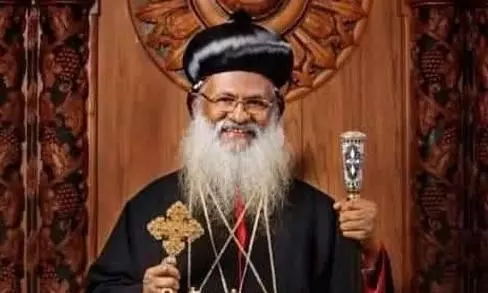
It is one such moment that one can perceive in Baselios Marthoma Mathews III — the Catholicos of the East & Malankara Metropolitan, the Supreme Head of the Malankara Orthodox Syrian Church (Indian Orthodox Church) — speaking out strongly against the recent attacks against Christians and Christmas celebrations in various parts of the country.
By placing God and the Constitution on the same moral footing, the Catholicos most interestingly imparts a political and ethical sacredness to the Constitution as an authoritative text that transcends the dictates of any temporary political majority.
While delivering the feast message at St Mary’s Church in Panayampala, Kottayam, on January 2, he did not mince words in calling out the Centre (“rulers”) for its conspicuous silence, stating in the plainest of terms that, in addition to failing in its responsibility to control “terror groups”, its silence can only imply that the attacks on minorities are indeed a part of the larger majoritarian programme of those in power.
A wake-up call
That the Catholicos’s speech marks a significant shift in the Orthodox Church’s position regarding the BJP-led Union government, the RSS, and its associate organisations, is beyond doubt.
After a period of cautious flirtation and high-profile diplomatic engagements—including direct meetings with Prime Minister Narendra Modi Modi and the BJP’s targeted outreach to the Christian community in Kerala—the Church appears to be finally waking up to the increasingly precarious predicament of the Christian community in a Hindutva-dominated India.
Also read: ‘India for Hindus’ slogans against Constitution and history: Catholicos Baselios
Though one may think that they were exercises in futility, one cannot entirely fault the Catholicos for his initial attempts at diplomacy, motivated as he might have been by a need to avoid conflict and a natural sense of responsibility to safeguard his minority congregation from the violent power of the majority.
Stinging direct criticism
It was evident even then that he harboured few illusions about the nature of the entity he was negotiating with, because he had notably reserved the right to criticise if there happened to be cause. And, at one point, when two Kerala Catholic nuns were arrested in Chhattisgarh on charges of human trafficking and proselytisation, he had even said that “a policy of simultaneous appeasement and persecution is contradictory”.
However, the current tone of stinging direct criticism is truly remarkable. By holding the government squarely responsible for, and even culpable in, the violence, the Catholicos has signalled that the danger can no longer be wished away or managed through quiet diplomacy alone.
That aside, the larger historical and political framework within which the Catholicos has placed his statement gives us pause for thought since it suggests a much larger shift of perception and policy under way. To put it in a nutshell, it constitutes a most incisive critique and condemnation of the most central tenets and assumptions of the entire Hindutva political programme, a critique that is probably the sharpest to date coming from any official Christian quarters.
If the Aryan was a migrant from 2000 BC and the Christian/Muslim a migrant from later periods, the differences are merely chronological, not ontological. It effectively renders the term “foreigner” meaningless in the Indian context.
On a closer look, there are five key takeaways from the short yet plain-speaking message.
Takeaway 1: On Sangh’s version of Indian history
The first is a trenchant critique of the Sangh’s monolithic version of Indian history, with the Catholicos directly contradicting the narrative of an indigenous Aryan/Hindu origin. Reflecting on the xenophobic slogans of right-wing groups that attacked Christmas celebrations declaring, “no foreign religions, no foreigners in India” he pointedly asks, “Who is the foreigner?”
Also read: Xmas outreach, silence on attacks: PM’s maiden service ahead of Kerala polls
He observes that Hinduism emerged as a religion only after “the Aryans, who migrated from Iran around 2000 BC, established Brahmanical worship”, noting that there is “no Aryan or Hindu who originated solely from India”.
Notably, he speaks of “Aryan migration” rather than “Aryan invasion”, indicating that he is abreast of recent insights in historiography, and describes how these early migrants seized control of the regions occupied by the “very powerful Indus Valley Civilisation”, pushing the Dravidians, who had “reached India from Africa through Iran” around 4000 BC, towards the south, their descendants being “those who speak Telugu, Kannada, Tamil, and Malayalam”.
Trump-like claims
Equating the Sangh followers’ “foreigner” claims to Trump’s ridiculous and exclusionary rhetoric of “America for Americans”, the Catholicos presents a vision of India as a vast tapestry of millenary migrations, asserting that since everyone arrived from other regions over the ages, no single community can claim primordial origin to the exclusion of others.
By framing Indian history as a series of migrations, the Catholicos effectively puts forward a multi-origin historical paradigm to dismantle the “Vedic Infallibility” claim, which insists that Hindu culture is the original, singular and indigenous spirit of the land.
Also read: India trashes Pakistan's remarks on its minorities as 'finger pointing'
If the Aryan was a migrant from 2000 BC and the Christian/Muslim a migrant from later periods, the differences are merely chronological, not ontological. It effectively renders the term “foreigner” meaningless in the Indian context. By showing that the judge (the Hindutva proponent) is the descendant of a former “immigrant”, so to speak, he invalidates the moral authority of the Hindutva state to categorise followers of faith based on the latter’s arrival date.
Takeaway 2: Constitution is akin to God
The second is his pointed reference to the Constitution as the very foundation of the Indian nation: “We all have the freedom of religion and the right to practise our rituals. All the people of India are equally free before the Constitution, without any distinctions of majority religion or minority religion. Every religion has equal rights and there is the right to believe in, practise, and propagate any religion. No one can deny the right to propagate. The freedom to build places of worship or to worship is granted to all religions equally by God, and by this Constitution.”
He strips the state of its mask of neutrality and holds the executive responsible for the subcontracted violence of vigilante groups and framing the protection of minority rights as the ultimate litmus test for the constitutional and democratic legitimacy of the government.
By thus placing God and the Constitution on the same moral footing, the Catholicos most interestingly imparts a political and ethical sacredness to the latter as an authoritative text that transcends the dictates of any temporary political majority.
His assertion that the freedom to worship and the right to propagate any religion are divinely and legally sanctioned pointedly distinguishes the constitutional right of propagation from the controversial spectre of proselytization, serving as an indirect challenge to the various state-level anti-conversion laws, framing them as a violation of a fundamental liberty that “no one can deny”.
Takeaway 3: Holding the State responsible for violence
Third, in what can only be construed as an oblique reference to the Bajrang Dal and other Sangh Parivar groups—indeed a courageous act of calling a spade a spade—he says: “A few extremists or terrorist groups have no right to act contrary to this (the tenets of the Constitution). It is the rulers governing this country who must control them. When they remain silent without raising their voice against it or condemning it, Christians or minorities can only understand it as being part of their programme.”
Also read: Derek O’Brien questions Modi’s Christmas message amid attacks on Christians
Apart from identifying, albeit indirectly, right-wing vigilante groups as “extremists” and “terrorists”, a statement that is in itself hugely radical given that he is the anointed leader of a minority religious community, his characterisation of their actions as violations of the Constitution moves the ultimate blame and responsibility for the attacks from them and places the onus squarely on the government.
It strips the state of its mask of neutrality and holds the executive responsible for the subcontracted violence of vigilante groups and framing the protection of minority rights as the ultimate litmus test for the constitutional and democratic legitimacy of the government.
Takeaway 4: New understanding of intersectional precarity
Fourth, in a significant departure from earlier Christian positions that tended to sympathise with Hindutva narratives that demonised Muslims, the Catholicos suggests that Christians and Muslims are comrades in distress.
“The Hindus of today are born and raised in India within the Hindu faith. The Christians here are also born and raised here, having embraced Christianity since 52 AD. They are citizens of this country. No Christian is here who has come from Israel," he says.
"No Christian is here who has come from Arab countries. The people here are of Indian origin; they are born and raised in India. It is the same for the Muslims here; they are born and raised here. There are no Muslims here from the Middle East. Only Muslims born and raised here are present here. Therefore, that religion has the right to exist here, as does Christianity and Hinduism.”
Equal in precarity
This move is quite path-breaking in the context of Kerala, where sections of the Church and of the Christian community—often satirically termed "Krisanghis” in popular Malayalam parlance—have previously flirted with Hindutva narratives to gain temporary favour. It exposes, and one should say even admits, that exceptionalism is a fallacy and dismantles the illusion that one minority can secure safety by pandering to a majoritarian system or by distinguishing its “worthiness” from that of another.
By mentioning Muslims and Christians in the same breath as being equally threatened, one could even see in his statement the possibilities of a new understanding of intersectional precarity.
Also read: Catholic Bishops' body condemns attacks on Chirstians ahead of Christmas
In a majoritarian-authoritarian framework, there are no “preferred” minorities; there are no bigger or smaller victims, nor can anyone get away by pandering to the majority. All minorities are equal in their precarity; it is only a matter of time, and the hour of reckoning shall come to each community, irrespective of whether it is sooner or later.
Takeaway 5: A clear message to State
Fifth, in a striking note of defiance, the Catholicos also signalled that the Christian community is not going to take persecution lying down: “It is the truth that if the RSS has a major motto that says ‘India for Hindus’…it is not going to work in this India. It will never happen. Christians have no hesitation in becoming martyrs for this cause because the Christian religion was formed through martyrdom and persecution. Resistance against persecution began in the first century.”
The message to the State is clear: The Church has survived two millennia of persecution by outlasting empires, and it possesses the historical and moral stamina to do so again.
If the words are taken to be more than mere rhetoric, this grounding of the Church’s current predicament in its ancestral identity and the present struggle not as a novel threat but as a continuation of a two-millennia-old heritage of resilience indicates a major shift in posture from one of seeking state protection to one of moral and civil confrontation.
It is a declaration that the Church possesses a long-term memory of survival that exceeds the lifespan of any passing political regime; it serves as a warning to the state that persecution will not result in submission, but rather in a fortified, principled resistance that draws its strength from the very history of suffering the state seeks to exploit. The message to the State is clear: The Church has survived two millennia of persecution by outlasting empires, and it possesses the historical and moral stamina to do so again.
Where do we go from here?
Whether this marks the emergence of a minority politics that no longer seeks a place at the table of the majority, but instead asserts its relative right to the house itself, only time can tell. Despite that, when a senior leader of a Christian Church calls out the government in such direct terms, there is no doubt that it will have international repercussions because Christians all over the world are bound to sit up and take note.
Also read: Minority rights panel lies defunct as discrimination complaints soar
Whether that will make any difference to the majoritarian culture of the government and its associates is doubtful, given that their whole political programme—indeed their very survival in power—thrives on minority baiting and hatred.
However, it is certain to speed up the country’s descent into a outcast state that the international community would choose to avoid.
(The Federal seeks to present views and opinions from all sides of the spectrum. The information, ideas or opinions in the articles are of the author and do not necessarily reflect the views of The Federal.)