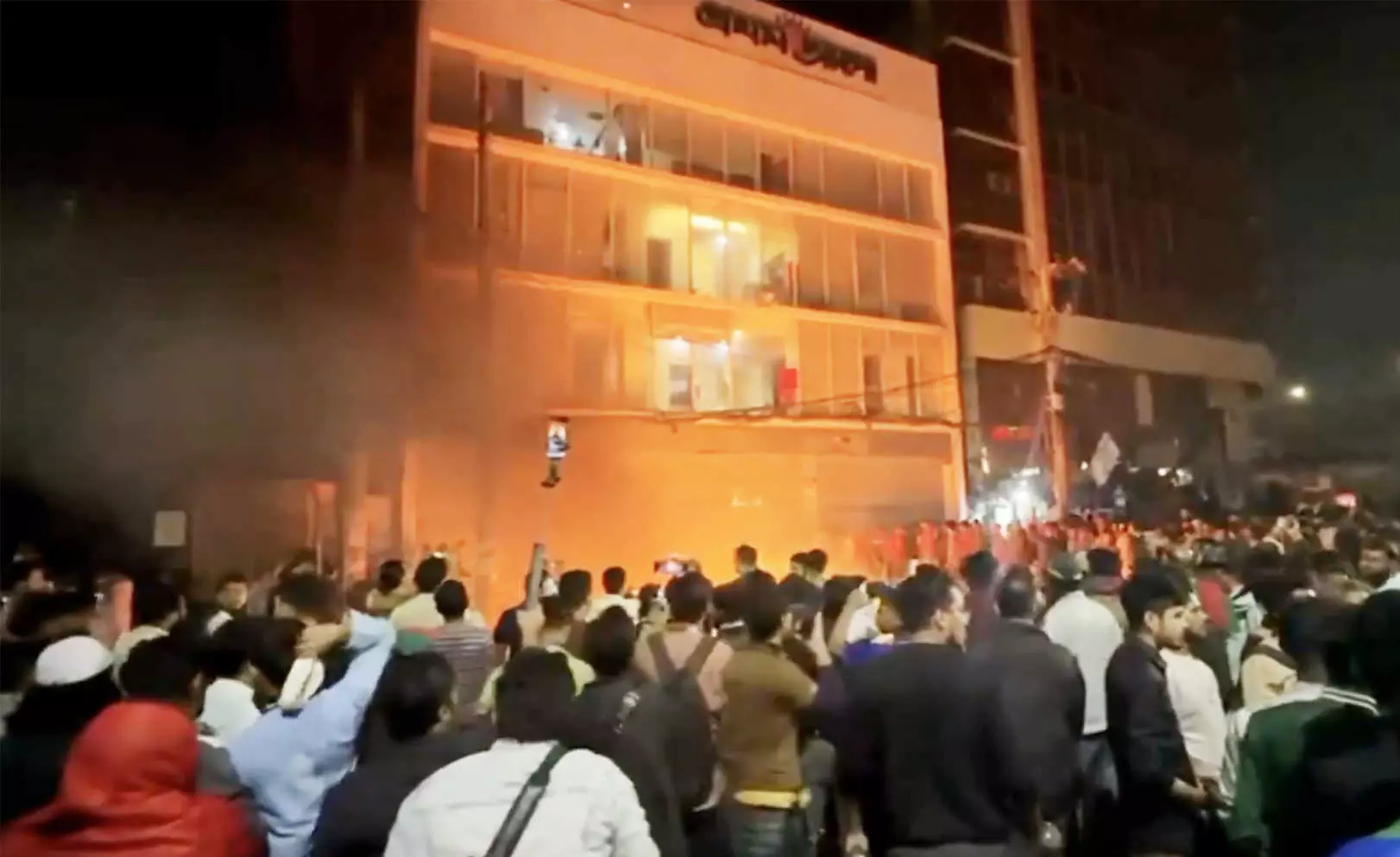
Protesters vandalise the office of Bangladesh daily 'Prothom Alo' amid widespread outrage on Thursday (December 18) night over the death of Sharif Osman Hadi, a prominent youth leader. Photo: PTI
The interim leader seeks the presidency through a 'Minus Two' plan to sideline the Awami League and BNP, as orchestrated violence targets Indian missions and rivals
In politics, there is often a method to madness. The escalating violence in Bangladesh, directed against Indian diplomatic establishments and minorities as well as leaders of mainstream political parties such as the Awami League and the Bangladesh Nationalist Party (BNP), is part of what Nobel laureate Muhammed Yunus describes as a "meticulous design". Like the July-August agitation last year that brought down the Awami League government of Sheikh Hasina, the present wave of violence is aimed at an Islamist takeover of the country.
Yunus, now head of Bangladesh's interim government, is determined to implement his 'Minus Two' plan — marginalise both the Awami League and the BNP — and bring to power the Jamaat-e-Islami, which opposed Bangladesh's independence and backed the cause of a united Pakistan in 1971.
Also read: 'Real concern is Pakistan or outfits like Lashkar or Jaish using Bangladesh to attack India'
Jamaat has remained a marginal player in Bangladesh politics, never garnering more than 10 per cent of the vote. After playing a major role in last year's successful anti-Hasina agitation, it used the Yunus-led interim government to put its assets in key positions in civil administration and the military hierarchies, educational institutions, media as well as other important echelons of power. Now, it is clearly aspiring for power on its own steam at the head of an Islamist coalition with a few other radical parties in tow.
Jamaat-e-Islami upbeat
With the Awami League banned and the BNP in a bit of disarray, Jamaat has reasons to fancy its chances at the hustings for the first time in independent Bangladesh. In Yunus, it has an ally of convenience. The Nobel laureate has not concealed his ambition to be the president.
Also read: India’s multiple diplomatic crises: Shyam Saran on how New Delhi is coping
The Awami League and the BNP have their own candidates, and only Jamaat would agree to make Yunus the president of the Republic. Seen as a party of radical mullahs, it finds in the Nobel laureate, who has many backers in the West, a very useful global image manager for what would essentially be a radical Islamist regime.
Yunus wants to be president
Yunus needs to be the president to ensure immunity from prosecution for the many cases of financial irregularities and money laundering against him. As president, he would also be the supreme commander of the armed forces. Determined to fulfil his ambition but without a political support base, Yunus has to turn to Jamaat.
Hadi's assassination was most probably a similar insider job, designed to whip up public sentiments against the Awami League, BNP and also India. The narrative widely circulated by Jamaat and the National Citizen Party (close to Yunus) is that Hadi's killer was an Awami student leader who escaped to India after the shooting.
The latter also needs the unstinted support of the Yunus-led interim government to manipulate the upcoming election, first by putting their assets in key positions and then by 'managing' the election process. In short, Yunus and Jamaat seem made for each other.
Hadi's killing an inside job!
The assassination of Osman Hadi, most likely an inside job, seems to have been organised to provide the fuel for a wave of Islamist violence that can be passed off as a spontaneous reaction to the killing.
Hadi, chairman of the Inquilab Mancha, was vocal but a marginal player in the youth leadership that led the agitation to oust Hasina. It is unlikely that the Awami League, which is on the run, would muster the will to go for him. Police investigations have so far revealed that he was killed by someone very close to him. Hadi had filed nominations to contest a seat in Dhaka against the BNP stalwart Mirza Abbas, but he was no real challenge electorally.
Also read: Bangladesh: Hasina gets 5-year jail term in land scam case
So, the real gainer from his agitation is Jamaat and the Yunus youth brigade. There is enough evidence of killings during last year's July-August agitation, which were engineered by those leading the agitation to whip up public frenzy against the regime.
Even Yunus's former home adviser Brigadier (retd) Shakhawat Hossain had admitted to the use of some bullets to kill agitators, which are not in use by Bangladeshi security forces. He was immediately removed from the home ministry and shunted to a less important one.
Hadi's assassination was most probably a similar insider job, designed to whip up public sentiments against both the Awami League and the BNP (by pointing fingers at Abbas) and also India. The narrative widely circulated by Jamaat and the National Citizen Party (close to Yunus) is that the killer of Hadi was an Awami student leader who escaped to India after the shooting.
Also read: Bangladesh crisis biggest strategic challenge for India since 1971: Panel
This has been used to provoke feelings to bring thousands of radicalised youth, mostly madrassa-educated, to the streets. The attacks on Indian diplomatic establishments across Bangladesh have taken place as part of this "meticulous design" to facilitate 'Rajpath Dokhol' (capture the broadways) by the Islamist radicals.
Tarique Rahman's return plans
The immediate urgency for this perhaps was a decision taken by the BNP's acting chairperson, Tarique Rahman, to return to Bangladesh from London after 17 years in exile. His return can steady the BNP's faltering fortunes and boost the morale of its party cadre.
With the Awami League banned and the BNP in a bit of disarray, Jamaat has reasons to fancy its chances at the hustings for the first time in independent Bangladesh. In Yunus, it has an ally of convenience.
The BNP, drawing on the legacy of its founder, Lt Gen. Ziaur Rahman (a front-ranking freedom fighter in 1971), is capable of drawing into the pro-liberation sentiments, with the Awami League out of the fray. That is exactly something that both Yunus and Jamaat do not want.
Hadi's killing and the orchestrated violence after that are designed to keep the pot boiling for an Islamist takeover in Bangladesh.
(The Federal seeks to present views and opinions from all sides of the spectrum. The information, ideas or opinions in the articles are of the author and do not necessarily reflect the views of The Federal.)