By defying Washington and striking Beirut, Israeli PM prioritises his domestic political strategy, ahead of parliamentary elections, over US diplomatic goals
At the heart of the recent Israel-Iran strikes is the ongoing war against Hezbollah in Lebanon, which is continuing despite the announcement of another ceasefire last week.
Iran had made it amply clear that any attack on Beirut’s southern suburbs, the stronghold of Hezbollah, would force it to retaliate. The Israel Defence Forces' (IDF) decision to strike Beirut appears to have crossed a red line for Iran.
Tehran responded with missile attacks on Israel, prompting Israeli retaliatory strikes deep inside Iran, including targeting the Mahshahr petrochemical complex.
Message behind Iranian strike
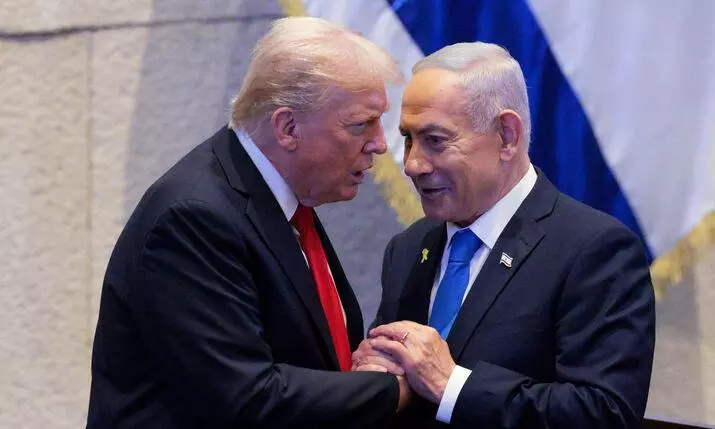
The exchange marks the most serious escalation since the April ceasefire and comes at an awkward moment for US President Donald Trump, who is hoping to get a peace deal with Iran, declare victory, and get out of a sticky situation and an unpopular war. Trump has been warning Benjamin Netanyahu not to escalate, but the Israeli Prime Minister appears not to have heeded the American leader’s advice.
The new Iranian regime wants to reassure the axis of resistance, comprising Hezbollah in Lebanon, the Shia militia in Iraq, and the Houthis in Yemen, that they will not be abandoned.
A confident Iran is now sending a message to Israel and the US that Lebanon is very much part of the equation. Tehran's missile strike was not just a support for Hezbollah but was the enforcement of a declared red line.
Also read: Trump asks Netanyahu not to strike Iran; says 'very close' to peace deal
There cannot be peace without stopping the assault on Hezbollah in Lebanon, something Israel has been doing despite the ceasefire. The new Iranian regime wants to reassure the axis of resistance, comprising Hezbollah in Lebanon, the Shia militia in Iraq, and the Houthis in Yemen, that they will not be abandoned. There is acknowledgement that Iran’s hands-off policy — when, after Gaza, Israel turned its attention to Hezbollah — was a mistake.
Iran’s security ring
Earlier, in Iran, the general public was critical of the Khamenei regime, spending money and resources on resistance groups. However, most realise now that these outfits provide Iran with a security ring.
These groups are important to Iran and serve an important security function, so abandoning Hezbollah and striking a deal with the US will not serve Iran’s long-term security interests. Thus the insistence that fighting has to stop in Lebanon before Iran can seal a deal with the US.
Watch: 'Trump is under pressure, wants to end Iran war' | Worldly-Wise
In an early morning reaction to Sunday’s escalation, Donald Trump posted on his social media outlet Truth Social: “Both sides, Israel and Iran, are looking to do an immediate CEASEFIRE! Final negotiations on “Peace” are proceeding, subject to ignorance or stupidity getting in its way. The Blockade will remain in place, and in full force and effect, until a “Final Deal” is reached. Things should move quickly. Thank you for your attention to this matter! President DONALD J. TRUMP.’’
The US President here is calling for de-escalation.
US, Israel not on same page
By striking both southern Beirut and Iran, Netanyahu has, in fact, defied Trump. The strikes highlighted a growing divergence between Washington's diplomatic objectives and Israel's military calculations.
Cynics wonder if all this is scripted. Are Israel and the US playing good cop-bad cop? This will only be clear if Israel has to face the consequences of defying Trump. If Washington overlooks Israel’s transgressions, then it becomes clear that the US was in the know, as some in the American media have suggested.
There is a strong Israeli lobby operating in the US, and it is not easy for Trump, despite all his boasts, to defy this powerful lobby.
One thing is clear: Netanyahu wants to continue the war and is averse to a peace deal with Iran. Not just Netanyahu, but the entire Israeli establishment considers Iran an existential threat and wants the regime to be defanged and destroyed, so as never again to pose a danger to the Jewish state.
Netanyahu’s political strategy
Despite Israel’s military success following the October 7 Hamas strike of 2023, killing both the political and military leadership of Hamas in Gaza and Hezbollah in Lebanon, Israel has not succeeded in eradicating either group.
Hamas continues to control Gaza, and Hezbollah has proved once again that despite the elimination of Hassan Nasrallah, neither of the militant outfits has buckled, though both, especially Hamas, have been considerably weakened.
Netanyahu is facing parliamentary elections at the end of September or October this year, and he wants to ensure that he faces the electorate from a position of strength, as the only leader who was able to drag the US to war against Iran.
Netanyahu is facing parliamentary elections at the end of September or October this year, and he wants to ensure that he faces the electorate from a position of strength, as the only leader who was able to drag the US to war against Iran.
Also read: US retreat, Israel’s isolation, India’s dilemma: Gulf crisis exposed more than limits of force
These political calculations will be part of Netanyahu’s strategy ahead of national polls. His message at the moment is not to Iran or to Hezbollah or the US but primarily for the domestic audience.
Iran refuses to back down
But it is not in Iran’s interest to continue the war. Having proved a point by three waves of missile attacks on Israel, the Iranian military's Khatam al-Anbiya Central headquarters said in a statement published by the Islamic Revolutionary Guard Corps-run Fars News Agency on Monday afternoon that the strikes were in response to Israel’s attack on Beirut’s Dahiyeh locality and have now ended. But it warned that if Israel persists, “much more severe and crushing measures will be on the way.”
Also read: The duplicity behind Trump's push to disarm Iran
Beyond the fact that Iran had previously stated that a ceasefire in Lebanon was one of the conditions for ending the conflict, this move also appears to serve as a message to its adversaries and to Arab states in the region that Iran remains prepared for confrontation if necessary. In that sense, the escalation can be viewed not only through the lens of the immediate military situation, but also as part of a broader effort to maintain deterrence and signal resolve.
Trump may believe a deal is within reach, but Lebanon has emerged as the real battlefield on which that agreement will succeed or fail. If the fighting in Lebanon continues, every ceasefire may prove to be little more than a pause before the next round of war.
(The Federal seeks to present views and opinions from all sides of the spectrum. The information, ideas or opinions in the articles are of the author and do not necessarily reflect the views of The Federal.)