Champat Rai’s grouse is unambiguous – that Nripendra Misra had a free run within the Trust insofar as its most important functions, temple construction and decisions related to it, was concerned.
Rai’s note and Nripendra Misra’s rebuttal spotlight the long-running tussle between the movement’s ideological foot soldiers and the Modi govt’s bureaucratic control over the Ayodhya temple project
Media reports on August 21of a nine-page note reportedly shared in the Vishwa Hindu Parishad (VHP) media group by former general secretary of Shri Ram Janmabhoomi Teerth Kshetra Trust (SRJTKT), Champat Rai, have triggered another round of turmoil within the Sangh Parivar ecosystem days ahead of the September 3 meeting of the Trust. This meeting is expected to choose the Trust’s first chief executive officer (CEO) in the wake of the donation theft row.
The fresh schism within the Sangh Parivar’s showpiece project comes amid reports that a retired bureaucrat has been shortlisted for the job of the Temple Trust’s administrative head. The VHP-backed Rai will have no voice in the selection due to his exit, underscoring an important sub-plot in the Ram temple’s multi-decade trajectory from street mobilisation to bureaucratic institutionalisation.
However, the former Principal Secretary to Prime Minister Narendra Modi, who is the chairperson of the Ram Temple Construction Committee and Temple Trustee, Nripendra Misra, promptly dismissed the note as “concocted and fabricated”.
Discordance within the Trust
Despite the proactive rejection of Rai’s note by Misra (media reports stated that Rai confirmed to journalists as having written the note), the episode underscores the sharp divergence within the Trust since its establishment in early 2020 by the Centre.
Although Rai has reportedly been given the proverbial clean chit by the Special Investigative Team in its preliminary report, he stands to be seen as “guilty” by the people. It seems highly unlikely that either he or any other powerful VHP figure would be nominated and eventually emerge as a powerful figure within the Temple Trust.
The element of discordance has been palpable from the Trust’s early days between the ideologically driven Sangh Parivar cadre – predominantly from the VHP - and the centralised, bureaucratic, and corporatised structure created by the Prime Minister’s Office (PMO).
The gulf between these two contrasting systems was apparent due to the Ram temple movement evolving imperfectly from being a mass and street movement to one being made to function like a bureaucratic institution, although as the donation scam demonstrated, there remain several loopholes in its structure and functioning.
Also Read: Champat Rai gets clean chit in Ram Temple donation embezzlement case: Report
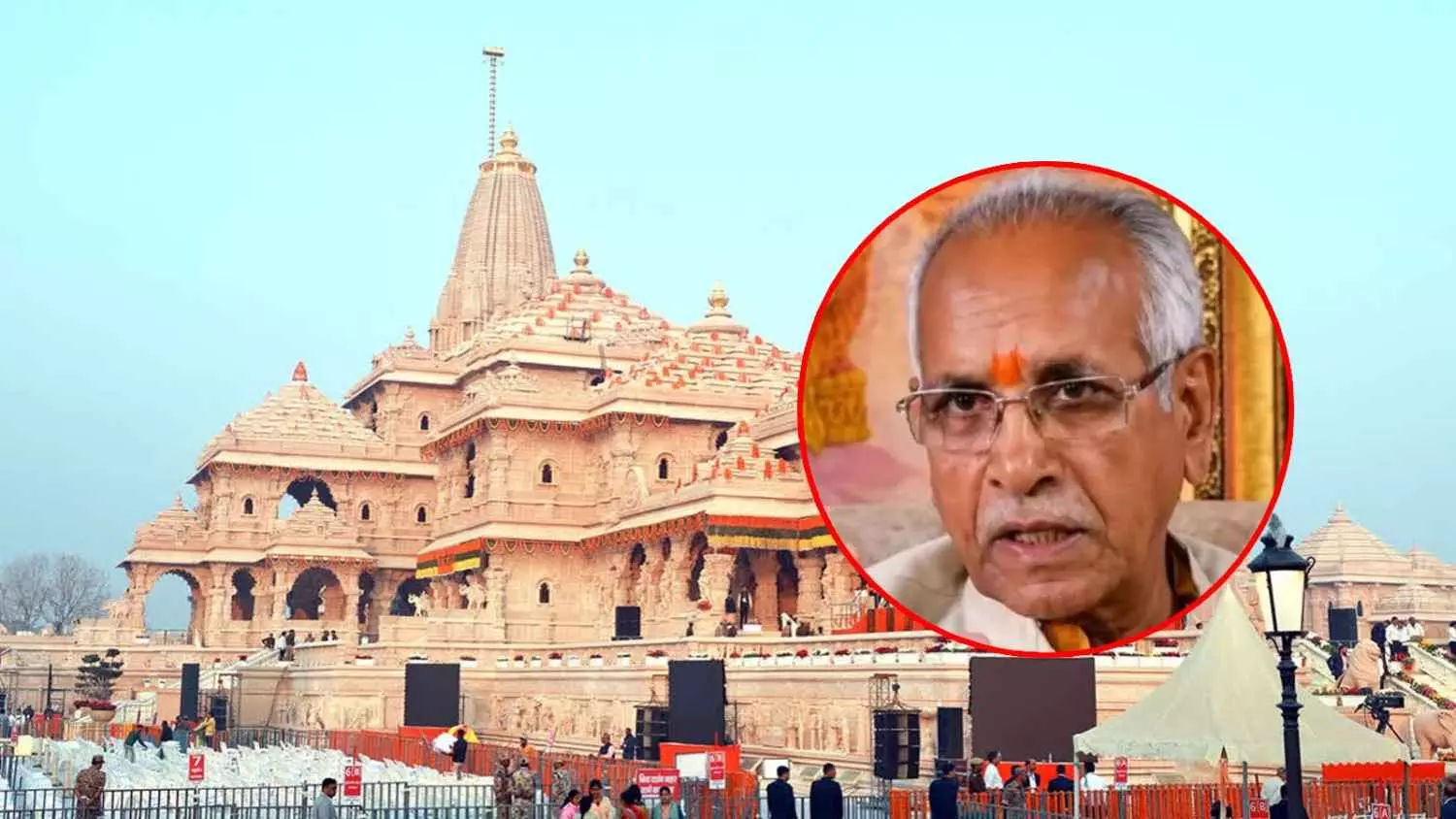
In complete contrast to the opposing versions of the narrative of temple construction and its management, the temple project in Ayodhya reached its final construction milestone on the same day when Rai’s note became public. Construction work within the Ram temple premises is now complete, with only the installation of the approved bronze Shri Ram Janmabhoomi Teerth Kshetra Trust logo atop the “Purn Smriti Stambh” remaining.
It has to be recalled that when the grand Ram Mandir in Ayodhya was consecrated, it was presented to the nation not merely as the culmination of a religious aspiration, but as the crowning glory of a decades-long political project.
At that stage, little doubt remained that the Sangh Parivar had successfully converted a localised dispute into the primary ideological engine of modern Indian politics. The latest episode in the series of controversies that have continued to tarnish the Ram temple, which Modi wanted to model as the undisguised Hindu Vatican, has sharpened the conflict between Rai and Misra.
However, it cannot be viewed merely as a clash between two individuals; it must be framed within the broader context of different working styles between Modi and the VHP-led groups within the Sangh Parivar.
Decision-making by Modi’s proxy, Nripendra Misra
After the consecration ceremony months before the 2024 Lok Sabha polls, it was clearly evident that a historic friction was in the offing – between the street-hardened pracharak and the polished bureaucrat. This may have played a role in the Rashtriya Swayamsevak Sangh's (RSS) relative disinterest in the 2024 parliamentary polls, compared with its total involvement in campaigning in the 2014 and 2019 polls.
The control of the union government (read PMO) over the Ram temple construction process, and eventually its administration too, was a paradox because Modi was never an active participant in the agitation, barring managing the Gujarat leg of LK Advani’s watershed Somnath to Ayodhya Rath Yatra in September 1990
To a great extent, individuals connected with the VHP did not appreciate the Supreme Court’s decision to give the Centre the power to establish the Ram Temple Trust and nominate members of its choice. This resulted in the Trust functioning just as the Union government does – in a highly centralised manner, with decision-making being considerably dictated by Misra, virtually acting as Modi’s proxy. Rai has since made this clear after his exit.
Also Read: Nripendra Mishra's shifting defences on Ram temple row: Genuine or managed?
Those who were actual foot soldiers, as well as their leaders, did not view the decision favourably. It should be recalled that the movement for the“liberation” of Shri Ram Janmabhoomi was waged by the VHP from the early 1980s under the guidance and supervision of the RSS.
After the judgment in favour of the Hindu parties, they expected controlling power to translate theological rhetoric into electoral momentum for the BJP. But their expectations of playing a major role in SRJTKT affairs were dashed.
The control of the union government (read PMO) over the Ram temple construction process, and eventually its administration too, was a paradox because Modi was never an active participant in the agitation, barring managing the Gujarat leg of LK Advani’s watershed Somnath to Ayodhya Rath Yatra in September 1990.
Modi performed all major rituals
Despite murmurs within the Sangh Parivar, Modi performed all the major rituals associated with the temple, from the Bhoomi Pujan in August 2020 to the Pran Prathistha in January 2024 and the final Dhwajarohan on the Shri Ram Janmabhoomi Mandir’s Shikhar (flag hoisting atop the temple).
Modi’s role in the final laps of the Ram temple’s actualisation was the result of the Supreme Court’s judgment in November 2019 entrusting the union government with the Trust formation and running its affairs. The verdict and its final order effectively ”shifted” the temple construction and management headquarters from the VHP’s central office in Sankat Mochan Hanuman Mandir Ashram in RK Puram, New Delhi to the PMO.
Also Read: RSS' Hosabale breaks silence on Ram Temple scam, wants guilty to be punished
When, within weeks of the Trust being established, Misra was appointed at the head of the Temple Construction Committee, it signalled that the Indian state, in its modern executive avatar, would oversee the physical manifestation of Hindutva's flagship project.
Displacement of ideological cadre by technocratic state
Importantly, Rai’s grouse, although understated in his contentious note, is unambiguous – that Misra had a free run within the Trust insofar as its most important functions – temple construction and decisions related to it – was concerned.
Rai removed all ambiguity with his note, and states in painstaking detail that every major operational decision – from handing major contracts to engineering conglomerates like Larsen & Toubro to appointing architects and making key committee placements – was directed by Misra.
Although Rai has reportedly been given the proverbial clean chit by the Special Investigative Team in its preliminary report, he stands to be seen as “guilty” by the people. It seems highly unlikely that either he or any other powerful VHP figure would be nominated and eventually emerge as a powerful figure within the Temple Trust.
The subtext is unmistakable: when accolades were distributed, the technocratic state took centre stage; when controversy over missing donations erupted, the ideological Trust was left to face public outrage.
Also Read: Ram temple donation scam: Real crackdown or bid to shield real kingpins?
This institutional friction reveals a broader pattern within contemporary Indian politics. The ruling apparatus has consistently preferred managerial centralisation over political cadre autonomy. Once a political movement achieves its primary objective, its agitational leadership is often sidelined in favor of bureaucratic efficiency. The cadre, accustomed to moral authority within their ecosystem, suddenly finds itself subordinate to administrative procedures and executive oversight.
There is no doubt that Rai’s note is far more than a personal defence mechanism following a financial scandal. Instead, it is an illuminating historical document.
On its surface, the note arrives in the wake of an investigation into alleged donation irregularities — a "stain”, as construction committee chief Nripendra Misra once termed it. But beneath the administrative jargon of online transfers, internal audits, and vendor selection, lies a profound ideological lament: the displacement of the ideological cadre by the technocratic state.
Primary legatee of the Ram Janmabhoomi movement
It is difficult to foresee the way forward because Modi is unlikely to share power with those he sees as ideological cadre. The Sangh Parivar leadership derived strength from its imagined capacity to always reconcile internal contradictions under the umbrella of ideological unity. But the transition from a movement in opposition to an ideologically-oriented establishment in power changes the dynamic.
From the time Modi prodded the apex court for a verdict and the inevitability of the Ram Temple became clear, the issue was transformed into a matter of ownership. The issue has been clear since 2020: who would be the primary legatee of the Ram Janmabhoomi movement? Would it be the foot soldiers and their leaders, or would it be the state apparatus with Modi at its head?
Also Read: Ram Temple donation probe: Is SIT's credibility already in question?
Champat Rai has clearly pointed a finger at the Temple Construction Committee. As its head, Misra took the decisions that Rai lists. But these were not his decisions only, as it is difficult to imagine that someone who had previously been Modi’s Principal Secretary would not act at his behest.
With his note, Rai has inadvertently revealed that in the battle between the movement and the machine, the machine always takes command.
(The Federal seeks to present views and opinions from all sides of the spectrum. The information, ideas or opinions in the articles are of the author and do not necessarily reflect the views of The Federal)