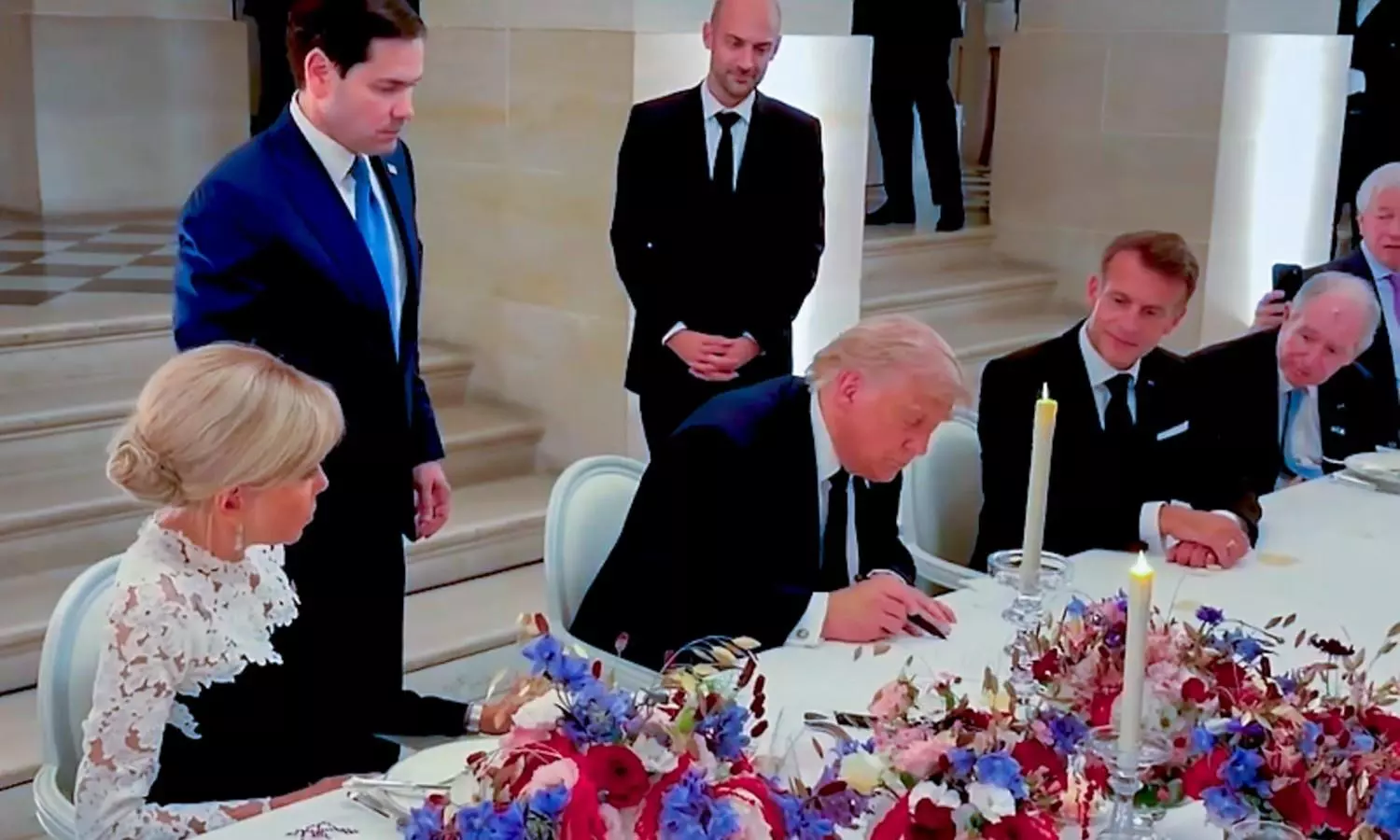
In this screengrab from a video posted on June 18, 2026, US President Donald Trump signs the Iran Memorandum of Understanding at the Palace of Versailles, in France. Secretary of State Marco Rubio, French President Emmanuel Macron and others are also seen. Photo: @WhiteHouse/X via PTI
The final agreement will not be much different from what Barack Obama achieved entirely through a process of peaceful negotiations
Typically, in Donald Trump-style, the MoU to end the US-Israel war on Iran was signed even before the announced official ceremony scheduled for Friday (June 19). As impulsive as he was in launching the war on Iran in February, the US president appeared equally eager to end it by signing the MoU a couple of days earlier.
Though Trump said he had achieved all his goals, a dispassionate reading of the MoU clearly debunks this claim. By not losing, Iran turned out to be the winner. And the US, after its “shock and awe” strikes, is left with no substantial gain. Israel, too, has had to eat humble pie.
Also read: US-Iran peace deal: Here's full transcript of MoU
Take the complete opening of the Hormuz Strait. When the war started on February 28, the Strait was anyway open. So that could not have been one of the initial aims of the war. Its reopening now merely restores the ante-war status quo.
On Trump’s biggest brownie point, that Iran had agreed to never develop nuclear weapons — it was always evident that the Islamic dispensation in Tehran had, over time, repeatedly asserted that it was never interested or sought to have nuclear weapons.
Iran was a signatory to the non-proliferation treaty (NPT), which it ratified way back in 1970 (though under the previous Shah regime), which confirmed its intention not to develop nuclear weapons. The Islamic dispensation that followed the Shah’s rule also reiterated that it was not interested in making nuclear weapons. It obviously meant that Trump need not have started the war on this account.
Comparison with 2015 deal
The one point where Trump claims his agreement is somewhat different from the earlier Iran-Barack Obama nuclear deal is on the issue of compensation. Even this is dubious. In the 2015 agreement, the US had promised to release around $300 billion to Iran. Though this was Iran’s own money, it would accrue when its frozen assets would be released, Trump and the Republicans made it out as if it was going out of the American kitty.
In the current MoU, Iran has similarly been promised money of around $300 billion. But now, Trump’s team claims this is from Iran’s frozen assets, not the US treasury. Actually, the same as the 2015 deal.
Also read: US, Iran agree over peace. What changed? Which pain points still remain?
More money would accrue to Iran when its frozen assets are released and as and when sanctions of various kinds are lifted on Iran. Trump has said the funds flowing into Iran would be its own or from other countries in its neighbourhood.
Though Trump said he had achieved all his goals, a dispassionate reading of the MoU clearly debunks this claim. By not losing, Iran turned out to be the winner. And the US, after its “shock and awe” strikes, is left with no substantial gain. Israel, too, has had to eat humble pie.
For Iran, the MoU and the subsequent permanent agreement will provide relief from excruciating sanctions that have been imposed on the country, many of them not related to its nuclear activities and dating back to 1979, when the Shah was toppled and, over time, replaced by an Islamic theocracy. The sanctions comprise several ones imposed by the US and the United Nations.
Enriched uranium issue
Another tough sticking point was the issue of enriched of uranium in the possession of Iran. As it stands now, Iran has enriched it to around 60 per cent. To make a nuclear weapon, the uranium needs to be enriched to 90 per cent. The MoU refers to what is called “downblending”, that is, reducing enrichment of uranium to such a level that it cannot be used in weapons.
In the earlier deal with Obama, Iran had agreed to cap uranium enrichment to 3.67 per cent — ensuring it uses the uranium for peaceful purposes only. It had also agreed not to store more than 300 tonnes of enriched uranium. Independent inspectors under the International Atomic Energy Agency would have unbridled access to Iran’s nuclear facilities, including enriched uranium, that would assure the world that Tehran was sticking to its commitment.
However, when Trump abrogated the deal unilaterally in 2018, Iran too decided not to honour its side of the bargain. It restricted and blocked access to international nuclear inspectors, resumed enriching uranium and increased the quantity of the nuclear material to around 440 tonnes now.
Also read: 'Idea of invincible US has eroded; Iran showed maturity' | AI With Sanket
The MOU, now signed by Trump, will, at the most, restore status quo — depending on how exactly negotiations go for the next 60 days before a final deal is arrived at.
Significantly, there is no word in the MoU on Iran’s ballistic missiles, which were used to maximum effect by Tehran to resist and inflict damage on Israeli and American bases in its neighbourhood.
If the US and Israel expected to defang Iran, this is clearly one example of their failure to do so.
Iran suffered massive damage
Iran has had its share of misery, however. Over the last nearly four months, it has suffered extensive damage to property, the killing of its supreme leader Ayotollah Khamenei and several top military commanders and political leaders, besides, of course, an estimated 6,000 civilians. The most gruesome of these was the bombing of the primary school that killed around 160 children.
The US, by joining Israel, provided the opportunity for Prime Minister Benjamin Netanyahu to indulge in blood-letting, despite Iran’s valiant resistance and counter-attack. Israel, too, ultimately, did not gain anything as its main goal was to oust the Islamic dispensation.
Also read: US retreat, Israel’s isolation, India’s dilemma: Gulf crisis exposed more than limits of force
Netanyahu was also not able to eliminate Iran’s nuclear facilities and disable them from ever resuming nuclear activities.
In the balance, it is clear that the Israel-US war on Iran until this point must rank alongside one of the most ill-planned, unprovoked, myopic and mindless wars on a country that was negotiating for peace.
And whatever Trump might claim, as the MoU now shows, the final agreement after 60 days will not be much different from what his predecessor Obama achieved entirely through a process of peaceful negotiation.