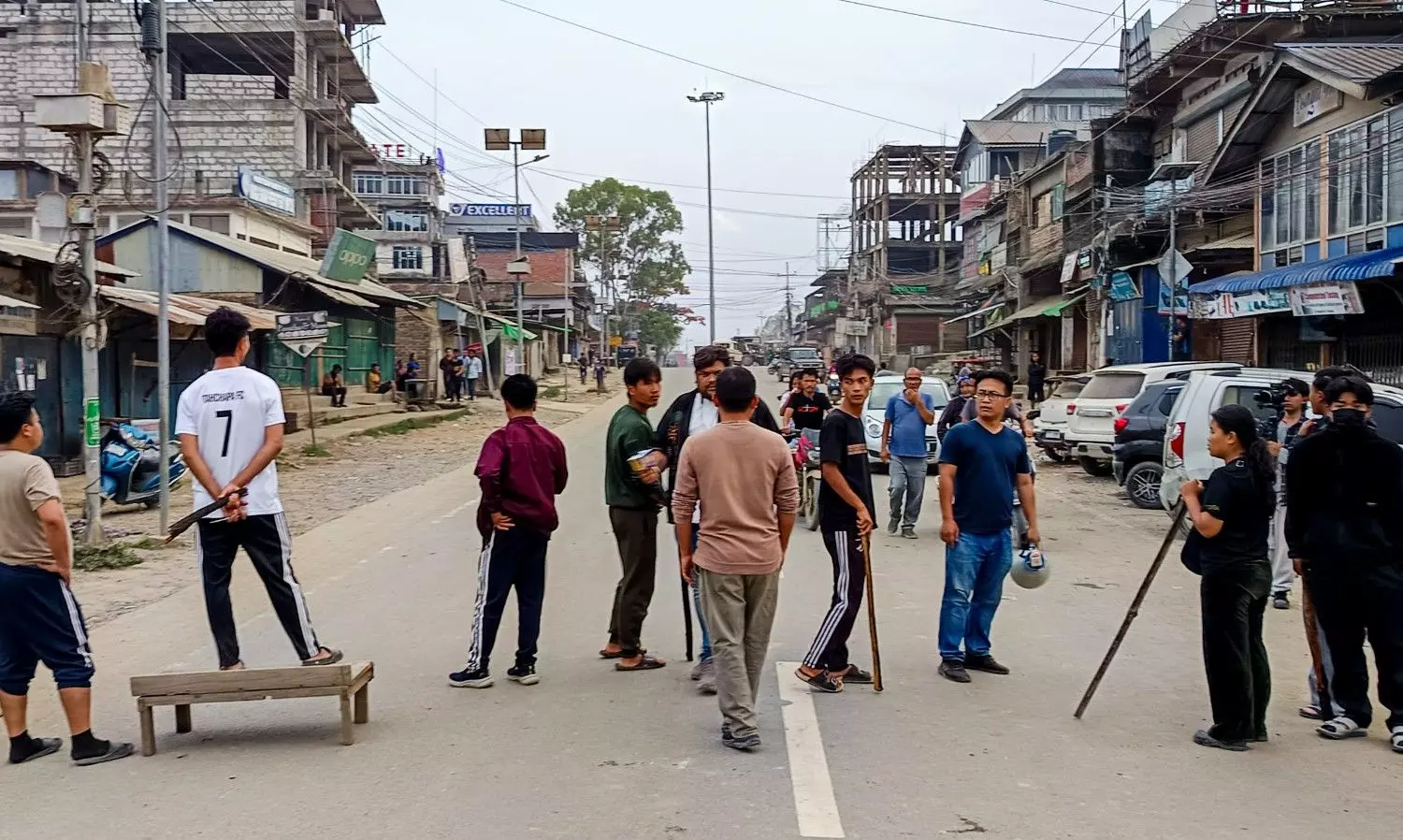
People block a road after the normal life was paralysed by shutdowns called by the Kuki Zo and Naga communities against the killing of three church leaders and a civilian on Wednesday in Kangpokpi, in Churachandpur, Manipur, on Thursday, May 14. PTI
The May 2026 Manipur crisis is a warning. The killing of Rev. Dr. Vumthang Sitlhou and his companions was not the beginning of something new. It was the revelation of something already underway.
A decisive shift is underway in Northeast India’s conflict landscape. The killing of three church leaders in Manipur on Wednesday (May 13)—and the subsequent hostage crisis that engulfed 44 civilians within 24 hours—is not merely another tragedy. It reveals how the intensification of inter-ethnic and intra-ethnic violence is rapidly complicating an already fragile region, pushing the older, more familiar paradigm of vertical conflict—between New Delhi and ethnicised political armed movements—into the strategic margins.
Also read: 3 killed, 5 injured in suspected militant attack in Manipur’s Kangpokpi district
For decades, the dominant lens through which analysts understood insurgency in Northeast India was vertical: state versus non-state armed group, centre versus periphery, constitutional order versus so called secessionist ambition. Groups like the United Liberation Front of Asom (ULFA), the National Socialist Council of Nagaland/Nagalim (NSCN), and various Kuki-Zo militant outfits framed their struggles around autonomy, sovereignty, or territorial reconstitution vis-à-vis the Indian state. New Delhi responded with counterinsurgency, peace accords, and co-optation. That architecture is now fracturing—not because the State has won, but because the ground itself has changed. The enemy is no longer exclusively the State. It is the neighbour.
The incident as symptom
On May 13, Rev. Dr. Vumthang Sitlhou (President of the Thadou Baptist Association International), Rev. Kaigoulun Lhouvum, Pastor Paogoulen Sitlhou, and their driver Lelen were ambushed and killed on the Imphal-Tamenglong highway (Tiger Road) between Kotlen and Kotzim villages in Kangpokpi district. They were returning from a peace and reconciliation conference in Churachandpur—a detail that transforms the attack from a simple act of violence into a symbolic assassination of the very idea of inter-community dialogue.
Also read: Three years on, Manipur’s hope for peace is shaken amid fresh unrest
The victims were Thadou church leaders. A thorough probe into the killings has not been able to reveal much, as there is no clear evidence as of now as to who could be the perpetrators. However, it bore the hallmarks of an armed group from a rival group. Within hours, the logic of retaliation kicked in. By May 14, approximately 23 Kuki individuals were reportedly detained by Naga groups in Senapati district. In response, 18 to 20 Naga villagers from Konsakhul were abducted and held in the Leilon Vaiphei area by Kuki groups. Deputy Chief Minister Losii Dikho found himself negotiating not with insurgent generals seeking a peace pact, but with ethnic vigilantes holding infants and religious leaders hostage.
This is not vertical conflict. This is horizontal slaughter.
The complication: recent horizontal ethnic warfare
The intensification of inter-ethnic and intra-ethnic conflicts introduces three immediate complications that vertical conflicts rarely produce.
No major armed group has claimed responsibility for the Kangpokpi ambush. The usual choreography of insurgency—demand, threat, ceasefire, dialogue—is absent
First, the multiplication of actors: Vertical conflicts typically involve a finite number of armed groups with identifiable command structures, political wings, and negotiable demands. Horizontal ethnic conflicts produce a proliferation of non-State actors—village defence committees, youth volunteer organisations, student bodies, ethnic affiliated militias, and spontaneous vigilante forces. The Kuki Students' Organisation and Thadou community groups that imposed indefinite shutdowns across Kangpokpi and Churachandpur are now not talking about reconciliation but retaliation with varying degrees of conflict intensity. Their logic is ethnic/communal survival, not State recognition. Negotiating with them is akin to herding smoke at the moment.
Also read: Three years on, renewed violence in Manipur casts a long shadow over calls for peace
Second, the collapse of deterrence: In vertical conflicts, the State retains a monopoly on legitimate violence in principle, even if contested in practice. Retaliation is calibrated. In horizontal ethnic wars, retaliation is immediate, decentralised, and escalatory. The hostage standoff in Manipur—44 civilians held across multiple locations—demonstrates how quickly assassinations can trigger a cascade of abductions and hostage-takings. There is no central command to order de-escalation. Each abduction begets another. Each killing demands blood for blood.
Third, the erasure of non-combatant immunity: Vertical conflicts, for all their brutality, maintain a grim theatre of distinction. Armed groups target security forces or state infrastructure. Civilians are collateral damage, not the primary object. In horizontal ethnic warfare, civilians become the battlefield. Church leaders—men of peace—are executed. People are taken hostage. Villagers are rounded up by their neighbours. The line between combatant and civilian dissolves because ethnicity itself becomes the uniform.
Marginalisation of the vertical
Where does this leave the traditional vertical conflict between New Delhi and the region's ethnicised political armed movements? In the margins.
No major armed group has claimed responsibility for the Kangpokpi ambush. The usual choreography of insurgency—demand, threat, ceasefire, dialogue—is absent. Instead, the state is reduced to crisis management: blockading National Highways, tightening security, and dispatching a deputy chief minister to plead for the release of hostages. Chief Minister Yumnam Khemchand Singh called the ambush a "dastardly terror act" and vowed justice. But justice against whom? The perpetrators are not yet officially identified. They are a shifting constellation of ethnic animosity or have been made to resemble it.
The peace accords that New Delhi has invested in for decades—the Naga peace process, the Kuki Suspension of Operation, and other peace agreements—were designed to end vertical conflicts. They assumed that if the State addressed political demands, violence would subside. But horizontal ethnic conflicts are not driven by political demands. They are driven by land, memory, demography, and the raw calculus of ethnic/communal security. No accord signed in Delhi can resolve why Naga and Kuki villages in Senapati district view each other as existential threats.
The feedback loop
The most dangerous dynamic is the feedback loop between horizontal and vertical conflicts. As inter-ethnic violence intensifies, the legitimacy of traditional armed groups erodes. Why negotiate with the NSCN if Naga vigilantes are holding Kuki civilians hostage or vice versa? Conversely, the State's inability to protect minority communities within ethnic blocks fuels further horizontal mobilisation. Kuki civilians who feel abandoned by the Manipur government will not turn to Delhi—they will turn to Kuki defence committees. Naga villagers who lose family members to Kuki armed groups will not wait for an NSCN political solution. They will arm themselves.
New Delhi can no longer afford to treat peace accords as endpoints. They are not. The real work—agonising, unglamorous, and deeply local—is the prevention of horizontal escalation
In this environment, the vertical conflict becomes irrelevant. The armed political movements that once commanded attention through coordinated campaigns now find themselves outflanked by street-level ethnic armies. New Delhi, trained for decades in the grammar of counterinsurgency and peace processes, lacks a vocabulary for horizontal ethnic warfare. Blockades and bandhs are not strategies. They are admissions of paralysis.
A new grammar of violence
The May 2026 Manipur crisis is a warning. The killing of Rev. Dr. Vumthang Sitlhou and his companions was not the beginning of something new. It was the revelation of something already underway. Across Northeast India—in Manipur, Assam, Nagaland, and Meghalaya—the centre of gravity is shifting from vertical to horizontal. From State against insurgent to neighbour against neighbour. From political negotiation to ethnic annihilation.
New Delhi can no longer afford to treat peace accords as endpoints. They are not. The real work—agonising, unglamorous, and deeply local—is the prevention of horizontal escalation. That means disarmament of civilian militias, not just insurgent groups. That means land and resource distribution, not just autonomy packages. That means recognising that the most dangerous enemy of the Indian State in the Northeast is no longer the armed revolutionary with a manifesto. It is the armed villager with a grievance. The vertical conflict has been pushed to the margins. If the State continues to look for it there, it will miss the fire burning at its feet.
(The Federal seeks to present views and opinions from all sides of the spectrum. The information, ideas or opinions in the articles are of the author and do not necessarily reflect the views of The Federal.)