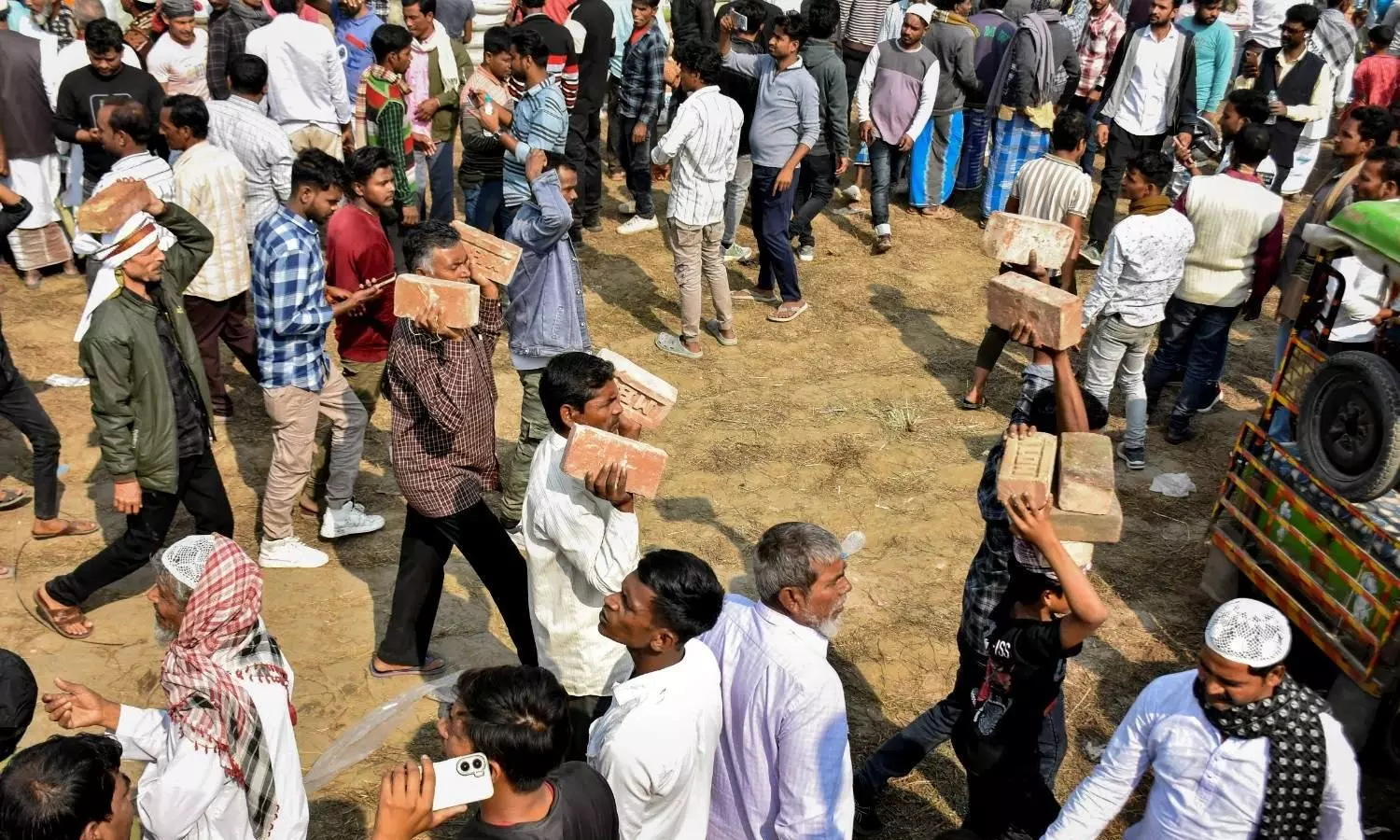
His unilateral move overlooks the legal path, undermines broader community efforts for equality, and plays into the hands of the BJP's polarising politics
West Bengal lawmaker Humayun Kabir’s move to construct another Babri Masjid at Murshidabad is deeply problematic, as the the symbolism behind this curious step seems to have come willy-nilly from the BJP’s playbook.
Like the BJP, Kabir’s plan and actions prioritise history over politics, parochialism over emancipation, and identity politics over egalitarianism. It has the potential to blur or obfuscate issues and upset the legal scheme of things – a situation which has already been dogging the public sphere to a worrisome extent.
Also read: Suspended Bengal TMC MLA to hold Quran recital after mega Gita event in Kolkata
The idea behind the latest salvo under the already overkilled Mandir-Masjid divide is apparently meant to assert minority rights in majoritarian times, but it can well push the country further into the impossibility of justice, not just for Muslims but also the larger society and more so its poorer sections.
Restraint shown by Muslims
Over three decades, the Mandir movement had begun to counter Mandal, with Muslims dragged in to serve as fodder to the communally charged cannon of Hindutva. Yet, Muslims have shown remarkable restraint all through.
And, if circumstances have proverbially been the best teacher of man, the majority of Muslims confined their response to the vicious onslaught to a legal fight in courts. At the societal level, they sought redemption by turning to educate and equip their children with knowledge more than in previous times.
This did not escape the eye of their detractors. Among myriad kinds of Jihad cited against them, the Muslim minority’s efforts to painstakingly become a bit more consequential than before were dubbed as 'IAS Jihad'. It was because a few more Muslims could make it to the UPSC list of successful candidates than in some of the years in the recent past.
Also read: Humayun Kabir lays foundation of Babri Masjid replica in Murshidabad
Also, of late, the law-enforcing agencies are repeatedly quoted by most media outlets to be blaming white collar jihadis from an elite background for being instrumental to some of the ghastly incidents. Most Muslims bear such collective stigmatisation with a possible detrimental impact on their future, courtesy the current jingoism, in silence and in the hope that eventually better sense will come, stay, and prevail among all, cutting across caste, creed, and community, and avert the creation of further bad blood and strife.
Kabir’s ill-conceived moves
So, Kabir’s step goes against the collective, though unarticulated or so far heavily understated will or inclination of the larger Muslim masses to defeat sectarianism and win back amity and communal harmony.
It was none other than the former Prime Minister, the late Atal Behari Vajpayee, who, way back in 1996, had remarked that the “issue is not Babri (Masjid) but barabari (equality).”
As for the loss of Babri Masjid and the West Bengal MLA’s efforts to undo it in the form of another mosque to be built at another place, he or anyone from among his cohorts could, instead, have well moved the court.
A case for expediting the construction of a mosque at the place marked in accordance with the 2019 judgment of the Supreme Court, off downtown Ayodhya, could easily be made for legal redress. The spot or site given in lieu of the demolished mosque, at Dhannipur village, near Ayodhya, still lies vacant, forlorn and deserted.
It is so even as the construction of a Ram Mandir at the spot where Babri Masjid once stood has recently been completed and marked by some of the grand ceremonies led by Prime Minister Narendra Modi and joined by other higher-ups in virtually state-sponsored shows.
Also read: 'Babri-style mosque': Security up; all eyes on West Bengal's Murshidabad
Once seen in the light of this, Kabir’s moves look ill-conceived. These may well take the attention away from the glaring and yet continuing non-implementation of the top court’s 2019 verdict, which upheld Muslims’ claim or right over the mosque, though after it was demolished on December 6, 1992, by a frenzied mob. The court ordered an alternative site to be given to Muslims to compensate for the loss by constructing a mosque.
Vajpayee’s ‘equality’ message
It was none other than the former Prime Minister, the late Atal Behari Vajpayee, who, way back in 1996, had remarked that the “issue is not Babri (Masjid) but barabari (equality).” Though he was literally or rhetorically right, his and his party’s understanding of equality was, and continues to be, different.
The BJP tried and succeeded in transferring the burden of caste-divide sharpened by the adoption of the BP Mandal Commission report on government job reservations for backward castes through a showdown with Muslims via the Babri Masjid-Ramjanambhoomi dispute. The battle around caste receded amid the virtual war for the sake of the temple resorted to by LK Advani through his Rath Yatra in September 1990.
Some Muslim leaders in those times ended up playing like a party to the BJP’s Mandir movement, which was meant to offset the possible loss of backward castes’ vote and support for the avowedly Hindutva party. The BJP could succeed because of these Muslim leaders. They wittingly or unwittingly helped the BJP’s plan, which could easily use them as a source for Hindu resentment. This is how the BJP could override the caste divide, and its Mandir agitation eventually enabled it to come to power.
To add insult to the injury, Kabir has called his move “emotional restitution” for the 1992 demolition at Ayodhya and asserted building of mosque by him and naming it after Babur as his “constitutional right”.
Now Kabir is apparently on a similar track that was once taken by his community’s select leadership and led to one of the worst disasters that Indian Muslims have ever faced. Ayodhya signifies the failure of Muslim leadership as palpably as it is painted to be the success of the BJP, the RSS, and its other offshoots.
Personal ambitions
Thus, West Bengal Chief Minister Mamata Banerjee had no choice but to expel Kabir from her Trinamool Congress (TMC) party. Yet, he went on with his plan to lay the foundation stone of the so-called Babri Masjid on Saturday, December 6, at Beldanga in Murshidabad.
This shows his desperation to recreate and swim through the turbulent waters of communal politics in a way similar to what had happened in the past. He is clearly driven by his personal ambitions more than the interests of his party, or that of the community and society that he belongs to and represents in public life.
As for Muslims and also other underprivileged sections, the task is to summon, follow and rely upon India’s modern constitutional ethos based on and nurturing the country’s wisdom since eons. It is the only way opened to them to improve their individual as well as collective lot. There is no other option to save them from getting trapped in dated and disastrous Mandir-Masjid tussle surfacing or resurfacing time and again in different forms and with one motive, which is to set the clock back and win elections at any cost.
To add insult to the injury, Kabir has called his move “emotional restitution” for the 1992 demolition at Ayodhya and asserted building of mosque by him and naming it after Babur as his “constitutional right”. Again, he is taking things literally, which may well suit his rants. Nevertheless, it hurts the very spirit of the Constitution, which resulted from Indians’ resolve to seek unity and fraternity among all, besides other laudable goals that it had set out for a promising and dignified future for the teeming millions.
(The Federal seeks to present views and opinions from all sides of the spectrum. The information, ideas or opinions in the article are of the author and do not necessarily reflect the views of The Federal.)