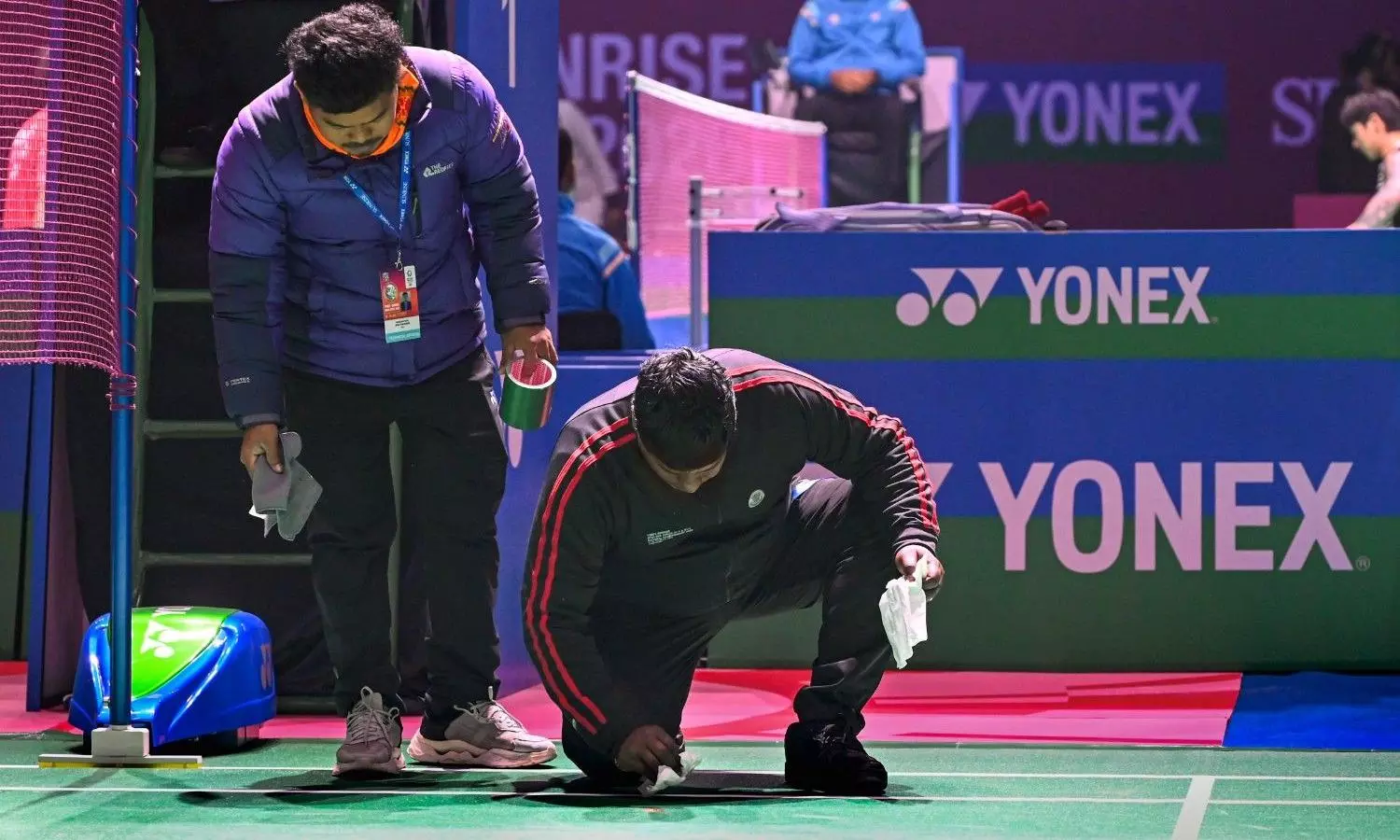
Maintenance staff clean 'bird droppings' during the men's singles round of 16 match between India's HS Prannoy and Singapore's Loh Kean Yew at the India Open 2026 badminton tournament, in New Delhi, Thursday, January 15. PTI
A bizarre stoppage at India Open after bird droppings fell on the court exposes a gap between ambition and execution that no amount of infrastructure spending can conceal
What is it with India that even when the world comes to play, the basics seem to fall apart? At the India Open badminton tournament in New Delhi, international matches were halted mid-play, not because a player was injured, but because bird droppings fell on the court. Inside a premier indoor stadium, on the main television court, officials had to stop play so the surface could be wiped clean.
The images were awkward, almost absurd. But they were also revealing. For a country that wants to project itself as a global sporting destination and speaks openly about hosting world championships and even a future Olympics, this was an embarrassing mishap. It was a snapshot of a deeper, more persistent problem that Indian sport has refused to confront.
Debris falls, monkey spotted
The incident occurred during a men’s singles match involving HS Prannoy and Singapore’s Loh Kean Yew. As the two players battled through a high-quality contest, play was interrupted twice as debris fell from above, reportedly from birds nesting within the stadium structure. A day earlier, spectators had spotted a monkey in the stands. Television cameras looked away, but smartphones did not. Within minutes, clips were circulating across the world.
Also Read: India Open badminton: Mia Blichfeldt calls out 'highly unprofessional' conditions
It would be easy to laugh this off. India often does. Sporting embarrassments are quickly converted into jokes and memes before being brushed aside. But this episode deserves more serious reflection, because it did not happen in isolation. Throughout the India Open, international players raised concerns about the conditions at the venue.
Players' feedback
Danish shuttler Mia Blichfeldt spoke openly about discomfort and health concerns. World number two Anders Antonsen stated on social media that Delhi’s severe pollution had forced him to skip the India Open, even though it meant risking heavy fines. Other players spoke privately about breathing difficulties and fatigue. These were not trivial complaints. For elite athletes, the environment is fundamental to performance and safety.
The root problem, clearly, is not infrastructure. It is about attitude. India has built impressive stadiums and sporting complexes
But what made the episode more telling was the reaction of sports administrators. Initial responses attempted to downplay the issue, suggesting that complaints were exaggerated. That narrative collapsed the moment play was halted on the main court, in full view of cameras, officials and spectators.
Now this instinct to deny problems is deeply ingrained in Indian sports governance. Feedback is often treated as criticism and, moreover, as an insult. And when international athletes raise concerns, their words are sometimes framed as unfair, or even politically motivated, rather than as professional inputs from stakeholders invested in the sport.
Contrast this with how established sporting nations operate. In countries such as Japan, China or across Europe, venue feedback is logged, analysed and acted upon. In India, too often, the priority is optics. Protecting image takes precedence over fixing processes. The India Open incident fits into a long and uncomfortable pattern.
Administrative apathy
To single out the Badminton Association of India (BAI) alone would be unfair, because this apathy cuts across sports. At the recent National Boxing Championships in Greater Noida, boxers arrived ready to compete only to discover that even the basic ring was not prepared until well past the scheduled start. During peak winter, athletes from several states were forced to vacate their accommodation a day before the finals because bookings had expired, leaving them to spend long hours outdoors in the cold.
Also Read: Denmark's Blichfeldt slams ‘unhealthy’ stadium conditions at India Open
Similarly, at the National School Wrestling Championships, young wrestlers travelling from across the country were seen sitting on the floor near train toilets due to a lack of confirmed tickets. These are not fringe sports. Boxing, wrestling and badminton are disciplines that consistently ensure India does not return empty-handed from the Olympics. If even their biggest tournaments are treated with such casual disregard, the scale of administrative apathy becomes impossible to ignore. The plight of athletes from less visible sports can only be imagined.
Governance problem
The root problem, clearly, is not infrastructure. It is about attitude. India has built impressive stadiums and sporting complexes. What is missing is a governance culture that treats maintenance and operations as ongoing responsibilities rather than post-inauguration formalities. Stadiums are opened with fanfare, but upkeep is treated as an afterthought.
Responsibility is also spread thinly across government departments, sports federations, organising committees and venue authorities. In theory, this layered structure allows coordination. In practice, it ensures deniability. When something goes wrong, each body can point elsewhere. No single authority owns the failure, and therefore no one is held accountable. This fragmentation explains why the same issues recur across sports and tournaments, regardless of which federation is in charge.
Many sports bodies continue to be run by political appointees or career administrators with limited exposure to international sporting standards. Decision-making remains reactive rather than anticipatory. Problems are addressed only after they cause public embarrassment.
If India is to be taken seriously as a global sporting hub, accountability has to become routine. Stadium management must be professional and expert-led
At venues like the Indira Gandhi Indoor Stadium, responsibility for upkeep is split across multiple layers: the national federation, the Sports Authority of India (SAI), event-specific organising committees and local venue staff. When everyone is responsible, no one truly is!
Accountability matters
In the age of global broadcasting and social media, this approach is increasingly costly. Visuals travel fast and a match stopped because of bird droppings on a televised court will always leave a deeper impression. This reputational damage matters much more with India aggressively positioning itself as a host for a future Olympics.
But hosting rights are not granted on ambition alone. International federations closely assess operational consistency, athlete experience and risk management. Repeated lapses invite higher scrutiny. Sponsors and broadcasters notice too. Disruptions are commercially inconvenient, and over time, they influence investment decisions.
Also Read: Chinnaswamy Stadium gets govt nod to host IPL 2026, international matches
If India is to be taken seriously as a global sporting hub, accountability has to become routine. Stadium management must be professional and expert-led. Athlete feedback needs to be welcomed and not dismissed as dissent. Hygiene, air quality and basic venue safety cannot remain negotiable.
Between ambition and execution
This episode should have prompted clear answers: who was responsible, what failed, and what will change. Instead, it became another moment to explain away and move past. International sport is built on trust that venues will function, athletes will be respected and organisers will respond professionally when things go wrong.
That is why the India Open incident matters far beyond one tournament. It exposes a gap between ambition and execution that no amount of infrastructure spending can conceal. India does not lack money or talent. What it lacks is a governance culture that treats standards as non-negotiable and feedback as an opportunity rather than an insult. Until that shift happens, every global event hosted here will carry the same risk that it will be remembered less for sport and more for the avoidable moments when play had to stop!
(The Federal seeks to present views and opinions from all sides of the spectrum. The information, ideas or opinions in the articles are of the author and do not necessarily reflect the views of The Federal.)