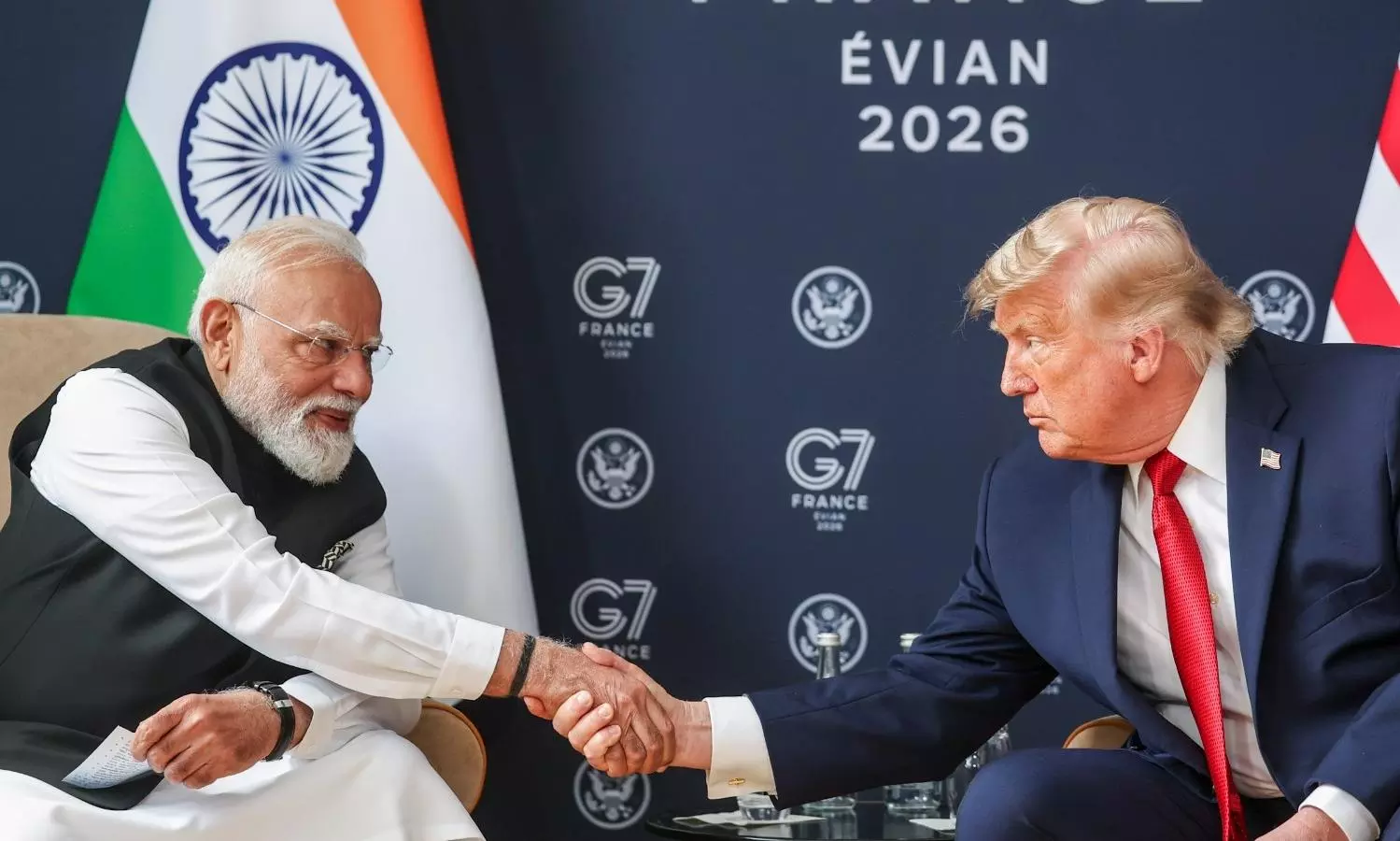
The challenge before India is not how to survive Trump. It is how to navigate an America that may be changing far more profoundly than many in New Delhi are willing to acknowledge
When Donald Trump returned to the White House in 2025, there was little sense of alarm in New Delhi. India believed it had the measure of the man. The smooth ride during Trump’s first term gave India reason for hope, as India-US ties emerged strong and the resurrection of the Quad in 2017 was reassuring.
There was a reason for that confidence. Prime Minister Narendra Modi had a personal rapport with Trump that few others could match. Diplomats fondly recalled the spectacle of the Houston 'Howdy Modi' rally and the carefully choreographed 'Namaste Trump' event in Ahmedabad. Even Trump's periodic complaints about India's tariffs and trade practices were largely dismissed as part of his negotiating style.
Sharpest turbulence
That confidence, however, proved misplaced.
Over the past year, India-US relations have experienced their sharpest turbulence in more than two decades. Trump imposed punitive tariffs, repeatedly claimed credit for brokering peace between India and Pakistan, ordered the deportation of undocumented Indians in the first two lots on military planes and in shackles, threatened sanctions over India's purchase of Russian oil and signalled a renewed American interest in Pakistan. At the same time, the shift in the US towards economic nationalism and anti-immigration politics began to touch some of the most important pillars of the relationship, from H-1B visas and Indian professionals in the American workforce to technology transfers, investment and higher education.
Also read: As China salami-slices at LAC, India must not decouple border from bilateral ties
The temptation in New Delhi is to treat the current turbulence as a passing phase. Many diplomats argue that the foundations of the relationship remain so strong that India simply has to endure the rest of Trump’s tenure and wait for a more predictable administration to arrive.
But what if that assumption is wrong?
The latest Trump threat of a massive tariff hike of up to 100 per cent on countries buying Russian oil will hit India hard. The Senate has already passed the Bill
What if the problem is not Trump alone, but a deeper transformation in American politics that is reshaping the country's attitudes towards immigration, trade, globalisation and even strategic partnerships? Once restrictions on visas, technology, investment and sanctions become institutionalised, they are rarely reversed by a change in administration especially when public opinion turns protectionist.
The uneasy signs are everywhere from H-1B visas to student admissions to weaponising sanctions as an instrument of foreign policy. Nothing is like what it had been earlier.
Sanctions and tariffs
The latest Trump threat of a massive tariff hike of up to 100 per cent on countries buying Russian oil will hit India hard. The Senate has already passed the Bill and now needs to pass it through the House of Representatives before it becomes law. The President will have the discretion to set the tariff rate or even provide an exemption if he so desires. India is still buying Russian oil. The share of Russian oil in India’s energy imports for June 2026 is as much as 42.9 per cent. New Delhi will have to replace this with alternative sourcing if Trump goes ahead with his threat. This will further complicate India’s energy flow.
Also read: Modi's 2047 vision offers little beyond longer wait for Gen Z and others
As the US ponders a crackdown on what the White House dubs as “the great transhipment scam”, India will also be affected. Chinese exports that come through a third country will be targeted. The regulation, which is being drafted, also includes countries that rely on inputs from China for the finished product. Indian manufacturing in key sectors like electronics, renewable energy and pharmaceuticals depends heavily on Chinese components. This move is currently under consideration but is likely to be pushed through and touted as Trump’s efforts to promote American local industry.
With Trump’s current outreach to China for stabilising trade ties, India’s strategic importance has diminished.
“This could affect us significantly given the Indian manufacturing sector's increasing dependence on intermediates from China. This is particularly so in two sectors that account for the largest share of India's exports to the US, viz., mobile phones and pharmaceuticals,” says Biswajit Dhar, former JNU professor.
Student and H1-B visas
F-1 and J-1 visas are becoming increasingly difficult to obtain. The strict screening process, which includes social media scrutiny of posts, and longer time for processing has brought down the approval ratings of visas for Indian students to a 62 per cent year-on-year drop in F-1 visas. The administration is also proposing to eliminate the 60-day period for laid-off H1-B workers and increase the extension fee by $4,000. These are currently just proposals, but they could easily become the norm. Add to this the extensive use of A1, which will lead to many more layoffs of foreign workers.
The truth is that India needs the US more than America needs India.
Also read: Uneasy ‘peace’ without a deal as US-Iran deadline passes
“As far as India is concerned, the relationship between India and the US is a defining relationship which has made steady progress in technology, science, innovation, defence and trade and investments. Under the Trump administration, India has been singled out for sanctions, seen itself as the non-preferred partner vis-à-vis countries like Pakistan, pressured on trade and tariffs and the defence and science and technology relationships have slowed down or have been affected since India is no longer seen as an indispensable partner for balancing China in the Indo- Pacific,” says retired Ambassador Anil Wadhwa.
India’s strategic importance diminished
With Trump’s current outreach to China for stabilising trade ties, India’s strategic importance has diminished.
“The China challenge has long been the strategic imperative underlying defence cooperation. American hope has been that as India builds its military capability it will project power in the Indo-Pacific and be a willing partner in countering China. This has aligned with an India that views itself as the net security provider and first responder in the Indian Ocean region,” says Aparna Pande of the Washington-based Hudson Institute.
While the relationship continues to move at the operational level, with commercial, defence and diplomatic cooperation, “it lacks the strategic underpinning that is critical to taking it forward,” she adds.
The solution for India lies in developing at home, self-reliance and becoming an indispensable partner, but at the same time finding a lasting partnership with other countries who are in a position to help India in its development path
Many diplomats believe that as China will remain America’s main challenger in the future, India need not worry about this temporary hiatus in ties, and it will not last. Perhaps the Ministry of External Affairs (MEA) is right, but can India afford to wait and watch? New Delhi cannot afford the complacency that marked the early months of Trump's second term. Waiting for Washington to change may no longer be a strategy. It may be a dangerous illusion. India needs the US for its development. The challenge before India is not how to survive Trump. It is how to navigate an America that may be changing far more profoundly than many in New Delhi are willing to acknowledge.
“An underlying current in American society is wariness about foreigners and qualified Indians, who, it is believed, are taking away American jobs,” says Wadhwa. He points to US deputy secretary of state Christopher Landau’s statement that the US will not allow India to rise like China, which is now challenging American supremacy. “... which means a deliberate policy of keeping down India,” Wadhwa adds.
American strategists optimistic
New Delhi needs to keep all this in mind as it considers its long-term relationship with the US. “The solution for India lies in developing at home, self-reliance and becoming an indispensable partner, but at the same time finding a lasting partnership with other countries who are in a position to help India in its development path. India should be wary of creating dependencies, whether on China or the United States,” warns Wadhwa.
Yet it is not all gloom and doom. Many Indian and American strategists are optimistic. “Like all democracies, America's policies evolve with each election cycle. But what endures is more consequential than what changes:...These are strong foundations, and there is every reason for confidence that sustained engagement will only deepen the bonds,” says Aryan D'Rozario, associate fellow on India and emerging Asia economics at Center for Strategic and International Studies (CSIS).
But assumptions have proved costly once. The lesson of the past year is that India can no longer build its American strategy on the expectation that the next administration will simply restore the old normal.
(The Federal seeks to present views and opinions from all sides of the spectrum. The information, ideas, or opinions in the articles are of the author and do not necessarily reflect the views of The Federal.)