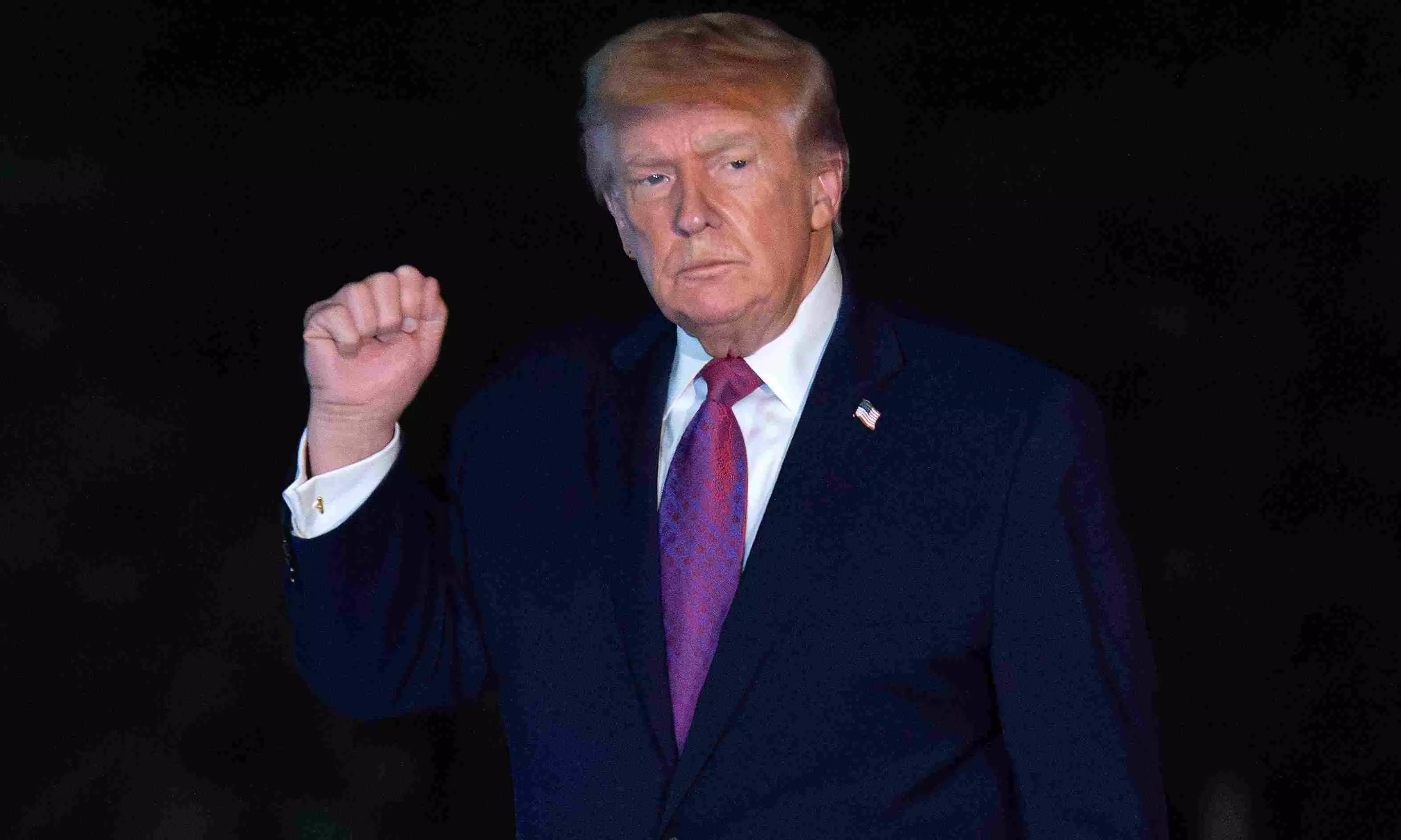
Besides failing to break Iran’s will, US President Donald Trump, who has ironically indicated many times during the war that he would like to end the fighting, has had to put up with some of the worst popularity ratings in America since he started the war. Photo: PTI
The conflict has willy-nilly turned into a war of attrition, with the US-Israel and Iran firmly holding on to their stated positions
The nearly two-month US-Israeli war on Iran has slipped into a stalemate – with the opposing sides unwilling to compromise on their core demands, even as new contentious issues take the conflict farther away from a solution.
It is increasingly becoming clear that the two sides have their own understanding of what negotiation means. In commonly understood diplomatic parlance, negotiation is when two rivals give up on some of their claims and meet the opposing side mid-way. In short, a compromise.
But, in the current war, in Trump’s view, Iran better oblige the US and Israel’s long-held demand – that is, give up its nuclear programme. In the first round of negotiation in Islamabad last week, when Iran refused to give in, the US team led by vice-president J D Vance summarily walked out without giving an opportunity to actually negotiate and try come to a compromise.
Iran stands its ground
For Iran, the stoppage of Israeli attacks on Lebanon initially cropped up as a key demand. Israel obliged, under Trump’s diktat. Iran in response opened up the Straits of Hormuz – these developments were the closest to peace since the war started on February 28, and paved way for the first round of negotiation in Pakistan’s capital Islamabad. But then, Trump threw in an obstacle by stating the US would not end the blockade of Hormuz, for ships going in and out of Iranian ports – until Iran agreed to US demands to halt its nuclear programme.
Ironically, Trump has indicated often times during the war that he would like to end the fighting. Iran’s position is that it did not start the war but draws the line on settling with the US entirely on Trump’s terms. Senior Iranian officials including President Masoud Pereshkian has said Iran will not “surrender” to the US, which is what Trump virtually wants.
Also read: Strait of Hormuz reopens: Iran’s quiet move, America’s loud claims
Israel would like to continue bombing Iran for as long as possible, but it can be halted under US command, as has happened a couple of times during the war – first when Trump directed Israeli Prime Minister Benjamin Netanyahu not to attack Iran’s South Pars gas field and later when he told to stop bombing Lebanon.
In effect, the balance sheet at the end of 53 days shows the initiators of the war – Israel and the US – have not been able to bend Iran to their will. The Islamic government continues to resist US, Israel attacks, Tehran’s nuclear programme is on track, around 400 kg of enriched uranium is stored safely within the country. Moreover, Iran has stowed away its sizeable arsenal of ballistic missiles where its enemies cannot find them.
At the same time, Iran has suffered enormous damage to its civilian infrastructure, destruction of public property, private homes and the killing of a few thousand people due to US-Israeli bombing. Though not clear to what extent its nuclear infrastructure has been destroyed, there is no doubt the missile strikes have damaged it.
Open-ended ceasefire
In the case of Trump, besides failing to break Iran’s will, he has had to put up with some of the worst popularity ratings since he started the war. With his own supporters and a large section of the American population refusing to back him, Trump is under increasing pressure – particularly as the US mid-term elections are just a few months away. A loss in these elections will turn him into a lame duck president as the Republicans are widely expected to lose their majority in the US Congress.
At the current stage of the war, the open-ended ceasefire declared by Trump is significant as there are bright possibilities that the fighting will come to a halt without actually declaring a formal end to the war.
Also read: 'Final and best offer': Vance's ultimatum, Iran's silence spell trouble
While this is overall good for the world and the war-battered Middle-East, or West Asia, if a resolution is not worked out soon, it is bound to create an air of uncertainty as there has been no formal end to fighting, through negotiation or mediation. In other words, the peace is ad hoc and the slightest of provocation on either side can potentially set off a fresh round of fighting.
Logical outcome
But, under the current circumstances, a stalemate is probably the logical outcome given the huge stakes on the narrative over who has won or lost the war. For instance, if Trump agrees not to insist on Iran giving up its nuclear programme, he will lose face and for the US it will be seen as the latest setback to its imperial ambitions. The world, and particularly American voters will question why Trump had to go to war with Iran in the first place. So, it will have immediate electoral repercussions.
It is now no longer whether Iran or the US and Israel have the stomach for a long-drawn fight, but whether the world can survive the calamitous effects of such a stalemate.
Trump has not only to deal with the nuclear issue but also ensure it is nowhere like the agreement with Iran signed by his predecessor Barack Obama. For, it was Trump who abruptly walked out of the Obama nuclear deal in 2018. So now, he is under pressure to justify that action and all that has followed since, including the June 2025 conflict and now, the ongoing war.
As for Iran, if it were to acquiesce to the US demand to give up its nuclear programme, it would be seen as a defeat. The consequences can potentially oust the Islamic government given the hype and stakes it has built around the nuclear issue within Iran.
War of attrition
A small window of opportunity presented itself after the recent first round of talks in Islamabad, when a specific timeframe was incorporated into the moratorium on the nuclear issue. The US reportedly wanted a 20-year window, during which period the nuclear programme would be shoved into cold storage. Iran was apparently willing for a five-year window.
Even as backchannel talks were on, the US Navy attacked an Iranian freight ship and captured it. The talks floundered and the ceasefire ended without a second round of negotiation. Meantime, Iran closed the Strait of Hormuz in response to the US action and blockade. Effectively, the war appears to have shifted to the high seas.
As for the Israel-Hezbollah conflict in Lebanon, an offshoot of the Iran war, Israel has occupied an area stretching up to eight kilometres in South Lebanon calling it a security barrier. Tension continues to prevail in Lebanon over the issue, though for the time being Hezbollah has ceased fighting, as does Israel.
Also read: Doomsday averted, but can Iran war be settled across the table?
The US is prowling the Persian Gulf while Iran is ensuring that no ship transverses through the Straits of Hormuz – all this making for a classic stalemate.
The conflict has willy-nilly turned into a war of attrition, with the parties involved firmly holding on to their stated positions. The impasse could have continued if not for the crucial value that the Hormuz Straits holds for the rest of the world.
It is now no longer whether Iran or the US and Israel have the stomach for a long-drawn fight, but whether the world can survive the calamitous effects of such a stalemate.