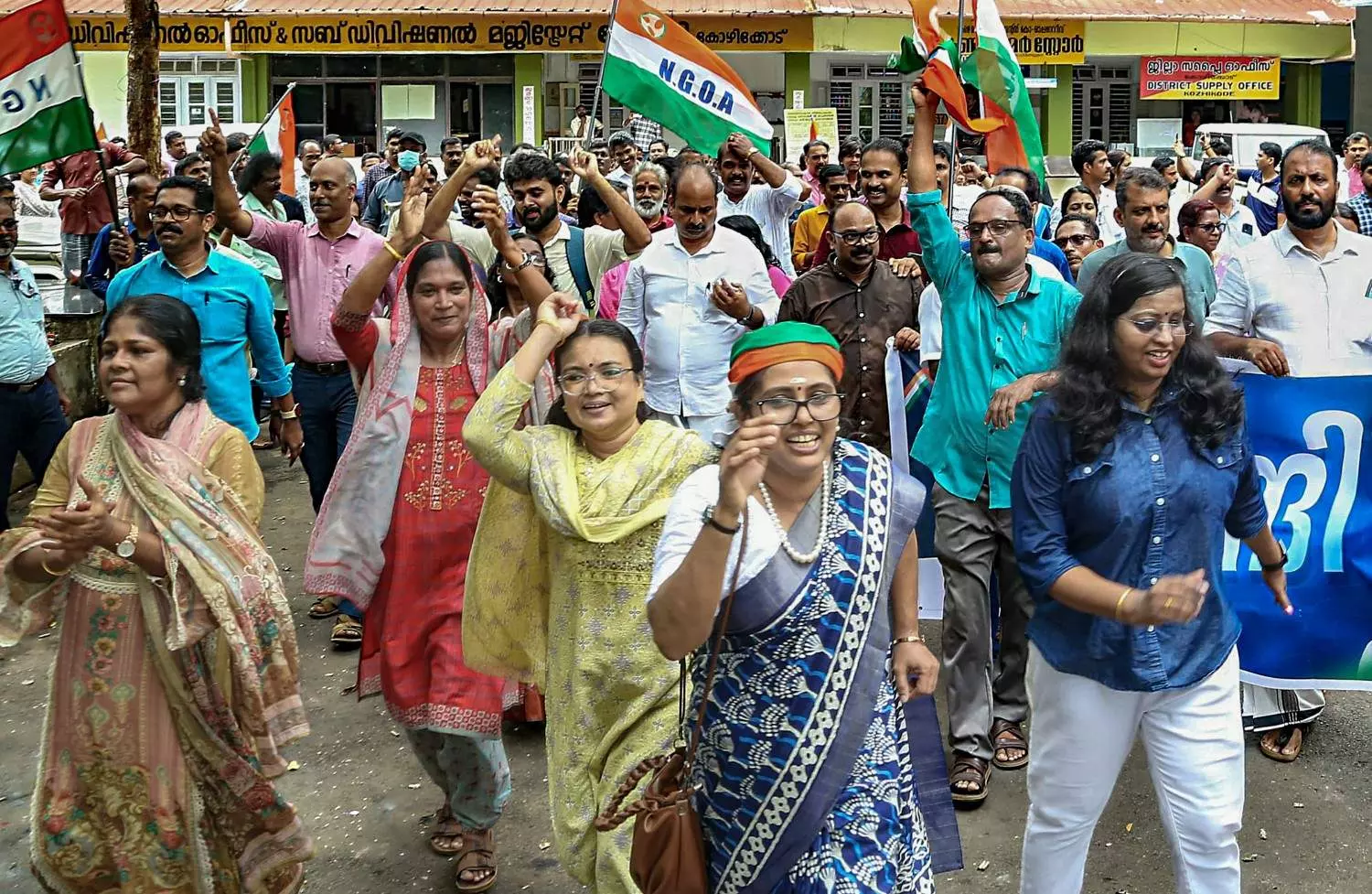
UDF supporters celebrate in Kozhikode after its victory on May 5. PTI
The LDF’s setback is a cautionary tale for any political entity attempting to use communal divisions for electoral leverage. It proves that 'social engineering' cannot replace 'social trust'
The results of the 2026 Kerala Assembly elections have delivered a verdict that is as much a clinical rejection of divisive "social engineering" as it is a triumphant return to secular consolidation. While the United Democratic Front (UDF) secured a landslide victory, the subtext of this mandate lies in the sophisticated political recalibration performed by Kerala’s influential minority communities. For a state that has long prided itself on communal harmony, the 2026 results signal a profound structural shift, proving that tactical voting can indeed act as a bulwark against perceived administrative betrayal.
The failure of the ‘Leftist Social Engineering’
For the better part of the last decade, the Left Democratic Front (LDF) experimented with a risky political model often termed 'social engineering'. The strategy aimed to fracture the traditional minority vote bank by wooing specific sections of the Christian community while simultaneously adopting a calculated silence towards anti-minority narratives. This approach, however, proved to be its undoing.
Also read: How Muslim groups are reshaping Kerala politics and reform debate
The leadership’s refusal to condemn polarising figures — most notably Sree Narayana Dharma Paripalana’s (SNDP) Vellappally Natesan—despite his recurring communal rhetoric, alienated a large section of secular voters. By maintaining a strategic proximity to those fanning communal flames, the LDF inadvertently signalled that it was willing to trade its core secular principles for short-term electoral gains. For the minority electorate, this wasn't just a political shift; it was a breach of trust.
Rhetoric and the trust deficit
The alienation was further deepened by a series of ill-timed and insensitive remarks from senior Left leaders. Statements from the likes of AK Balan, Saji Cherian and VN Vasavan, which were perceived as dog-whistling against the Muslim community, created a palpable sense of anxiety. While the government officially claimed to be in dialogue with community leaders, the reality on the ground was one of growing marginalisation.
The LDF’s sympathetic silence during the "narcotic Jihad" controversy — a manufactured narrative that sought to drive a wedge between Christians and Muslims — was perhaps the most critical turning point. It allowed the BJP to present itself as a "protector" to certain Christian denominations, a move the Left failed to counter with any ideological conviction.
The Panakkad Diplomacy
The UDF’s resurgence was not merely a byproduct of anti-incumbency but the result of meticulous grassroots diplomacy. Recognising the growing rift between the Christian and Muslim communities, the leadership of the Indian Union Muslim League (IUML), led by Panakkad Sayyid Sadiqali Shihab Thangal and PK Kunhalikutty, launched a major outreach initiative.
Also read: Pinarayi calls LDF defeat a ‘new beginning’, flags threat to Kerala’s secular fabric
By directly engaging with Church heads and organising 'harmony meets', they dismantled the BJP’s burgeoning narrative. The 'Manipur effect' —the tragic ethnic violence in Northeastern India—served as a stark reminder to the Kerala Church that the secular fabric of the UDF offered a far safer sanctuary than the transactional promises of the NDA. This diplomatic 'thaw' ensured that the Christian vote, which had briefly flirted with the Left and the Right in 2021, returned decisively to the UDF fold.
Secular maturity over communal identity
Crucially, the 2026 mandate was not an exercise in communalism, but a display of political maturity. This is best exemplified by the results in two key constituencies: Tavanur and Thiruvambady. In Tavanur, a Muslim-majority heartland, the electorate chose VS Joy, a young Christian leader from the Congress, over the high-profile incumbent KT Jaleel. Conversely, in the Christian-dominated settler belt of Thiruvambady, the UDF’s Muslim candidate, CK Qasim, won with a significant margin.
Against the backdrop of the BJP’s totalising dominance at the national level, the minorities in Kerala realised that a fractured vote would only empower the very forces they sought to resist. The entry of the NDA into the Kerala Assembly for the first time has only served to heighten this vigilance
These victories serve as a powerful rebuttal to those who characterise minority consolidation as "communal". Instead, it showcases an electorate that prioritised secular credentials and constitutional values over the religious identity of individual candidates.
Governance, grievances, and the national context
The pivot was also fuelled by deep-seated grievances regarding governance. Allegations of "backdoor appointments" in government jobs and a perceived lack of transparency in major infrastructure projects had sparked widespread resentment among the youth. The economic strain of inflation and a deepening fiscal crisis further eroded the LDF’s "pro-people" image.
Also read: Protest rally for VD Satheesan as Congress CM race intensifies in Kerala
Against the backdrop of the BJP’s totalising dominance at the national level, the minorities in Kerala realised that a fractured vote would only empower the very forces they sought to resist. The presence of three NDA MLAs in the Kerala Assembly for the first time has only heightened this vigilance.
A lesson for national politics
The LDF’s setback is a cautionary tale for any political entity attempting to use communal divisions for electoral leverage. It proves that "social engineering' cannot replace 'social trust'. The UDF’s victory, bolstered by a unified minority-majority secular front, offers a blueprint for resistance in a polarised era.
For the rest of India, the Kerala 2026 mandate is a reminder that when secular forces unite with a clear ideological purpose, they can withstand the tide of majoritarianism. Kerala has once again asserted that in a diverse democracy, the most potent political weapon is not division, but the quiet, strategic unity of a conscious electorate.
(The Federal seeks to present views and opinions from all sides of the spectrum. The information, ideas, or opinions in the articles are of the author and do not necessarily reflect the views of The Federal.)
Live Updates
- 8 May 2026 9:59 AM IST
BJP legislature party meet to elect new West Bengal CM
The BJP legislature party is scheduled to meet in Kolkata on Friday in the presence of Union Home Minister Amit Shah to formally elect its leader, with Suvendu Adhikari emerging as the frontrunner to become the party's first chief minister in West Bengal.
The BJP registered a historic victory in the just-held assembly elections, ending the TMC's 15-year rule and dealing Chief Minister Mamata Banerjee one of the biggest setbacks of her political career.
Though the BJP has not officially announced its chief ministerial choice, Adhikari has emerged as the frontrunner after securing two of the most politically significant victories -- retaining Nandigram, where he defeated Banerjee in 2021, and now wresting Bhabanipur, long regarded as the TMC supremo's pocket borough.
The swearing-in ceremony of the state's first BJP government is scheduled to be held at Brigade Parade Ground on May 9, with Prime Minister Narendra Modi, Shah, BJP president Nitin Nabin and chief ministers of all NDA-ruled states expected to attend.
Once among Banerjee's closest associates and a key architect of the TMC's organisational expansion in rural West Bengal, Adhikari joined the BJP in December 2020 and went on to become the party's most aggressive campaigner in the state.
"His sustained political battle against the TMC, organisational reach and electoral victories against Mamata Banerjee have strengthened his claim," a senior BJP leader said.