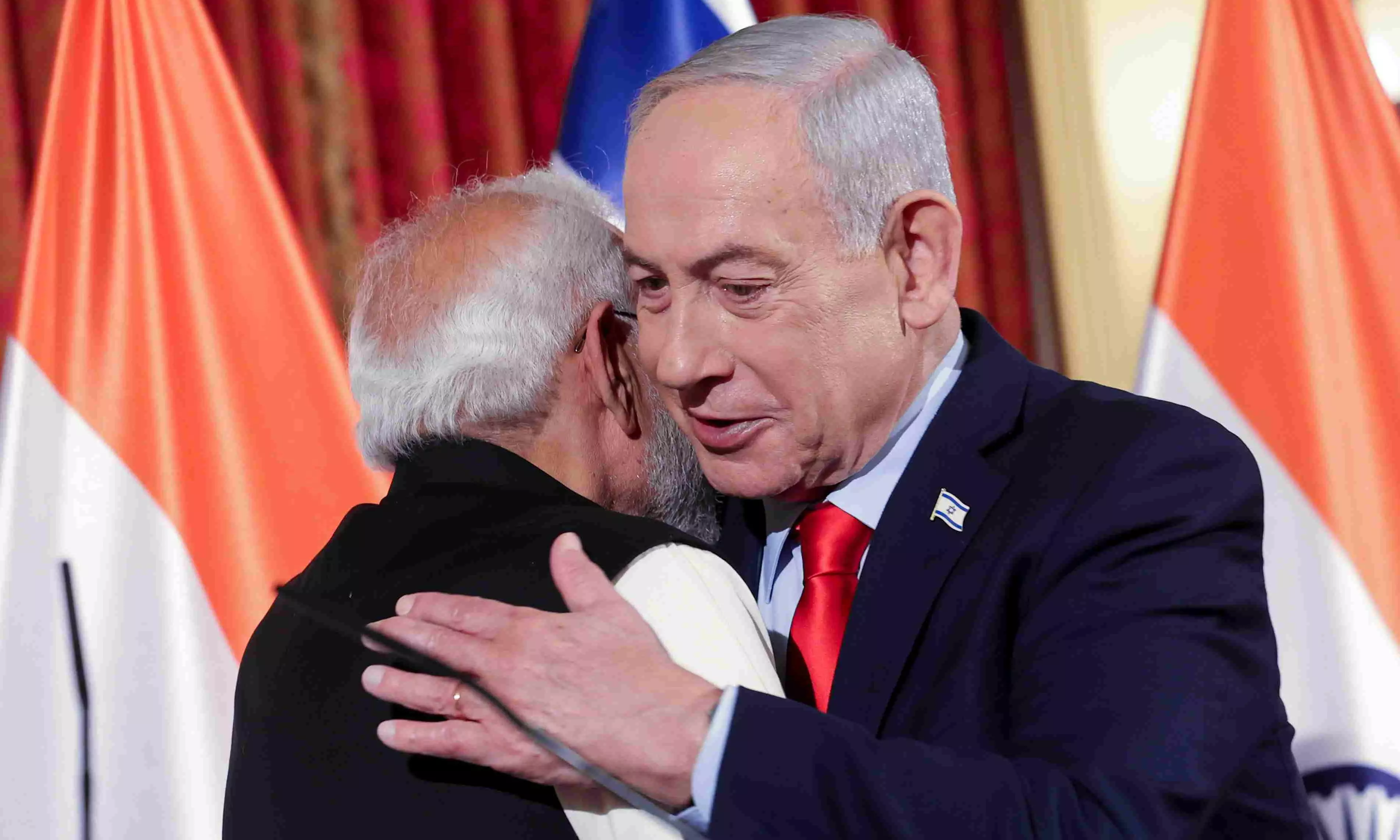
When your house is on fire, you call the fire department. But what do you do when your best friend is the one holding the match?
Prime Minister Narendra Modi has reportedly picked up the phone to commiserate with his “best friends” Benjamin Netanyahu and Sheikh Mohamed bin Zayed Al Nahyan, over the “rapidly worsening situation” in the Middle East.
He is concerned. Countries are all concerned. But Modi’s concern seems somewhat strategically misplaced, and his outreach is a diplomatic masterclass in missing the point.
Friends all
The situation isn’t “worsening” due to a natural disaster. It is worsening because Netanyahu and Modi’s other “best friend", Donald Trump, launched a war on Iran. Let’s call it what it is: “Operation Epic Fury” is a unilateral, unprovoked act of aggression.
Why is the Prime Minister not reaching out to the man who started this fire? Why is he not using his famed personal diplomacy to urge Washington to stand down?
Days before the bombs fell, Modi was heaping praise on Netanyahu— a leader now rightly branded an alleged war criminal by international bodies for his genocidal campaign in Gaza.
Did Netanyahu whisper a warning to his friend
when he was in Tel Aviv? Did he give Modi a heads-up that the region was about to be plunged into chaos? We don’t know. But we do know who Modi hasn’t called: Donald Trump.
Why is the Prime Minister of India not reaching out to the man who started this fire? Why is he not using his famed personal diplomacy to urge Washington to stand down? Instead, his silence on the root cause — the US-Israeli war machine — speaks volumes. It tells the world that India is willing to manage the fallout of a catastrophe but unwilling to prevent it. And the fallout is already here.
Geo-economic nightmare
This is no longer a conventional war — it has metastasised into a geo-economic nightmare. Iran, drawing on a civilisational history of strategic patience, has moved to Phase Two. It has correctly calculated that it cannot win a military confrontation, but it can make the war economically untenable for the West and its regional allies.
In the past 48 hours, Tehran has lit a match under the global economy. By targeting the energy juggernauts of the region—the facilities of Saudi Aramco, the gas fields of Qatar, the oil hubs of the UAE, Kuwait, and Iraq—Iran has sent an unmistakable message to Washington: you may be able to destroy our facilities, but we will destroy your economy.
Consider the math. Qatar, the world’s third-largest LNG exporter, has already suspended work at its largest gas field. This isn’t just Doha’s problem. It is Europe’s problem, as it desperately weans itself off Russian gas. It is China’s problem, as it relies on the Strait of Hormuz for 38 per cent of its oil. And it is most certainly India’s problem.
India's silence tells the world that it is willing to manage the fallout of a catastrophe but unwilling to prevent it. And the fallout is already here.
With Brent crude already spiking toward $82 a barrel, every Indian citizen is about to become a casualty of this war. India is a nation that imports the vast majority of its oil. Every dollar increase in the price of crude punches a hole in our fiscal deficit, widens India's current account gap, and pushes the price of petrol, diesel, and everything that moves on a truck further out of reach for the common man.
Grim reality
Trump boasts about lowering gas prices for Americans. But this reckless gamble — as the Financial Times has rightly called it — will soon have Americans feeling the pinch at the pump. And when Americans feel the pinch, the world feels the tremor.
But Iran’s playbook is longer than two phases. Analysts warn of a third and fourth layer to this strategy: a deliberate move to target strategic wartime depots — food storage, water desalination plants — and eventually, residential areas. It is a terrifying escalation designed to maximise leverage. Iran is betting that total regional destabilisation is its only path to survival.
This is the grim reality. The United States has once again launched a war without a clear exit strategy, a tragic echo of Vietnam, Afghanistan, Iraq, Libya, and Syria. Thousands will die. The global economy, already battered by Trump’s unilateral tariffs, is staring down the barrel of stagflation.
India's leverage
And yet, Prime Minister Modi’s response is to call the "arsonists" "friends" to express concern. India is a major power with major stakes. It cannot afford a foreign policy that curries favour with warring allies while our own strategic interests — energy security, a stable neighbourhood for trade, and the safety of millions of our citizens in the Gulf — go up in flames.
Iran has correctly calculated that it cannot win a military confrontation, but it can make the war economically untenable for the West and its regional allies.
Mr Modi could pick up the phone. Call the man who started this war. That is where India’s leverage lies.
That is where India’s interests demand you speak. Silence in the face of your friends’ follies is not diplomacy; it is complicity. And India cannot afford to be an accomplice to its own economic immolation.
(The Federal seeks to present views and opinions from all sides of the spectrum. The information, ideas or opinions in the articles are of the author and do not necessarily reflect the views of The Federal.)