Modi's Independence Day address leaned on rhetoric and cultural nationalism, and left economic distress, stalled reforms and farm worries unaddressed
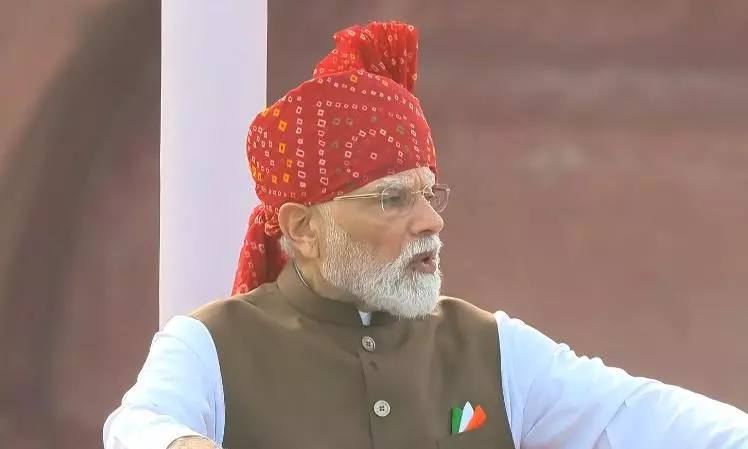
Over his 12-year raj, Prime Minister Narendra Modi has never delivered, from the Red Fort, as an insipid speech — full of rhetoric and utterly lacking a roadmap for future India — as he did on Saturday, the 80th Independence Day.
Coming within a month of the Cockroach upheaval, it was expected that Modi would send a positive message to the countrymen, but his speech resonated as coming from a frightened person, haunted by ‘Dimagi Naxals’ (Intellectual Naxals) though his lieutenant Amit Shah had claimed loudly that the “Naxal menace” has been finished and Naxalites have been eliminated forever.
'Dimagi Naxals' and Modi’s message
But Modi’s tracing the existence of Naxalism in the form Dimagi Naxals simply underscores that over these years Shah simply fed lies about the eradication of the Naxalite movement with the simple mission to weaponise the security forces and unleash the reign of torture and repression on the poor Adivasis and Dalits protesting against the mechanism of the corporate houses to evict them from their homes and grab their lands.
Modi, through his assertion, sent the candid message that Naxal ideals and ideology could not be finished with the killing of some Naxalite leaders and activists by resorting to repressive mechanisms.
Also read: After Instagram fiasco, why PM Modi wants Gen Z to read books
The truth is Modi used the Dimagi Naxals remark to terrorise the middle class who have of late been shifting their loyalty from him and looking for some alternative forum. He cautioned that Naxalism and Maoism decimated the futures of millions of youth, snatched away the innocent young sons of countless mothers, ruined them, and shattered the dreams of every parent into absolute oblivion.
There was an assurance to provide AI training to one crore youth and expand free online coaching for students who cannot afford expensive preparation programme. What's needed is good education to prepare the students for future challenges at their doorsteps — the schools.
According to him, this Naxalism, for four gruelling decades, held a colossal expanse and a massive populace of Hindustan in its suffocating grip. It held them hostage at the barrel of a gun. It shredded the Constitution to pieces. In all honesty, he should have also spoken of how Hindutva politics has been brainwashing Hindu youths into becoming mercenaries.
Gen Z missing from speech
The Prime Minister’s Independence Day address sets the national political, economic, and strategic agenda for the coming year. It serves as an official report card of past governance, a platform to unveil major policy frameworks.
But Modi’s recent speech failed to provide an insight or present a broader framework for future growth. References to Gen Z and Gen Alpha were completely missing. There was no mention of the NEET paper leak controversy, no direct reference to allegations of police excesses.
Also read: Modi’s I-Day speech: 'PM failed to address students, youth issues'
Also missing was any specific outreach to address the anxieties and aspirations of Gen Z and to tackle the issue of reforms in education as raised by their protest at Jantar Mantar.
Misplaced priorities
There was an assurance to provide AI training to one crore youth and expand free online coaching for students who cannot afford expensive preparation programme. What's needed, on the other hand, is good education to prepare the students for future challenges at their doorsteps — the schools.
Already 94 thousand government schools have been shut down, most of which catered to the educational needs of Dalit and SCstudents in rural India. That Modi does not have a future plan to provide inexpensive good education to poor students was explicitly conveyed to the people.
Also read | How government school mergers have triggered varied fallout across states
After all, if the children of the poor get educated, the government will find it difficult to transship indentured labourers to capitalist and Middle East countries.
Waiting for achhe din
Modi does not have a future growth plan and this is evident from his admission of the truth that the five years since 2019 were spent on preparation and the real achhe din will only come after five more years. Yet again, he projected 2047 as the year of prosperity and growth.
Obviously, the people will have to wait for another 20 years to get emancipated and come out of the morass of the miseries and poverty.
It is his admission that during his 12-year rule, no concrete measures have been initiated to ameliorate the condition of the people and to propel the country on the path of development and growth. Without any hesitation, he says that “in the year 2047, we shall definitively emerge as a developed India”.
Vande Mataram and pluralism
While he does not have any concrete promise to make and assurance to offer to the people, he did not forget to narrate his pet communally polarising agenda. He said that every heart resonates with the majestic cadence of Vande Mataram. Through this remark, he emphasised cultural nationalism, which seeks to build a uniform majority identity and suppress pluralism.
Also read: PM running out of words and ideas? Modi's shortest, least consequential I-Day speech yet
It is an exclusionary tool akin to fascism that seeks to homogenise society and marginalise minorities, though proponents maintain it is a legitimate expression of patriotic identity.
Modi did not mention Jana Gana Mana, the national anthem. Instead, he framed Vande Mataram as the heartbeat of the populace, linking India’s identity directly to its historical, pre-Independence spiritual awakening.
Economic claims
Modi claims that once relegated to the ignominious ‘Fragile Five’, India has metamorphosed over 12 years into the most rapidly ascending titan among major economies. But this is not the truth. Modi may cite statistical figures to substantiate his claim, but the reality is India continues to hover between the Fragile Five and Ascending Country.
Modi has been using skewed information to malign previous governments on behalf of the rightist forces. India still faces vulnerability to external capital flight. It has not achieved high growth rates. It is entirely wrong to say India negotiates from a position of confidence.
The US trade deal is the best example where Modi mortgaged farmers’ interests to suit a foreign power. Tariff threats from major economies like the US force Modi into making calculated compromises or opening specific sectors to secure predictable export corridors.
A better picture in 2008
The global investment bank Morgan Stanley coined the term Fragile Five in August 2013 and used the label to describe five emerging-market economies: India, Brazil, Indonesia, South Africa, and Turkey. India became victim of US manoeuvrings.
Obviously, the people will have to wait for another 20 years to get emancipated and come out of the morass of the miseries and poverty.
It worth mentioning that in 2008, when the world economy was trembling, India, under then Prime Minister Manmohan Singh, weathered the crisis much better than Western economies.
Of course, as a fallout of the global crisis, India’s growth slowed from nearly 9 per cent to 6.7 per cent but the fact remains that India did not suffer any banking collapse and maintained positive growth, backed by strong fiscal stimulus and cautious regulation. As global demand dropped, obviously, it hurt Indian exporters and tightened local liquidity.
Corporate interests
Modi boasted of liberating a designated 99 per cent of the expansive maritime coastline from ‘No Go Area’ to “Go Ahead Area”. He accused the previous governments of nursing archaic thinking, which reflected true poverty of intellect. It's simply a tool to justify his offer to some big business.
Labelling past policies that restricted offshore areas as a "foolish" or a "poverty of thought" reflects a shift toward capitalist resource exploration. Restrictions were driven by specific security, bureaucratic, and environmental priorities rather than mere oversight. Fragile marine ecosystems, coral reefs, and local fishing communities relied on protected coastal regulatory zones to prevent commercial over-exploitation and habitat destruction. Earlier governments were not "foolish" to implement strict coastal restrictions.
Also read: Bhagwat’s pitch on GenZ protests exposes RSS-Modi fault line over dissent
Adani Ports and Special Economic Zone Limited (APSEZ) has grown substantially over the past decade, securing major domestic and international logistics projects, such as the Mundra expansion in Gujarat and the Vizhinjam Seaport in Kerala. Regulatory reforms, streamlined green clearances, and strategic infrastructure policies disproportionately benefit large conglomerates like Adani, accelerating market consolidation.
The government defends these changes as vital macro-level structural reforms aimed at modernising national infrastructure, reducing logistics costs, and enhancing energy security rather than favouring any single corporate entity.
Middle class under strain
Modi claimed that he strived to ensure the dividends of the progress accrue to the nation’s middle class and common households. If the benefits have really reached to the middle class, it must not have turned against him. The Indian middle class has shown signs of strain and shifting political support away from Modi's party, as seen in recent electoral outcomes and urban discontent.
While the ruling government highlights extensive digital infrastructure and welfare delivery, a combination of economic pressures has driven this friction. The salaried and professional middle class feels heavily squeezed by direct income taxes and indirect levies like GST, with many feeling that tax policies favour large corporations over individual taxpayers.
Urban citizens feel they pay high taxes while receiving poor local civic infrastructure, high inflation, and inadequate social safety nets in return. Stagnant real wage growth and high joblessness have disrupted the traditional upward mobility expected by middle-class families.
Divided on reforms
Modi talked of accelerating the tempo of reforms, but in the same breath he said reform is by no means a compulsion for us. For him, reform is a profound conviction.
The PM ought to comprehend the difference between conviction and compulsion. Reform is imperative in the modern economy and it's time to fix outdated rules, adapt to fast-moving technology, and handle global changes. Without continuous updates, countries face slow growth, high costs, and unfair markets.
He must not cover his inability to undertake reforms under the garb of conviction (pratibaddhata) rather than a compulsion (majboori). This he has been stance to undermine the reform measures of the UPA government. If Modi has really carried forward reforms, the middle class would not have shifted its loyalty.
Trickle of Sapt Dhara
Modi is an expert in coining gorgeous Hindi axioms for catching the imagination of the people and this time he has come out with the Sapt Dhara ('Seven Streams') strategy covering manufacturing, green energy, technology, and innovation. Manufacturing is already on the decline. Chinese goods, which have flooded the market, have left no scope for the revival of the Indian manufacturing sector.
A decade in power is sufficient time to deliver broad prosperity without requiring further extended waiting periods.
The most hilarious aspect of Sapt Dhara is that it would be implemented in the next 5 to 7 years. Ironically, Modi, who is not pulling his weight for the revival of the MSME sector, which is the key to manufacturing and provider of 65 per cent of job, is talking of reviving the manufacturing sector.
India's trade deal with the US has already given a significant setback to the agricultural sector. US agro products will dictate the Indian agriculture market. It is wrong to say that a colossal market awaits India and its agriculture sector.
Time for honesty
If the youths had really been beneficiaries of a developed New India, the 'cockroaches' would not have invaded Jantar Mantar. The PM must let the people know what he has precisely done, and the mechanism he has evolved to tackle the catastrophe of unemployment.