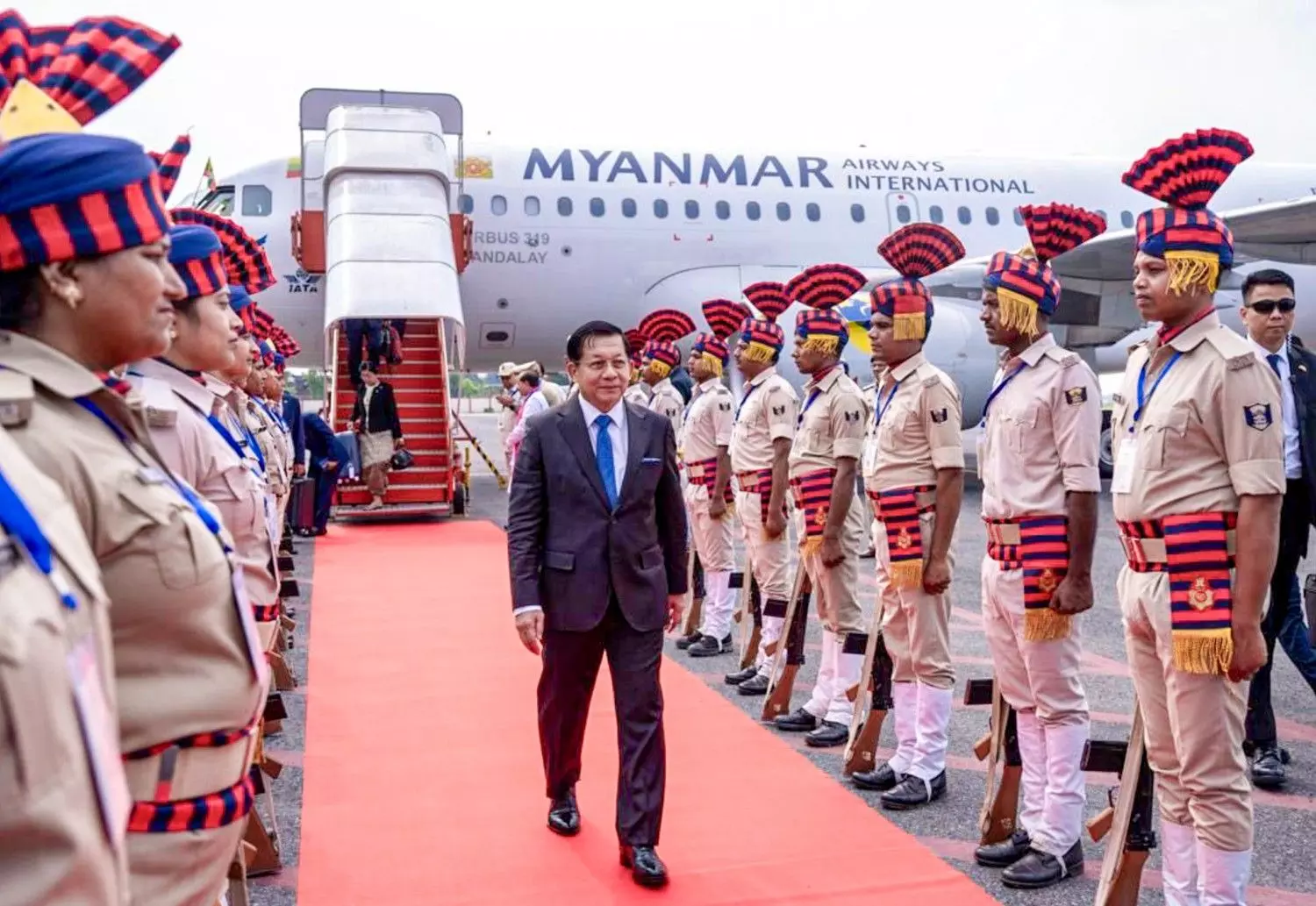
Myanmar President Min Aung Hlaing being accorded a ceremonial Guard of Honour upon his arrival as he began his five-day visit to India, at the airport in Bodh Gaya, Bihar, on May 30, 2026. Photo: @MEAIndia/X via PTI
The leader's five-day visit has disappointed the eastern neighbour's pro-democracy opposition which has asked how a vibrant democracy could back a brutal regime
Visits by Myanmar's military supremos to India are not new. New Delhi has always felt the need to deal with whoever is running the government in the eastern neighbour. But the country's incumbent president, Min Aung Hlaing's five-day visit to India starting Saturday (May 30) has provoked a furious reaction from Myanmar's pro-democracy opposition, which is seeking to oust him from power.
Hlaing emerged as the president in a managed election after a controversial parliamentary poll earlier this year saw the return of the pro-military Union Solidarity and Development Party (USDP) to power with a sweeping majority. The military controlled the electoral environment amidst a raging civil war, which has led to a sharp loss of territorial control by the military.
Also read: Is Myanmar military junta set to lose Rakhine?
Forty parties, including Nobel laureate Aung San Suu Kyi's National League for Democracy (NLD), were forced to stay away from the elections. The NLD had not only run the government successfully for a full five-year term (2015-2020) but had swept the 2020 polls with a bigger tally.
Hlaing, then heading the national army Tatmadaw, staged a coup on the day the NLD was to take charge of the government in February 2021.
India had a wonderful opportunity to take charge of the Myanmar peace process when the ASEAN effort was faltering. It could have even used the BIMSTEC to launch the peace process. But New Delhi, rarely known for initiative-driven diplomacy, decided on a "wait-and-watch" approach.
In the five years that followed, Myanmar was ravaged by the civil war, with multiple ethnic rebel armies taking control of huge swathes of its territory. Pro-democracy activists, mostly ethnic Burmans, have also set up armed rebel groups like the People’s Defence Force (PDF) and joined the fight to dislodge the military-backed regime.
While China has got directly involved in backing the military-backed dispensation, the West, particularly the US, has provided covert backing to the rebel forces. India has stayed away from either backing the military-backed regime or its opponents, but called for a peaceful settlement through dialogue and a return to democracy.
India had backed the Myanmar peace process based on the ASEAN's (Association of Southeast Asian Nations) Five-Point Consensus. Now that the peace process has completely fallen apart and positions have hardened on either side, anyone trying to pitch on the middle ground is bound to face difficulties.
National Unity Government protests, writes to Jaishankar
Myanmar's National Unity Government (NUG), run by representatives of political parties and lawmakers elected in the 2020 polls, have lashed out at Hlaing’s India visit.
Its Foreign Minister Zin Mar Aung has sent a letter to External Affairs Minister Subrahmanyam Jaishankar objecting to Hlaing’s visit. “We are deeply concerned about the reports of terrorist junta leader Min Aung Hlaing’s visit to India, news that causes great worry and anxiety to the people of Myanmar,” the letter said.
Also read: In Myanmar's Rakhine, India has to hunt with the hounds, swim with the crocodiles
Zin Mar Aung told this writer that any engagement that could be perceived as granting political legitimacy to the "illegal military regime" must be avoided.
Hlaing's India itinerary irks opposition
What seems to have upset the NUG, which is seen as the key opposition group holding together the disparate anti-junta coalition, is the elaborate itinerary of Hlaing.
He will start with a pilgrimage to Bodh Gaya in Bihar, where the Great Buddha had attained enlightenment centuries ago. Politicians, including heads of state from Buddhist-majority countries, always come to pray at the shrine. Earlier in May, Vietnam President and the general secretary of the country's Communist Party, To Lam, went there during his visit to India.
Hlaing will meet Prime Minister Narendra Modi in New Delhi on Monday (June 1), when they will discuss “further strengthening the historical and civilisational ties between the two countries”.
The two leaders are expected to focus on strengthening cooperation in defence, trade and regional connectivity. Hlaing will also meet with President Droupadi Murmu during the trip, before ending his visit in Mumbai with a planned interaction with captains of Indian business and industry.
Hlaing’s India visit has also upset ethnic rebel armies like the Kachin Independence Army and the Arakan Army, who are fighting the military junta. These groups have looked up to India not only for tactical support, like using frontier spaces for base areas, but also expected Delhi to pressure Myanmar's generals to start meaningful negotiations that could lead to the creation of a "truly federal union" of Myanmar.
'Never expect India to back brutal junta'
The country's pro-democracy activists, who have traditionally seen India as a role model of a federal democracy, are also upset. "We are not surprised by China or Russia backing the Myanmar junta because they are one-party states. But we never expect India as a vibrant democracy to back a brutal, oppressive junta like the one in Myanmar," said a top pro-democracy leader now in hiding in Thailand.
Also read: Why Bangladesh warming up to US's Myanmar plan spells trouble for India
However, this is not the first time that New Delhi has hosted military supremos from Myanmar before.
Myanmar generals' India visit over the years
General Ne Win (of then Burma) visited New Delhi in 1964 when Jawaharlal Nehru was the prime minister, and then again in 1974 (as the president of the country) when he was hosted by then prime minister Indira Gandhi, who had visited Myanmar in 1969.
Senior General Than Shwe paid a historic six-day state visit to India in October 2004. This was the first trip by a Myanmar head of state to India in 24 years. General Maung Aye, the then second-in-command of the country's military, visited New Delhi in April 2008 to strengthen security and economic cooperation.
Hlaing’s India visit has upset ethnic rebel armies like the Kachin Independence Army and the Arakan Army, who are fighting the military junta. These groups looked up to India not only for tactical support but also expected it to pressure Myanmar's generals to start meaningful talks towards a "truly federal union" of Myanmar.
Hlaing himself has visited India thrice in the last decade, as army chief (2012, 2015, 2019), during the tenure of elected governments. He even held discussions with Prime Minister Modi, giving rise to speculations that India was both engaging the elected government and the army in recognition of ground realities.
The only time that India unambiguously supported the cause of Myanmar's democracy was when Rajiv Gandhi was the prime minister. New Delhi supported the 1988 popular uprising there and even backed the government-in-exile launched by pro-democracy groups.
Is India losing Myanmar?
Many in the Indian foreign policy establishment argue that it would be unwise to push the military junta "totally towards China". However, critics say that the Myanmar military is totally in China's grip, and its very survival depends on Beijing's support. According to them, India, in an attempt to engage the military through events like President Hlaing's visit, is only losing out on influence in Myanmar's pro-democracy circles. It is like losing both the mangoes and the sack.
Also read: India backs 'Myanmar-led, Myanmar-owned' peace process: EAM Jaishankar
India had a wonderful opportunity to take charge of the Myanmar peace process when the ASEAN effort was faltering. Some suggested India could have sent a peace mission because it had good enough connection with the military, the democratic parties and the ethnic rebel groups.
It could have even used the BIMSTEC (the Bay of Bengal grouping) to launch the peace process because both Bangladesh and Thailand, fellow members of the forum, have a strong interest in the resolution of the conflict in Myanmar.
But the Indian foreign policy establishment, rarely known for initiative-driven diplomacy, decided on a "wait-and-watch" approach on Myanmar. Wait-and-watch is often tantamount to strategic inaction.
(The Federal seeks to present views and opinions from all sides of the spectrum. The information, ideas or opinions in the articles are of the author and do not necessarily reflect the views of The Federal.)